Clear Sky Science · en
Iontronic click-to-release enables electrically controlled delivery of drugs and biomolecules beyond charge and size limitations
Remote control for medicine
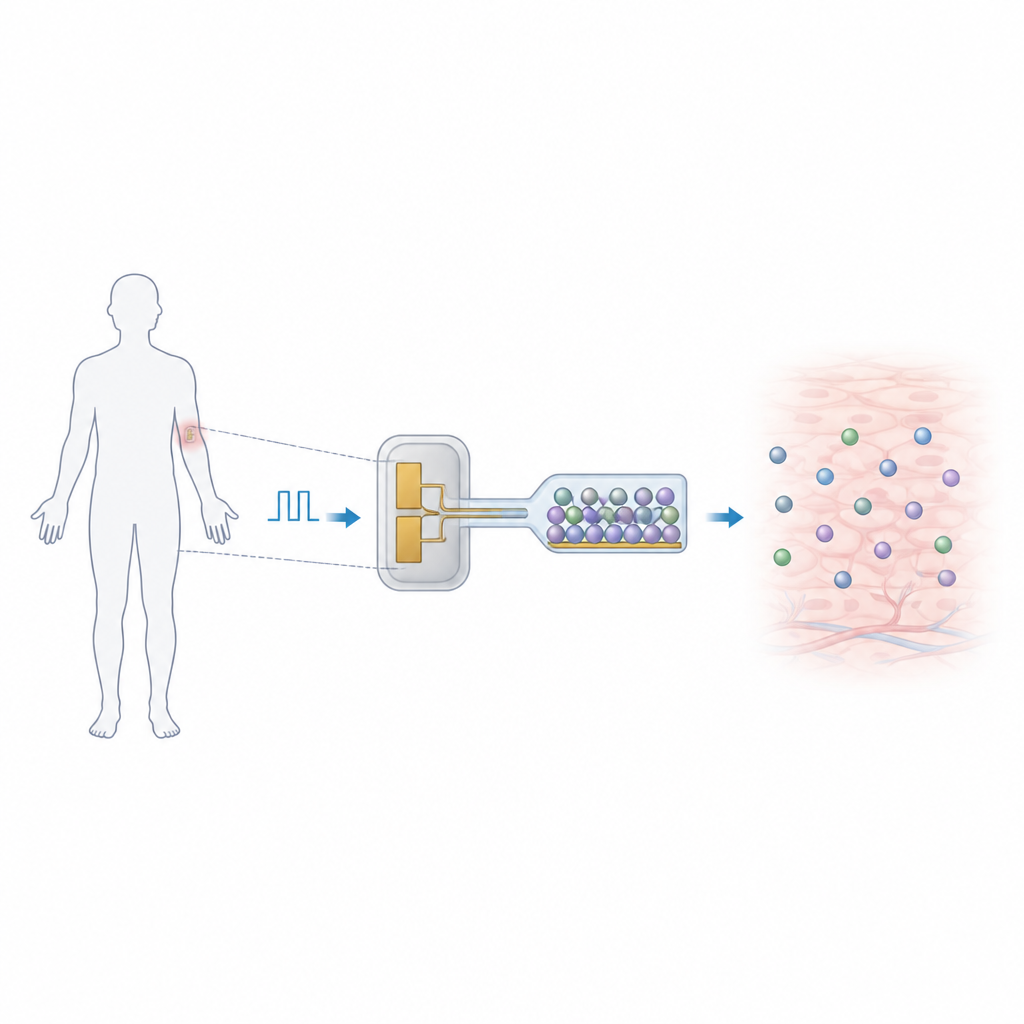
Imagine a tiny implant that can turn a medicine on and off with simple electrical signals, releasing just the right dose exactly where and when it is needed. This study introduces such a concept, aiming to move beyond slow, one-way drug implants toward smart systems that respond in real time to a patient’s needs.
Why timing and place matter
Many current drug implants and slow-release materials work like time bombs: once started, they leak medicine at a preset rate that doctors cannot easily adjust. They often show an early surge of drug followed by a long, flat trickle, and they usually cannot be paused or reprogrammed. Other approaches rely on triggers such as light, heat, magnets, or chemical changes in tissue, which can be hard to focus precisely and may disturb healthy areas. The authors argue that the ideal system would let clinicians dial drug levels up or down at a specific spot inside the body, much like adjusting the volume on a radio.
Using electricity to move molecules
Iontronic pumps already offer a way to steer charged molecules using low electrical currents. These devices have a drug reservoir, a special membrane that only lets certain charged species pass, and electrodes that set up an electric field. When a voltage is applied, selected molecules are pulled through the membrane into a target region without moving the surrounding liquid. This gives sharp control over how much and how fast a compound arrives. Until now, however, such pumps could only handle small, stable, charged molecules, shutting out many larger drugs and proteins that are central to modern therapies.
Chemical scissors on demand
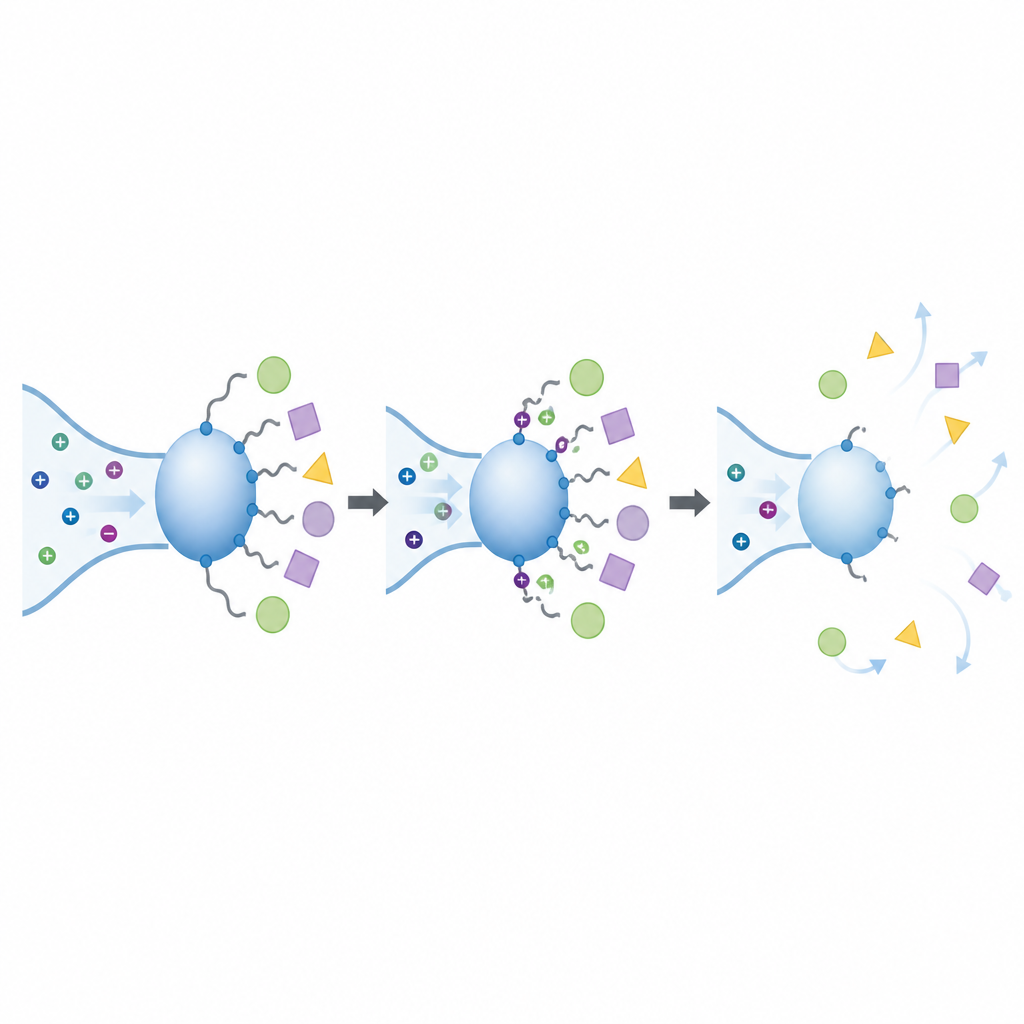
To break this size and charge barrier, the team combines iontronic pumping with a special “click-to-release” chemical reaction that works safely in biological settings. Instead of pumping the drug itself, the device delivers a small charged trigger molecule called a tetrazine. Nearby, drug or protein payloads are anchored to solid supports, such as magnetic beads, using a linker based on a strained ring structure. When the pumped tetrazine reaches these linkers, it snaps into them and rapidly causes the bond to fall apart, freeing the attached payload. In this way, the electrically guided trigger acts like a remote-controlled pair of chemical scissors that can release many different kinds of cargo, regardless of their size or electrical charge.
From cancer drug to large proteins
The researchers first show that their small trigger can be pumped in a highly predictable way: the amount delivered scales linearly with the applied electrical current and can be switched on and off over several days. They then couple a powerful cancer drug, combretastatin A-4, to the cleavable linker and test its behavior in cell cultures. The linked form is essentially harmless until the tetrazine is present, at which point the freed drug kills glioblastoma cells as effectively as the original version. By changing the current direction, the device can either drive the trigger toward the drug depot and start release, or halt its movement and keep the payload inactive. The same scheme is applied to a large protein, bovine serum albumin, demonstrating that sizable biomolecules can also be released in a controlled, time-dependent fashion.
Toward programmable electroceuticals
In simple terms, this work shows how tiny electrical currents can be converted into precise bursts of active medicine, even for large and otherwise incompatible molecules. By separating the transport of a small trigger from the actual drug release, the platform sidesteps many physical limits that have held back earlier electronic delivery systems. The authors suggest that future versions using soft, biocompatible scaffolds could form the basis of “electroceutical” implants that tailor drug schedules to each patient, adjusting dose and timing much like reprogramming a medical device rather than replacing a drug reservoir.
Citation: Hecko, S., Vleugels, M.E.J., Bayer, C. et al. Iontronic click-to-release enables electrically controlled delivery of drugs and biomolecules beyond charge and size limitations. Nat Commun 17, 4629 (2026). https://doi.org/10.1038/s41467-026-70985-0
Keywords: iontronic drug delivery, click to release, electroceuticals, controlled release implants, bioorthogonal chemistry