Clear Sky Science · en
Active site design enables industrial scale H2O2 electrosynthesis with metal-free catalysts
Why cleaner peroxide production matters
Hydrogen peroxide is a workhorse chemical that helps clean computer chips, disinfect water, and drive many industrial reactions. Today it is mostly made in giant centralized plants and shipped long distances, a process that wastes energy and creates safety and cost challenges. This study explores how to make hydrogen peroxide on demand using electricity, air, and inexpensive metal-free carbon powders, opening the door to smaller, safer, and more sustainable production units.

A new way to make a familiar chemical
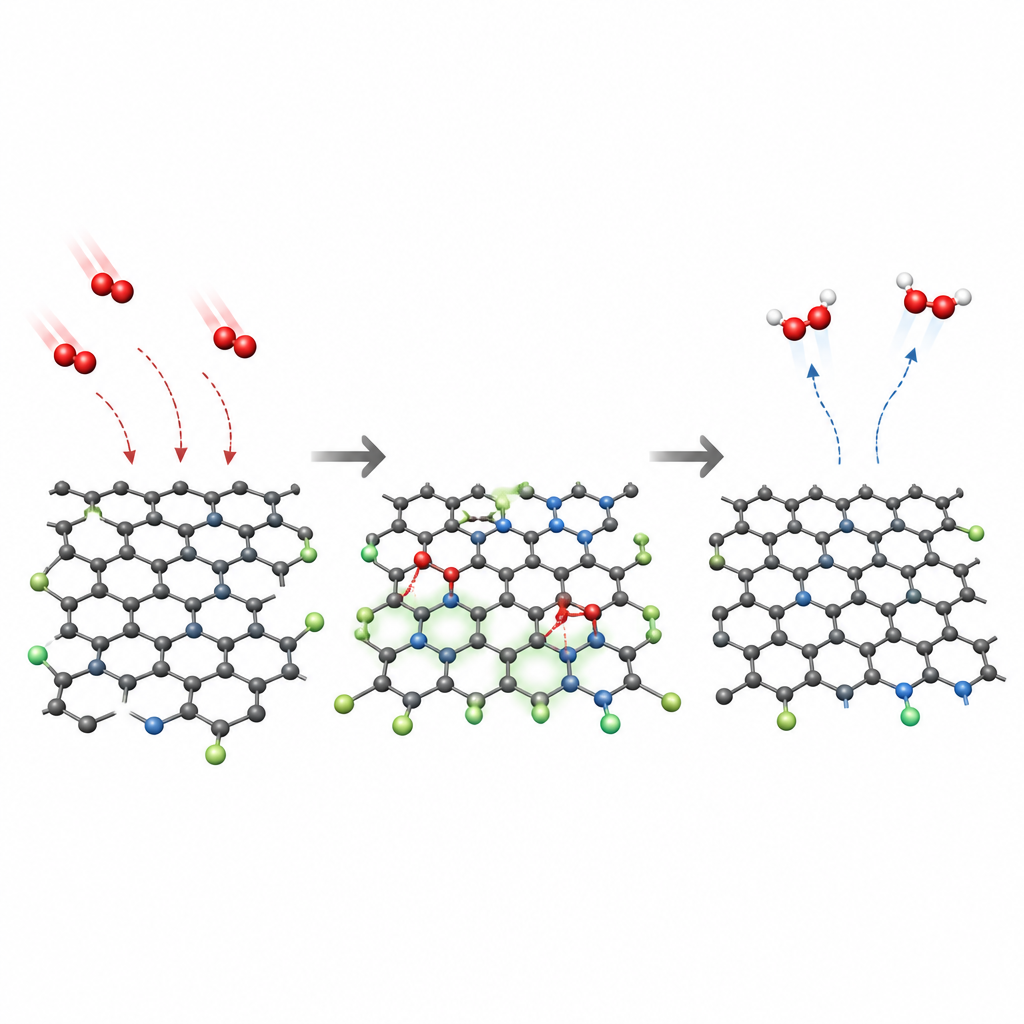
Conventional hydrogen peroxide plants rely on a multistep process that consumes fossil fuels and is hard to scale down. An emerging alternative uses an electrochemical cell: oxygen from air is reduced at a cathode so that each oxygen molecule picks up exactly two electrons and protons to form hydrogen peroxide in water. The trick is to design a catalyst that strongly encourages this two-electron route while suppressing a competing four-electron path that turns oxygen into harmless water. Metal-free carbon catalysts are attractive because they are cheap, abundant, and stable, but in practice their performance has been limited by poorly controlled defects and uncertain active sites.
Shaping carbon at the atomic scale
The researchers tackled this problem by deliberately reshaping the tiniest features of carbon. They started with carbon doped with nitrogen atoms, a common way to create active sites, and then introduced fluorine atoms by heating the material with a fluorine-rich plastic. Using quantum mechanical calculations combined with statistical analysis of 66 different atomic arrangements, they found that fluorine atoms play a dual role: they passivate unstable defects while gently tuning how oxygen-containing intermediates bind to the surface. In particular, fluorine near nitrogen sites brings the binding strength of a key intermediate to nearly ideal levels, which favors hydrogen peroxide formation and discourages further reduction to water.
From computer predictions to real materials
Guided by these insights, the team synthesized a family of carbons containing different mixes of nitrogen and fluorine and probed their structure with advanced X-ray and electron microscopy tools. They observed that fluorine selectively attacks the least stable nitrogen configurations and replaces them with semi-ionic carbon–fluorine bonds that smooth out reactive defects without destroying the conductive carbon network. Measurements of surface charge and work function showed that the treated carbon becomes more electron rich, which helps draw in oxygen and stabilize reaction intermediates. At the same time, the surface becomes more water-repellent, improving the contact between gas, liquid, and solid that is crucial for fast reactions in fuel-cell-like devices.
Turning design into performance
Electrochemical tests revealed that the optimized nitrogen-and-fluorine codoped carbon converts oxygen to hydrogen peroxide with nearly perfect selectivity over a wide range of operating voltages. In rotating electrode experiments, it channels more than 95 percent of the current into peroxide rather than water, and it maintains its activity far longer than the nitrogen-only version because its passivated defects are less vulnerable to attack by aggressive radicals. In a flow-cell electrolyzer that resembles a practical device, the material supports industrial-scale current densities close to one ampere per square centimeter while sustaining high efficiency for more than one hundred hours. When the peroxide-producing cathode is paired not with the usual energy-hungry oxygen evolution reaction, but with methanol oxidation at the anode, the whole cell runs at much lower voltage, produces more peroxide per unit energy, and, according to the authors’ economic analysis, could yield several times higher annual profit than the conventional setup.
What this means for future chemical plants
In plain terms, the authors show that carefully placing fluorine atoms into a nitrogen-doped carbon lattice can turn a cheap, metal-free powder into a highly selective and durable catalyst for making hydrogen peroxide from air and electricity. By clarifying which atomic arrangements work best and proving that they can deliver industrial current levels in realistic devices, the work outlines a roadmap for smaller, more flexible peroxide generators that could sit next to factories, water treatment plants, or even fuel cells. The same design strategy, which links atomic-level modeling and statistics to real-world performance, could also guide the development of other sustainable electrocatalysts for turning simple molecules into valuable chemicals.
Citation: Yu, A., Bi, H., Joshua, F. et al. Active site design enables industrial scale H2O2 electrosynthesis with metal-free catalysts. Nat Commun 17, 4474 (2026). https://doi.org/10.1038/s41467-026-70983-2
Keywords: hydrogen peroxide electrosynthesis, metal-free carbon catalysts, fluorine nitrogen codoping, two-electron oxygen reduction, electrochemical production