Clear Sky Science · en
Continuous evolution of a halogenase enzyme with improved solubility and activity for sustainable bioproduction
Cleaner Chemistry for Everyday Products
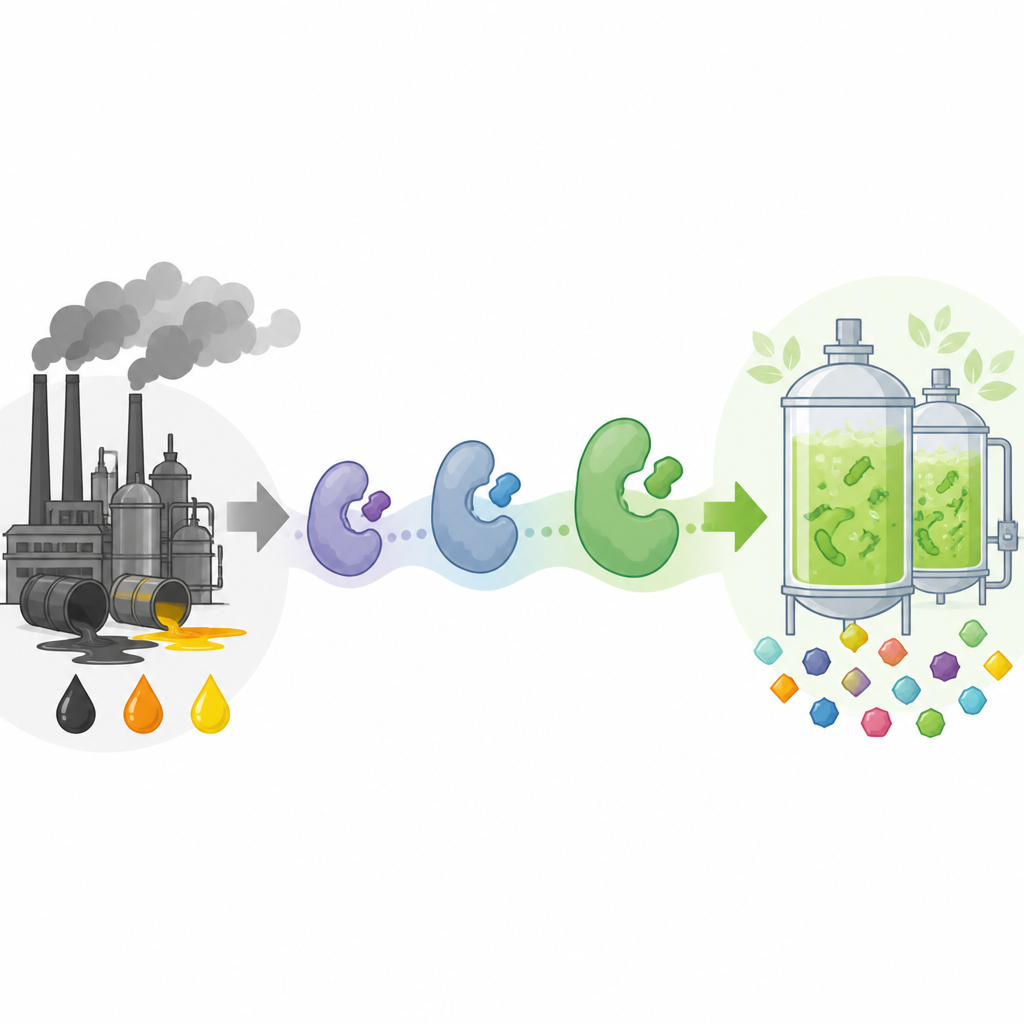
Many medicines, crop treatments, and high-tech materials work better when chemists attach a chlorine or bromine atom to them. Today this "+halogen" upgrade is usually done in large chemical plants that use harsh, toxic reagents. This study shows how scientists can instead train a bacterial enzyme to carry out the same type of transformation inside living cells, making the process cleaner, more precise, and easier to scale.
Why Adding a Single Atom Matters
Roughly a quarter of prescription drugs and most modern agrochemicals contain halogen atoms that boost how long they last in the body, how easily they reach their targets, or how well they survive in the environment. A molecule called tryptophan is a key starting point for many of these compounds, including dyes, crop-protection agents, and experimental antidepressants. Adding a halogen to tryptophan at just the right position can turn it into a valuable ingredient for drugs and colored materials, or into a special building block that can be slipped into proteins and tiny antibiotic peptides to make them tougher and more potent.
The Problem with Nature’s Original Enzyme
Nature already has enzymes that can place halogens on tryptophan very selectively, avoiding the waste and side reactions common in traditional chemistry. One of the best studied is called RebH. Unfortunately, in the warm, crowded interior of a cell RebH tends to clump, works slowly, and falls apart at higher temperatures. That makes it difficult to use in microbes that ferment sugar into useful products, and it has limited earlier attempts to manufacture halogenated tryptophan and related molecules at industrially relevant levels.
Using Viruses to Continuously Evolve a Better Tool
The researchers built a clever sensor inside bacteria that glows green only when a halogenated form of tryptophan is made and inserted into a test protein. They then linked this glow to the life cycle of a harmless virus that infects the bacteria. Only viruses carrying more effective versions of the RebH enzyme allowed their host cells to glow and to make new viruses. By running this "survival of the fittest" loop continuously for over 500 hours, while gradually raising the temperature, the team let evolution search through countless enzyme variants. The final version, named RebHEvo4, carries 12 small changes in its structure that together make it much more soluble, more active, and able to function well at 37 °C, the typical temperature for large-scale bacterial fermentation.
From Lab Bench to Bioreactor
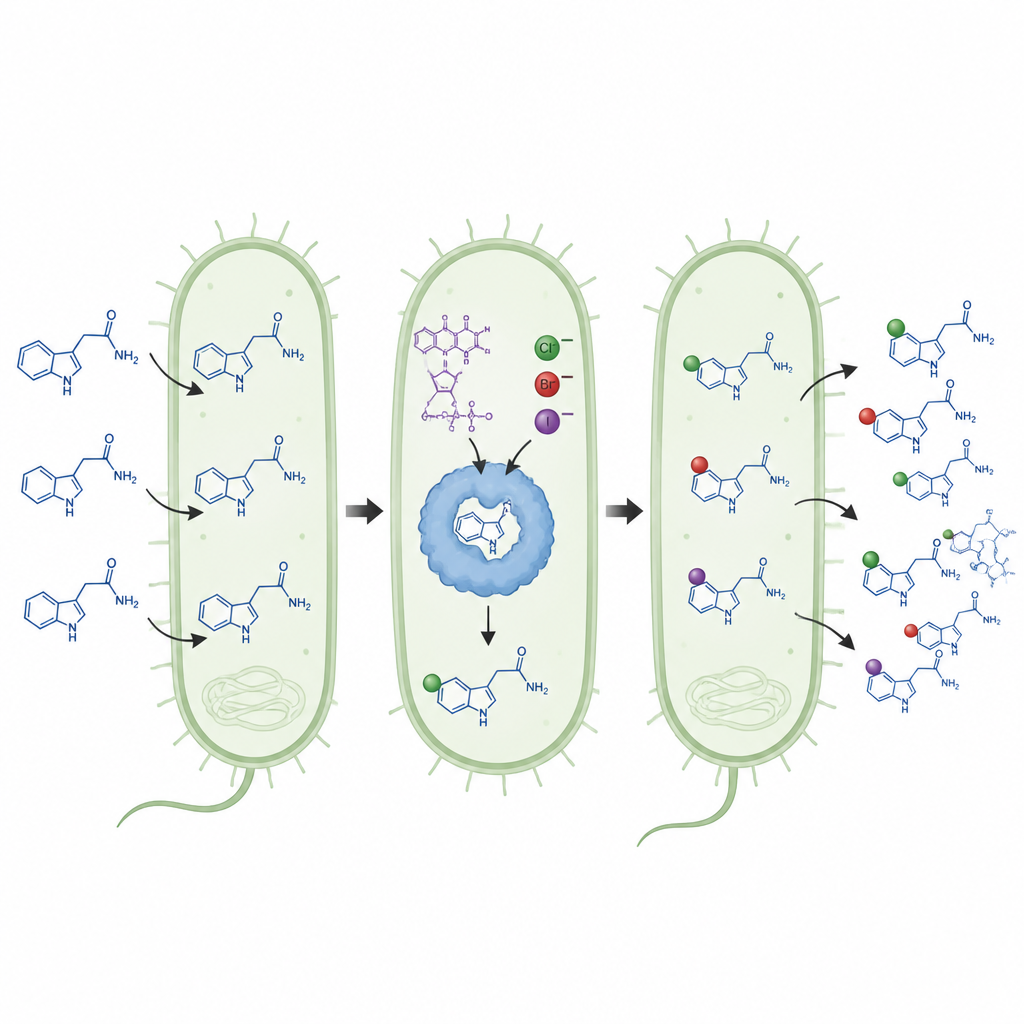
When the improved enzyme was tested in whole cells, it produced about 37 times more chlorinated tryptophan and 44 times more brominated tryptophan than the original enzyme under the same conditions. Even when compared to the original working at its preferred cooler temperature, the new enzyme at 37 °C still delivered more than ten times higher output. In a 5-liter fermenter, the team reached 2.7 grams per liter of chlorinated tryptophan, the highest level reported so far for this kind of product. By adding a partner enzyme that clips off part of tryptophan, they also created a pathway to halogenated tryptamines, molecules related to some migraine medicines and experimental psychiatric drugs, achieving over thirtyfold higher yields than before.
Making Stronger Tiny Antibiotics Inside Cells
Halogenated tryptophan can also be built directly into short protein chains known as antimicrobial peptides, which are being explored as future antibiotics. The team combined their evolved enzyme with a specialized translation system so that bacteria could make these peptides with a chlorine or bromine placed at precise positions. They used this to scan different sites in a candidate peptide and found one that tolerated the extra atom without losing its ability to kill bacteria. The same cellular machinery then produced milligram quantities of this halogenated peptide, which matched the performance and structure of an equivalent peptide made by traditional chemical synthesis.
What This Means for Future Green Manufacturing
By evolving RebH into a faster, more robust, and more soluble version, the researchers turned a fragile natural catalyst into a practical workhorse for industry. The new enzyme lets bacteria manufacture halogenated building blocks, drug-like molecules, and designer peptides using simple sugars and salts instead of corrosive chemicals. This approach could be extended to other enzymes and other nonstandard building blocks, opening the door to cleaner, more flexible production of halogen-containing drugs and materials.
Citation: Pulschen, A.A., Booth, J., Satanowski, A. et al. Continuous evolution of a halogenase enzyme with improved solubility and activity for sustainable bioproduction. Nat Commun 17, 4357 (2026). https://doi.org/10.1038/s41467-026-70981-4
Keywords: halogenated tryptophan, enzyme evolution, biomanufacturing, antimicrobial peptides, green chemistry