Clear Sky Science · en
Piezoelectric activation of dual lattice-oxygen mechanism through OH− Grotthuss transport in water electrolysis
Why shaking water could help make clean fuel
Hydrogen is often hailed as a clean fuel for the future, but producing it efficiently from water still wastes a lot of energy. This study shows that giving the electrolyte in a water-splitting device a brief dose of ultrasound can rearrange the water molecules and make oxygen release much easier. That simple extra step cuts the energy cost of making hydrogen without changing the main power supply, hinting at a new way to upgrade electrolyzers using mechanical energy.
Turning sound into useful electrical help
The researchers focus on the oxygen side of water splitting, which is notoriously slow and energy hungry. Instead of redesigning the entire catalyst, they add a thin piezoelectric film made from a flexible plastic mixed with ceramic particles. When ultrasound passes through the liquid, this film bends and generates tiny electric fields. Those fields reach into the surrounding electrolyte, briefly polarizing the solution and creating swirling microflows. The key idea is that mechanical vibrations are converted into electrical effects directly inside the liquid, supplementing the usual voltage applied between the electrodes. 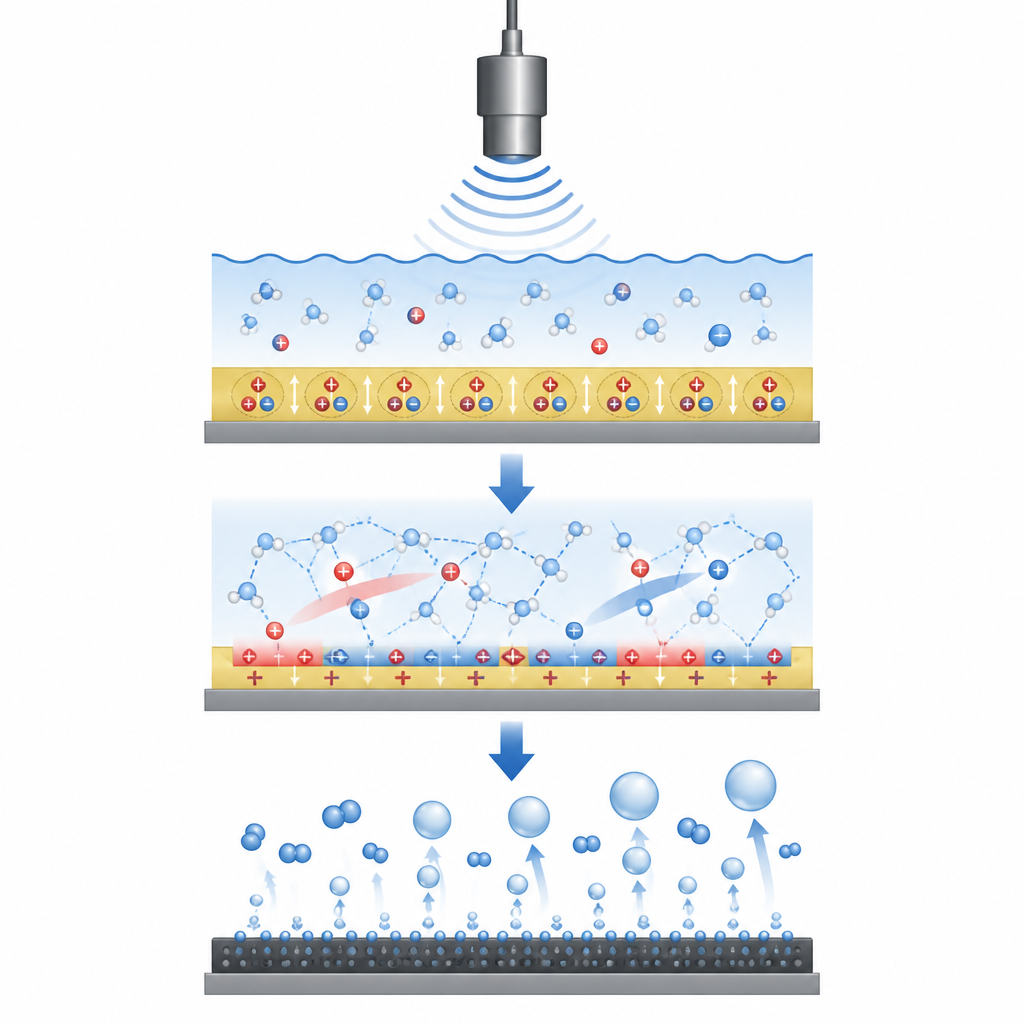
Making water molecules easier to rearrange
Under normal conditions, the hydroxide ions that carry charge in alkaline electrolyzers are wrapped in tight cages of water molecules and drift slowly through the liquid. Spectroscopic measurements and computer simulations in this work show that the piezoelectric fields weaken the hydrogen bonds tying those cages together. After just one minute of ultrasonic treatment, the population of loosely bound water molecules rises sharply. In this looser network, hydroxide ions can hop from one water molecule to another in a relay-like Grotthuss process instead of dragging their full hydration shell. This shift to a faster transport mode persists well after the ultrasound is turned off, meaning the electrolyte keeps its altered character for many hours.
Helping the catalyst surface work smarter
The authors then investigate what this restructured water does at the surface of a nickel oxyhydroxide catalyst, a common material for oxygen evolution. Infrared and Raman probes show that the treated electrolyte packs more hydroxide ions near the surface and weakens oxygen–hydrogen bonds there, which makes it easier to form key reaction intermediates. At the same time, X-ray and electron microscopy studies reveal that nickel atoms in the catalyst become more highly oxidized and their bonds to oxygen grow shorter and more covalent. In simple terms, the electronic structure of the catalyst reorganizes so that electrons can move more freely through the metal–oxygen network, reducing the barrier for turning water into oxygen gas. 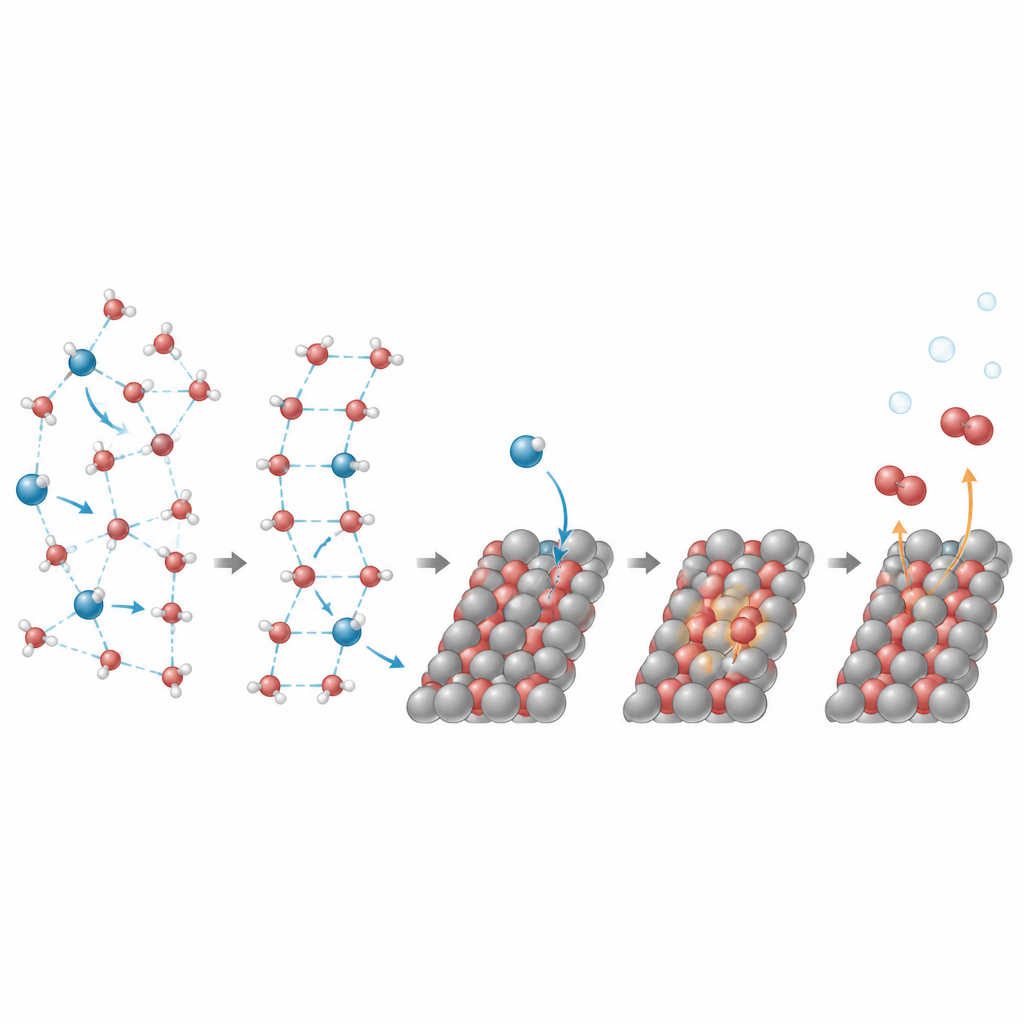
Opening new oxygen pathways inside the material
To see how the reaction pathway changes, the team tracks oxygen atoms labeled with a heavier isotope. In the treated electrolyte, much more of the oxygen gas produced comes directly from lattice oxygen atoms inside the catalyst rather than only from adsorbed species on its surface. These results point to two cooperative routes: one where lattice oxygen pairs with oxygen bound on the surface, and another where two lattice oxygen atoms couple with each other. Both avoid the usual high-energy intermediate that limits conventional oxygen evolution. Calculations of the reaction energies confirm that, under polarization, these lattice-involved pathways become easier than the traditional route.
What this means for future hydrogen devices
By briefly polarizing the electrolyte with ultrasound and a piezoelectric film, the researchers simultaneously speed up ion motion in the liquid and tune the electronic structure of the nickel catalyst. This dual effect lowers the extra voltage needed to drive oxygen evolution at high current by more than 200 millivolts and keeps the improvement for many hours with only occasional reactivation. For non-specialists, the message is that a short mechanical “pulse” to the liquid can make water splitting more efficient without continuously feeding in extra energy. Such modular, pulsed treatments could be added as separate units to future electrolyzers, offering a practical way to boost green hydrogen production by letting water and catalysts work together in a more favorable microscopic environment.
Citation: Li, Y., Wang, S., Yuan, M. et al. Piezoelectric activation of dual lattice-oxygen mechanism through OH− Grotthuss transport in water electrolysis. Nat Commun 17, 4346 (2026). https://doi.org/10.1038/s41467-026-70979-y
Keywords: water electrolysis, oxygen evolution reaction, piezoelectric electrolyte, hydrogen production, nickel oxyhydroxide catalyst