Clear Sky Science · en
Engineering non-interfacial hydrogen spillover in a Ni17W3-WO2 heterostructure
Why cleaner hydrogen matters
Hydrogen is often promoted as a clean fuel, but making it without burning fossil fuels remains a challenge. Today’s most efficient devices for splitting water into hydrogen still rely heavily on precious metals like platinum, which are costly and scarce. This study explores a new way to build high‑performance, low‑cost materials that can drive hydrogen production in acidic conditions similar to those used in industrial electrolyzers, potentially lowering costs and easing the shift to a low‑carbon energy system. 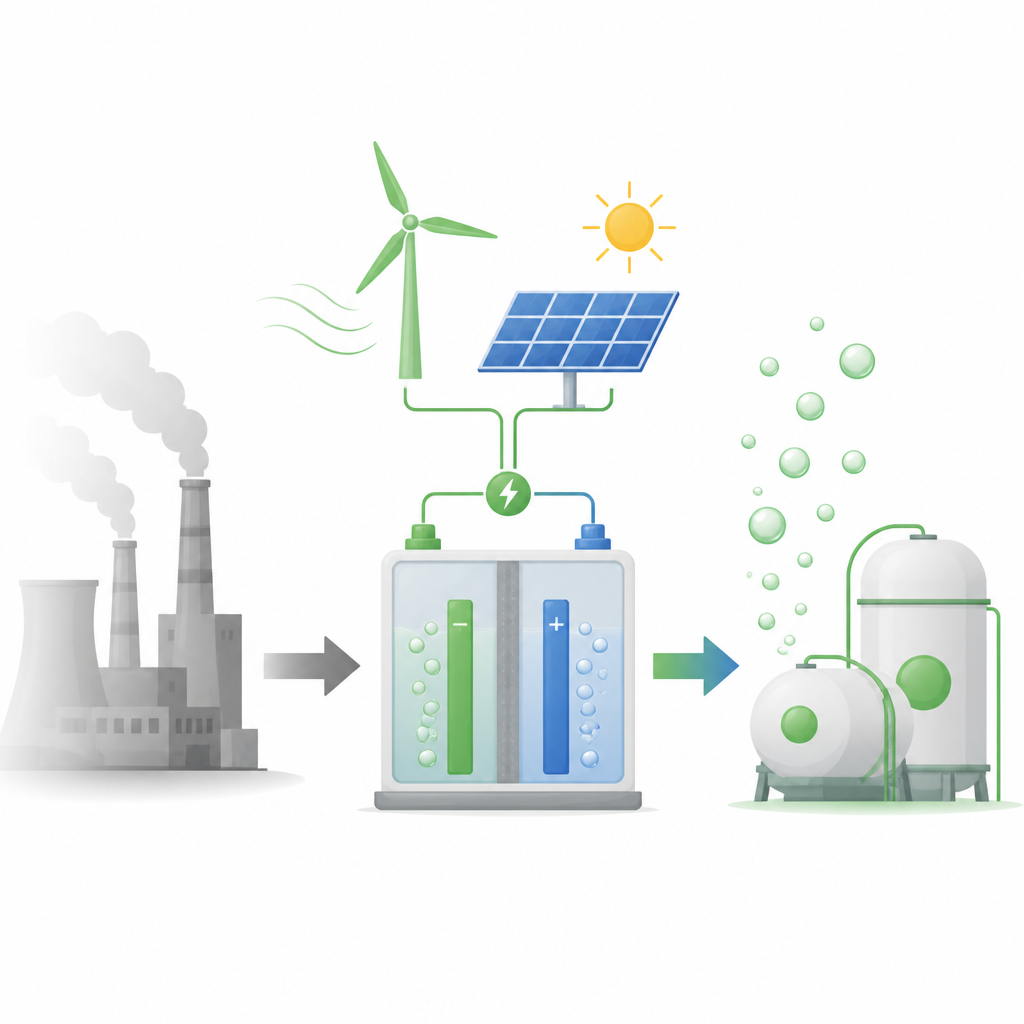
A new path for moving hydrogen atoms
Many modern catalysts try to speed up hydrogen production by using a trick called hydrogen spillover, where hydrogen atoms hop from one part of a material to another that lets them leave more easily as gas. In most designs, this hopping happens across the boundary between two different materials, and that boundary acts like a toll booth that slows traffic. The authors designed a different approach using a composite of a nickel–tungsten alloy, called Ni17W3, and tungsten oxide, WO2. Instead of forcing hydrogen to cross from one material into the other, they arranged things so that the entire journey of the hydrogen atom happens inside the metallic Ni17W3 region, while WO2 quietly reshapes the landscape from the side.
How the invisible strain is engineered
To build this catalyst, the team heated a simple nickel–tungsten compound in a hydrogen‑containing atmosphere, causing it to reconstruct itself into tiny particles that hold both Ni17W3 and WO2 in intimate contact. Advanced microscopes and diffraction techniques showed that the two parts form a clear shared boundary, but the atomic lattice of Ni17W3 is slightly stretched and squeezed near that boundary, creating a gradual strain pattern across the metal. Computer simulations and X‑ray photoelectron measurements revealed that electrons flow from the nickel‑rich alloy into the tungsten oxide. Together, this internal strain and charge shift create a smooth gradient in how strongly different spots inside the Ni17W3 region hold onto hydrogen atoms. 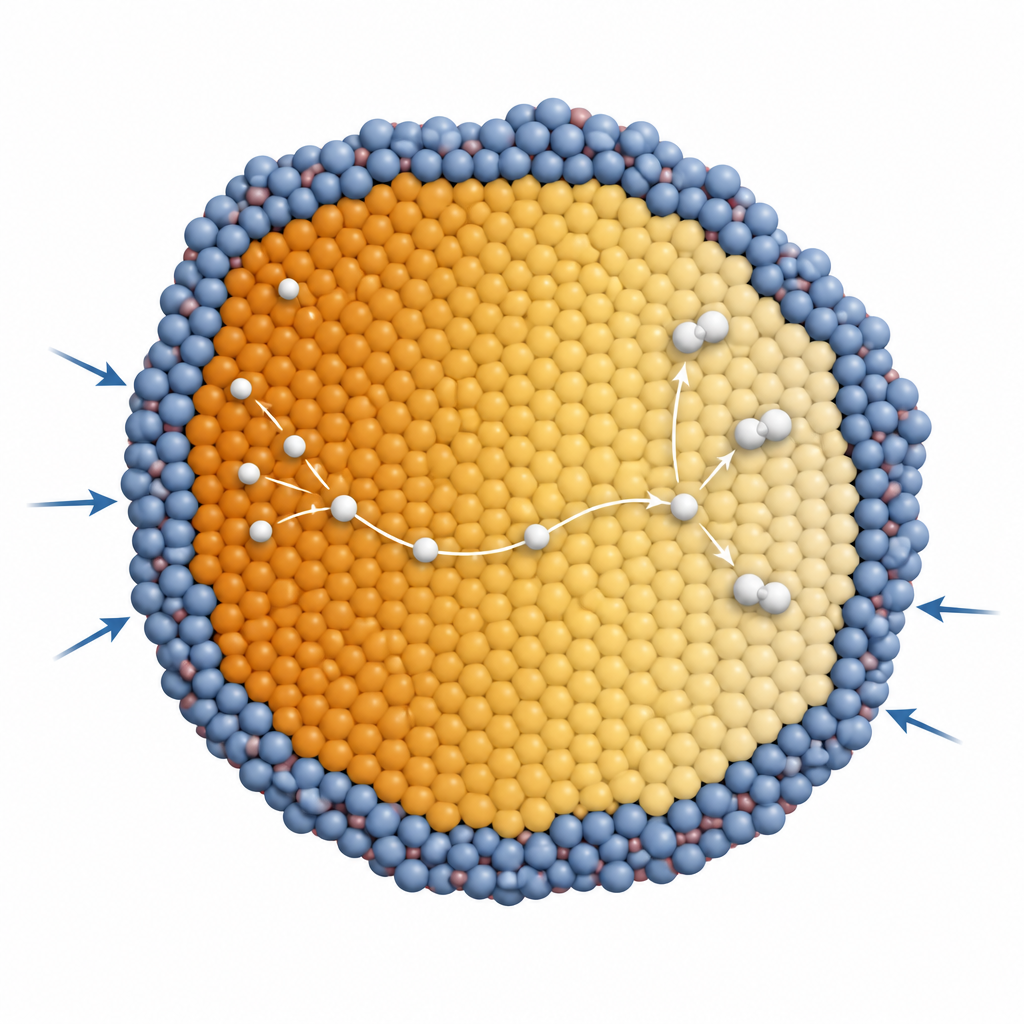
Turning structure into speed
Electrochemical tests in acidic solution showed how strongly this hidden tuning changes performance. Compared with either pure Ni17W3 or pure WO2, the combined material needs far less extra voltage to drive the same current, and its reaction steps proceed more quickly. Measurements of the effective surface area and turnover frequency indicate that not only are more sites active, but each site in the alloy also works better. The catalyst on carbon cloth reaches industrial‑scale current densities with overpotentials close to those of platinum‑based catalysts, while remaining stable for more than 1500 hours. Gas analysis confirmed that nearly all the electrical charge goes into making hydrogen rather than side reactions, and tests in a full proton‑exchange membrane electrolyzer showed performance on par with commercial platinum cathodes.
Following hydrogen’s trail inside the particle
To see where hydrogen actually goes, the researchers combined several probes. Substituting heavy water for normal water sharply slowed the reaction only for the composite material, indicating that the movement of protons is the bottleneck, as expected for a spillover‑type process. A color‑change test with tungsten oxide confirmed that the catalyst can split hydrogen and move it along its surface. In situ Raman spectroscopy, which tracks how chemical bonds vibrate under operating conditions, showed that in the composite, hydrogen builds up on bonds in the Ni17W3 region while the WO2 region remains largely unaffected, unlike in conventional systems. Detailed quantum‑level calculations backed this picture, showing that hydrogen prefers to migrate through a series of sites within Ni17W3 and faces a high energy wall if it tries to cross into WO2, confirming that the key pathway is a “non‑interfacial” spillover confined to one phase.
What this means for future hydrogen devices
In simple terms, the authors have built a tiny highway for hydrogen atoms that runs entirely inside the metallic part of their catalyst, while the adjoining oxide quietly shapes the route without becoming the main road itself. This clever control of strain and electron flow sidesteps the usual barriers at material boundaries and lets a non‑precious metal catalyst rival the performance of platinum in tough acidic environments. The design principle, in which a supporting material engineers an internal energy gradient rather than serving as a second reaction site, could be applied broadly to other alloys and oxides, guiding the development of cheaper and more durable catalysts for large‑scale green hydrogen production.
Citation: Xie, S., Dong, H., Cao, S. et al. Engineering non-interfacial hydrogen spillover in a Ni17W3-WO2 heterostructure. Nat Commun 17, 4305 (2026). https://doi.org/10.1038/s41467-026-70976-1
Keywords: hydrogen evolution reaction, electrocatalyst, hydrogen spillover, nickel tungsten alloy, green hydrogen