Clear Sky Science · en
Noncollinear ferrielectricity in a van der Waals crystal
Twisting Tiny Electric Arrows
Inside many modern gadgets, special crystals quietly move electric charges around in highly ordered ways. This study explores a new kind of electrical order in a layered crystal called WO2Br2, where countless microscopic "electric arrows" do not all line up straight, but instead lean at angles to one another. Understanding and controlling this unusual behavior could lead to more versatile memory chips and ultrafast light-controlled electronics.
A New Kind of Electric Order
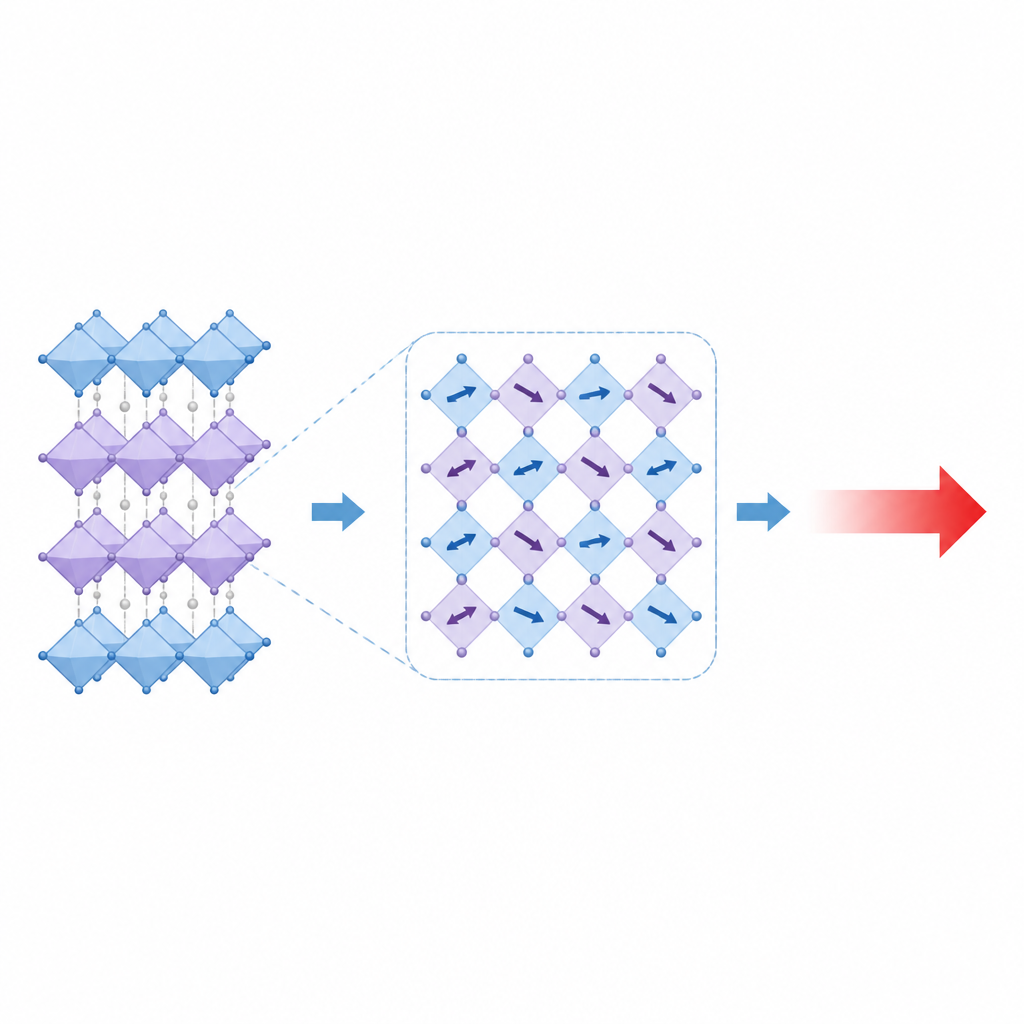
In most familiar ferroelectric materials, the tiny electric dipoles inside a crystal point either all in the same direction or exactly opposite to each other, much like rows of soldiers or neat stripes. Here, the researchers focus on a more intricate arrangement called noncollinear ferrielectricity, where neighboring electric dipoles are tilted relative to each other rather than simply parallel or antiparallel. The team investigates this effect in a van der Waals crystal, WO2Br2, whose layers are held together by relatively weak forces. The unusual shape of the atomic building blocks in this material allows electric dipoles to adopt a richer set of directions than in more rigid, conventional crystals.
Seeing Atoms Shift Sideways
To show that these angled electric dipoles really exist, the scientists directly imaged how tungsten atoms inside the crystal shift from their ideal positions. Using advanced electron microscopes, they looked at very thin samples from different viewing directions. Along one direction they could detect a pattern of opposite sideways shifts that cancel each other, a so-called antipolar pattern. Along another direction they found a net shift that adds up to a clear polar direction. Together, these measurements revealed that the local electric dipoles are not all lined up, but instead form a long-range, noncollinear pattern across many layers of the crystal.
Electric Polarization You Can Flip Sideways
Next, the team asked whether this intricate dipole pattern behaves like a useful ferroelectric material, where electric polarization can be switched. Using a sensitive scanning probe technique, they mapped in-plane ferroelectric domains at room temperature and showed that they can be reversed by applying voltage through a tiny tip. Theory calculations traced this behavior to two competing vibrational patterns in the high-symmetry phase of WO2Br2: one that favors parallel dipoles and another that favors opposite ones. When these patterns act together, they stabilize the noncollinear state while still leaving a net in-plane polarization that can be switched.
Turning the Polar Direction With Pressure
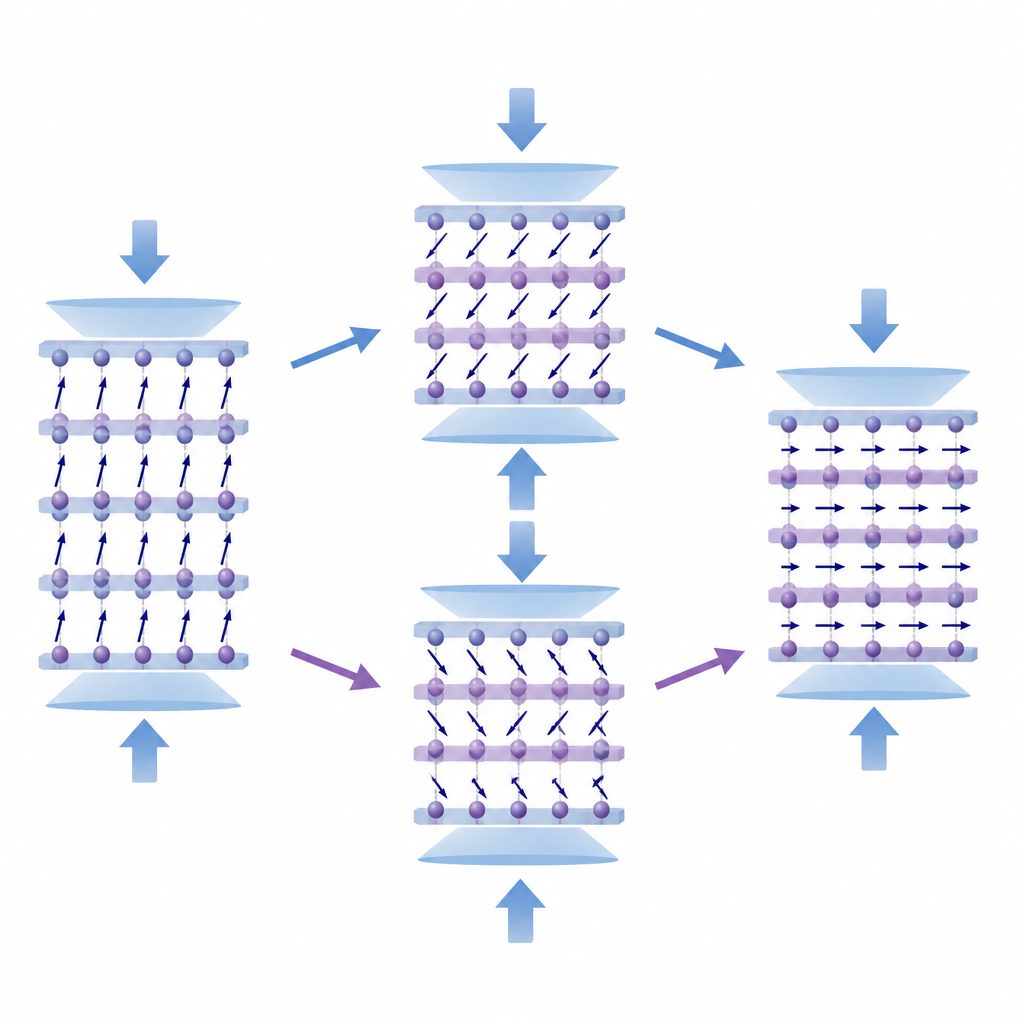
One striking feature of this crystal is that its overall polar axis can be rotated by 90 degrees using hydrostatic pressure. By squeezing the material in a diamond anvil cell and watching how it emits light at twice the frequency of an incoming laser, the researchers tracked how the polar direction slowly turns from one crystal axis to a perpendicular one. Their calculations show that this rotation can follow two nearly equal-energy paths: one passes through an almost nonpolar intermediate state, and the other through a state where the dipoles line up along a new, 45-degree direction before reaching the final orientation. Experiments find clear signs of both routes, highlighting how the angled dipoles allow multiple ways to reorganize without every local dipole needing to rotate by a full right angle.
Shaking the Lattice With Light
Finally, the team used ultrafast electron diffraction to see how the crystal responds when hit with very short laser pulses. They observed two distinct, long-lived vibrational modes that correspond to the same competing patterns responsible for the noncollinear dipoles: one mainly changes the net polar shifts, while the other modulates the opposing shifts. Because these modes can be excited together or separately on a trillionth-of-a-second timescale, WO2Br2 offers a way to steer polar and antipolar order with light, hinting at the possibility of ultrafast switching between different polarization states.
Why This Matters for Future Devices
In simple terms, this work shows that WO2Br2 hosts a stable, angled arrangement of electric dipoles that can be flipped and reoriented in ways not possible in standard ferroelectrics. Pressure can turn the polar direction sideways through two distinct intermediate states, and ultrafast light pulses can selectively shake the underlying vibrational patterns. Together, these abilities point to new strategies for designing memory and optoelectronic devices in which information is stored not just in "on" or "off" polar states, but in a richer landscape of controllable electric patterns.
Citation: Fu, J., Wang, G., Qi, Y. et al. Noncollinear ferrielectricity in a van der Waals crystal. Nat Commun 17, 4245 (2026). https://doi.org/10.1038/s41467-026-70975-2
Keywords: noncollinear ferroelectricity, van der Waals crystal, polarization switching, hydrostatic pressure, coherent phonons