Clear Sky Science · en
Breaking the rate limiting barrier in lithium||sulfur batteries via spin state engineering
Why this battery study matters
Lithium–sulfur batteries could one day power electric cars and devices for much longer than today’s lithium-ion cells, using cheap and abundant sulfur. Yet they suffer from slow reactions and unstable performance. This study uncovers a hidden bottleneck in how sulfur stores and releases energy and shows a clever way to speed things up by tuning a quantum property of electrons called spin, making lithium–sulfur batteries more practical for real-world use.
Where sulfur batteries get stuck
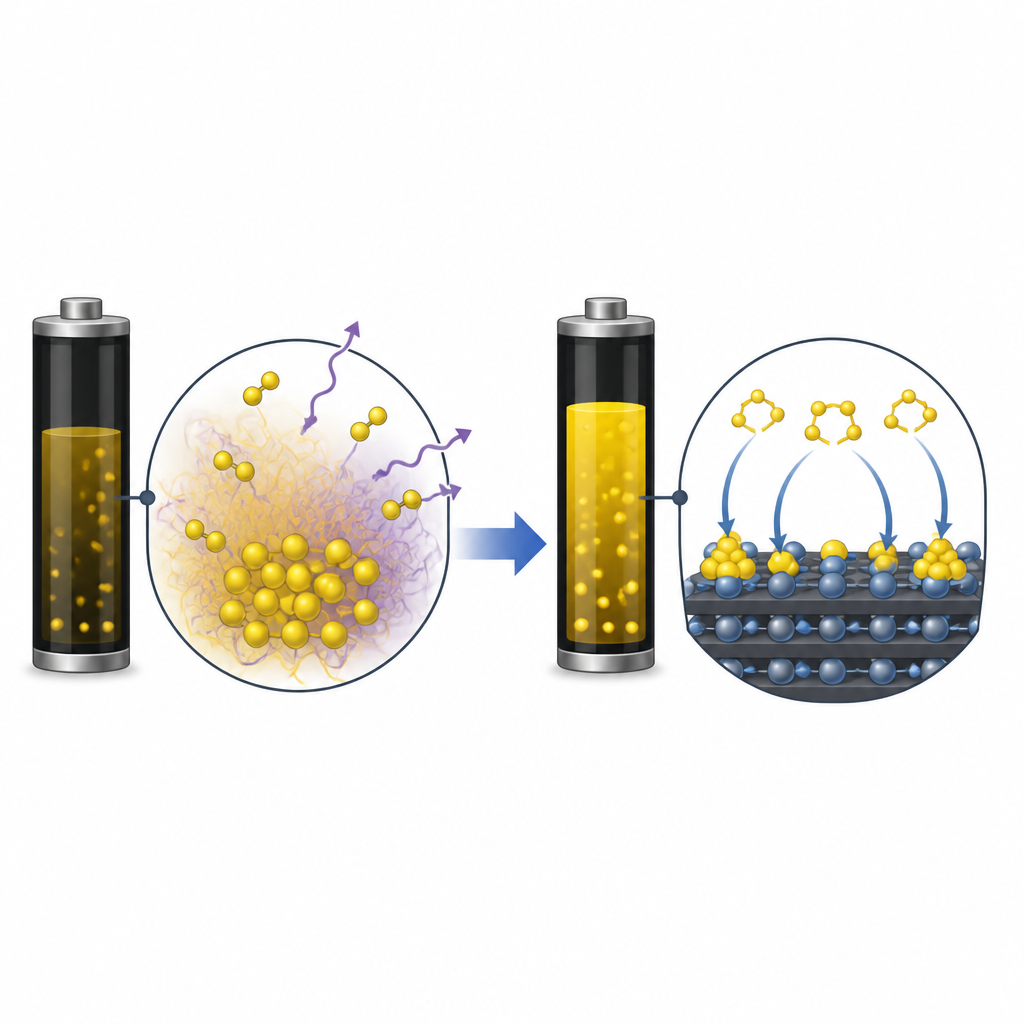
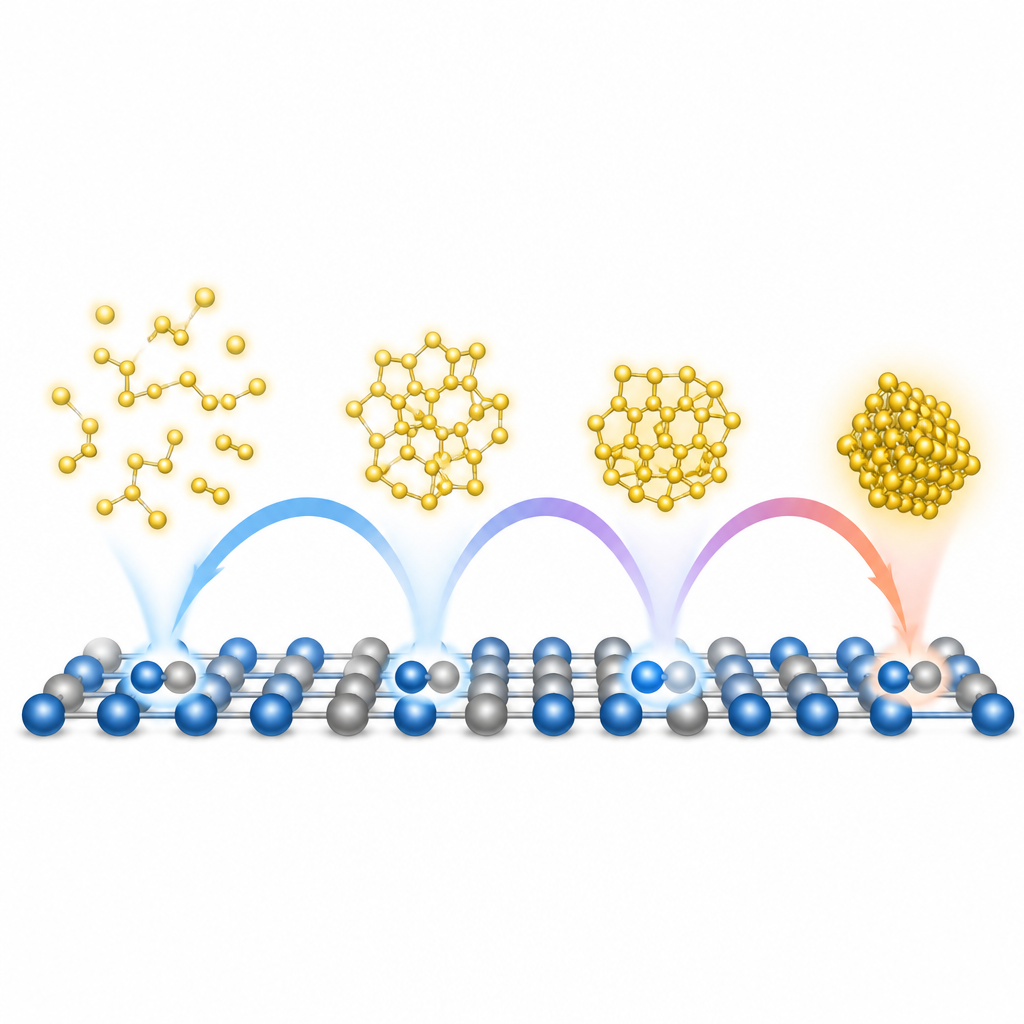
Inside a lithium–sulfur battery, sulfur does not simply switch on and off. It passes through a chain of forms as the battery charges and discharges, moving between solid sulfur, dissolved sulfur species in the liquid electrolyte, and finally solid lithium sulfide. The last step, where one solid form called lithium disulfide turns into another solid called lithium sulfide, is especially slow. Earlier work focused mostly on the liquid steps, which cause leakage of sulfur species between the electrodes and waste energy, but this final solid-to-solid step quietly limits how fast and how fully the battery can work.
Discovering the hidden role of electron spin
The researchers used advanced computer calculations to watch how electrons rearrange during this stubborn solid-to-solid change. They found that the intermediate fragments that appear between lithium disulfide and lithium sulfide carry unpaired electrons, while the starting and ending solids do not. That means the reaction must flip the spin state of electrons along the way, and such spin changes cost energy and slow things down. By comparing many possible reaction paths, they showed that this spin hurdle, not just ordinary chemical bonding, is a major reason the reaction is sluggish.
Designing a smarter catalyst surface
To overcome this bottleneck, the team set out to build a catalyst surface that is itself rich in spin activity, so it can help shuttle electrons between different spin states more easily. They started from molybdenum disulfide, a layered material, and replaced some molybdenum atoms with pairs of transition metals such as cobalt, nickel, manganese, or vanadium. Using a mix of quantum calculations and machine learning, they screened ten such dual-metal combinations and searched for patterns across dozens of material properties. A clear trend emerged: the higher the spin moment on the catalyst surface, the lower the energy barrier for the troublesome solid-to-solid sulfur step.
How cobalt and nickel change the game
Among all the tested combinations, a surface doped with both cobalt and nickel stood out. This Co,Ni–modified molybdenum disulfide showed strong spin polarization, meaning many unpaired electron spins arranged in a way that can interact with reacting sulfur species. Calculations indicated that on this surface, the difficult conversion between the two solid sulfur forms proceeds with a much smaller energy cost. Lab measurements backed this up: batteries using this catalyst showed faster formation and breakdown of solid lithium sulfide, stronger signals of reaction activity, and lower energy barriers compared with cells using undoped molybdenum disulfide or other metal pairs.
Cleaner reactions and longer-lasting cells
Speeding up this solid step has another benefit. When sulfur species linger in the liquid phase, they can drift to the lithium side of the battery, react where they are not wanted, and then drift back, a process known as shuttling that wastes energy and shortens battery life. The cobalt–nickel catalyst not only grabs these dissolved sulfur species more strongly but also converts them quickly into stable solids, cutting down on wandering sulfur. Tests showed lower activation energies, smaller polarization in charge–discharge curves, and much more stable cycling than with standard materials, even at high currents and low temperatures.
What this means for future batteries
By deliberately engineering the spin properties of a catalyst surface, the authors broke through a fundamental rate limit in lithium–sulfur batteries. Their cobalt–nickel doped material enabled pouch cells that stored 13.2 ampere-hours with a specific energy of 435 watt-hours per kilogram, while maintaining stable performance. For a general reader, the key message is that looking beyond simple chemistry to the quantum behavior of electrons can unlock new ways to design better, longer-lasting batteries that make fuller use of inexpensive elements like sulfur.
Citation: Jiang, Q., Xu, H., Ye, X. et al. Breaking the rate limiting barrier in lithium||sulfur batteries via spin state engineering. Nat Commun 17, 4466 (2026). https://doi.org/10.1038/s41467-026-70974-3
Keywords: lithium sulfur batteries, catalyst design, electron spin, energy storage, machine learning materials