Clear Sky Science · en
In-situ revitalizing end-of-life MBR membranes via a curtain-type dynamic membrane process
Turning Old Filters into New Helpers
Modern cities rely on hidden machines that quietly clean enormous volumes of wastewater every day. One of the workhorses in this system is the membrane bioreactor, which uses fine plastic filters to strain out germs and grime. But these filters wear out after a few years and are usually thrown away, adding hundreds of thousands of tons of plastic waste each year and driving up energy and replacement costs. This study explores a way to give those worn filters a second life while still cleaning water well enough to meet discharge standards.
How Today’s Water Filters Fall Short
Membrane bioreactors use very tight filters to produce crystal clear water. Over time, however, these filters clog and their plastic surfaces are scratched and damaged by the mixture of sludge and particles they handle. Even when only the thin outer filtering skin is worn, entire modules are discarded because their performance drops too quickly. Globally, this means large amounts of non-degradable plastic are burned or buried, and new filter modules must be manufactured using energy-intensive processes and chemicals. At the same time, the push for ultra-clear water often means we spend more energy than needed, since many uses do not require the very highest clarity.
A Curtain of Fibers that Builds Its Own Skin
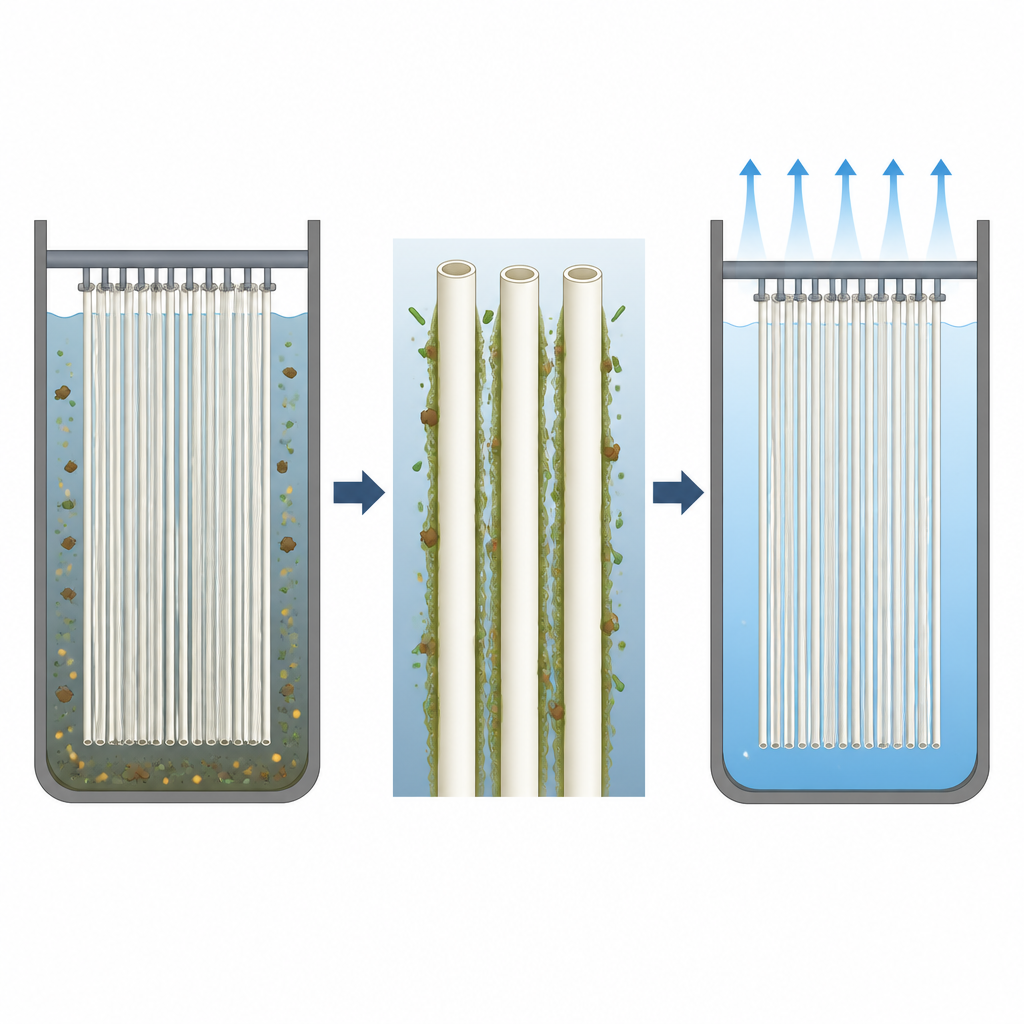
Instead of relying only on a fragile filter skin, the researchers use a different idea called a dynamic membrane. In this setup, water passes through a coarser support made from many thin hollow fibers that hang like a curtain. As mixed wastewater flows past, the natural sludge in the water quickly coats the fiber surface and pores, forming a biofilm layer that acts as the real filter. Within about ten minutes, this living coating produces stable, relatively clear effluent with turbidity below 5 NTU, close to the clarity needed for safe discharge. Computer simulations show that the curtain layout keeps water flow more even than flat sheets when scaled up, helping the self-formed layer stay uniform and stable.
Upcycling Old Filters from Waste to Resource
The key insight is that most end-of-life modules already contain a strong inner support layer beneath the damaged outer skin. By peeling away only about 5 percent of that outer skin to expose the inner support, the team turns old modules into curtain-type dynamic membranes. Tests with aged polyvinylidene fluoride (PVDF) filters from real treatment plants show that once the support is exposed, sludge particles are more likely to stick and build a filtering cake layer. With just a small exposed area, the refurbished modules regain flow behavior similar to new ones while still keeping effluent turbidity within discharge limits. The best results come when the exposed spots are scattered rather than concentrated, which encourages thinner, less stubborn biofilms that are easier to clean.
Keeping the System Running Over Time
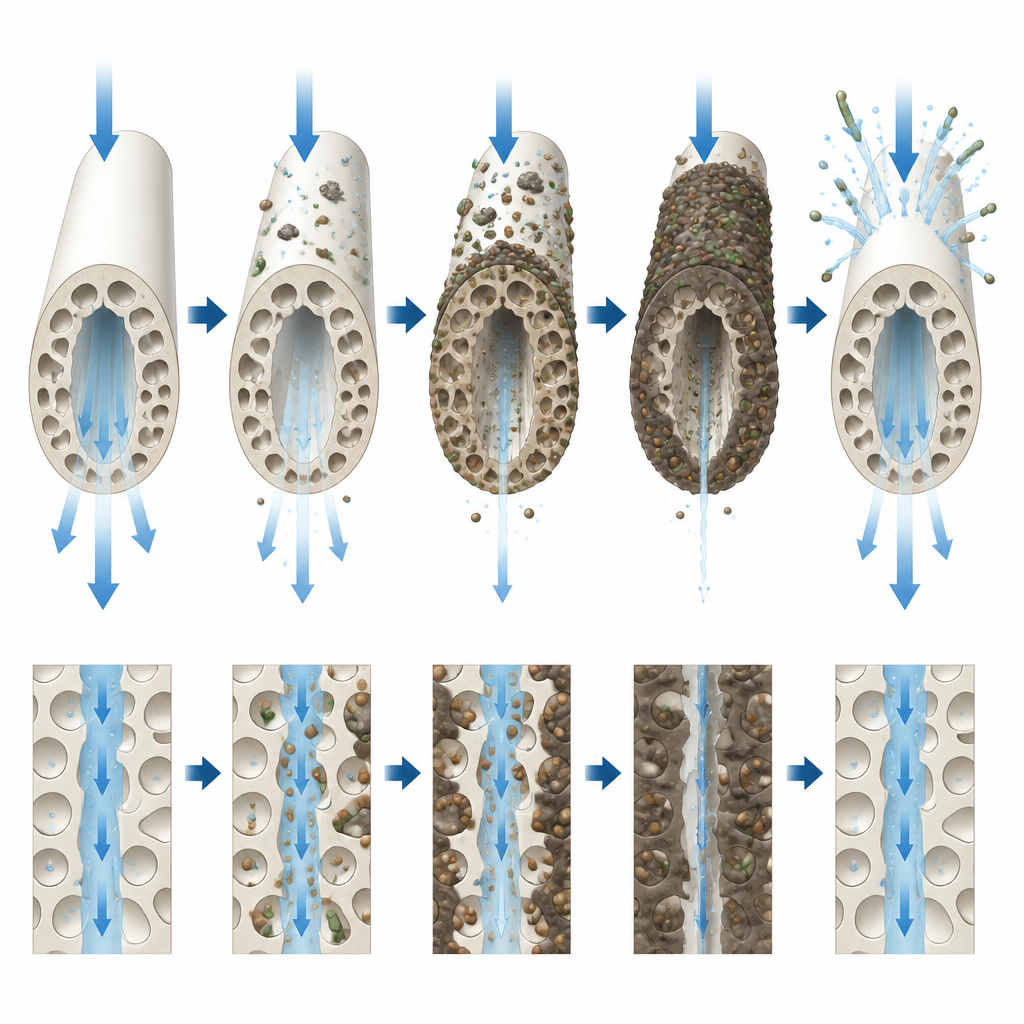
Because the new filtering action occurs inside the pores and within the built-up layer rather than only on the surface, some common cleaning tricks do not work well. Simple backwashing with clean water removes only large chunks and leaves fine growth lodged inside. In contrast, ultrasonic treatment, mechanical brushing, or short soaks in dilute bleach effectively remove the fouling and restore flow. In month-long tests with real domestic wastewater, modules with 5 percent exposure maintained stable performance through repeated cleanings, keeping water clarity within municipal discharge limits. A larger pilot system treating town sewage showed that while the refurbished modules gave slightly cloudier water than brand-new ones, removal of key pollutants like organic carbon, nitrogen, and phosphorus was essentially the same.
Big Climate and Cost Gains from a Small Change
The researchers compared the environmental footprint of the usual practice of discarding old modules and installing new ones with their reuse approach. Per square meter of membrane area, the reuse strategy cut estimated carbon emissions by a factor of 1,070 and slashed overall environmental costs by 99.9 percent, mainly by avoiding new plastic production and waste handling. Modeling of China’s fast-growing membrane bioreactor capacity suggests that if reuse replaced traditional replacement over the next decade, it could prevent roughly 441 thousand tons of carbon dioxide emissions and save about 1.29 billion US dollars in combined operating and environmental costs. While this approach cannot fully replace high-grade treatment where ultra-clear water is required, it offers a practical way for many plants, especially in resource-limited regions, to stretch the life of existing equipment, reduce plastic waste, and lower the energy and money spent on keeping water safe.
Citation: Liang, Y., Zhang, Y., Ye, F. et al. In-situ revitalizing end-of-life MBR membranes via a curtain-type dynamic membrane process. Nat Commun 17, 4383 (2026). https://doi.org/10.1038/s41467-026-70969-0
Keywords: wastewater treatment, membrane bioreactor, dynamic membrane, plastic waste, carbon emissions