Clear Sky Science · en
Supercurrent-controlled spontaneous ferromagnetism of magnetic impurities in a spin-orbit-coupled superconductor
Why tiny magnets in a superconductor matter
Modern supercomputers crave ultra fast, ultra efficient memory that works in the cold environment required for superconducting electronics. This study explores an unusual material where a flow of electrical current without resistance, called a supercurrent, can quietly organize many tiny magnetic moments on the surface into a collective state. The work points to a new way to store information using almost no energy loss.
Superconductors and hidden magnets
In a standard superconductor, electrons pair up in a way that usually clashes with magnetism. Magnetic bits tend to break apart these pairs, so long range magnetic order is discouraged. The material studied here, an iron based compound known as Fe(Se, Te), behaves differently because its electrons feel a strong link between their motion and their spin, known as spin orbit coupling. Extra iron atoms squeezed between the regular atomic layers act as tiny magnets scattered across the surface. Theory had suggested that, in such a setting, these impurities could talk to each other through unusual currents in the superconductor and align like a ferromagnet, but this had not been directly observed.
Imaging invisible magnetic patterns
The researchers exfoliated thin flakes of Fe(Se, Te) containing a relatively high density of interstitial iron atoms and cooled them below their superconducting transition. Using a highly sensitive scanning SQUID microscope, they mapped how the material responded both to small magnetic fields and to applied currents. Instead of the familiar pattern of vortices that usually marks a magnetic field entering a superconductor, they saw broad magnetic domains spread over tens of micrometers. These domains changed from one cooling cycle to another, appeared only when the material was superconducting, and faded rapidly as the temperature approached the critical temperature. This behavior showed that the domains did not arise from ordinary impurities, but from a magnetic state that depended on the superfluid of paired electrons.
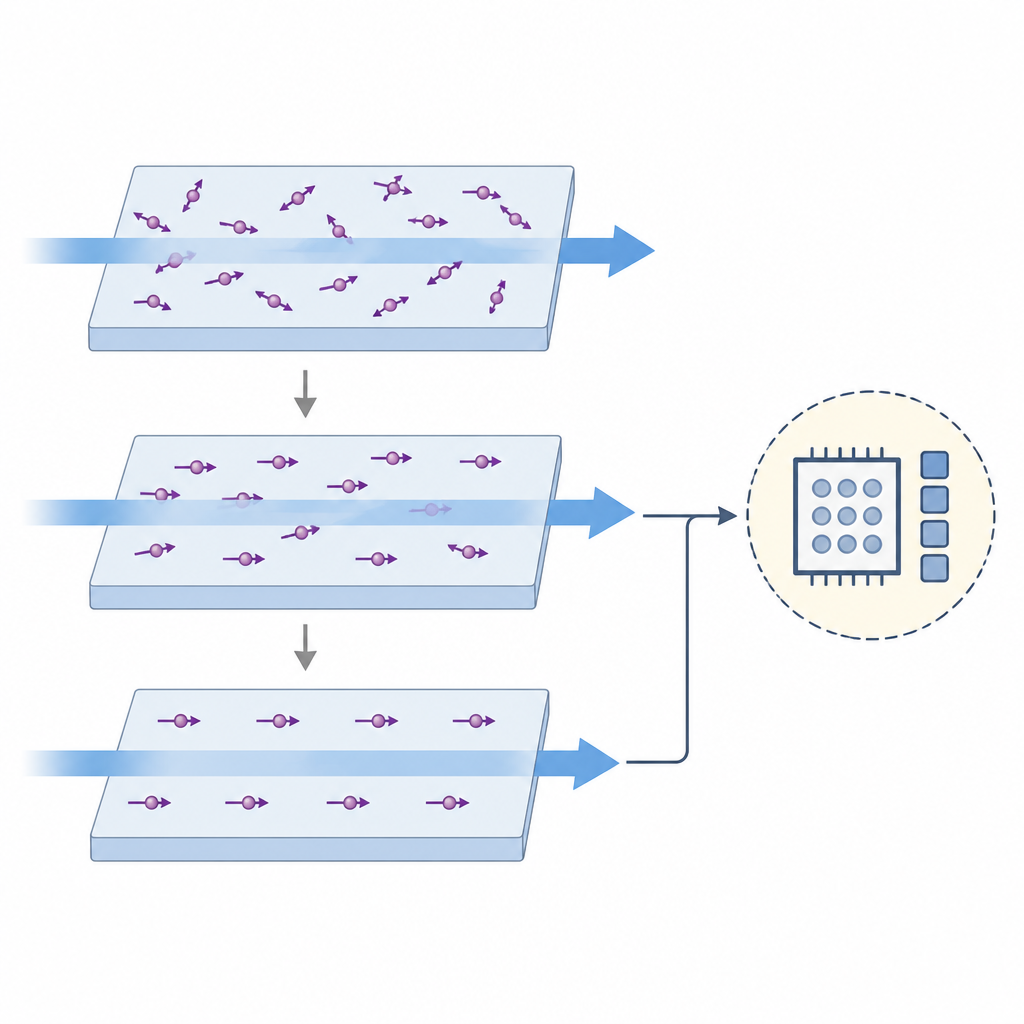
Current that writes magnetization
To test whether supercurrent could control this magnetism, the team fabricated devices with gold electrodes on similar flakes. When they sent a small bias current through the sample, the observed magnetic signal followed the ordinary magnetic field generated by the current itself. Above a threshold current, however, the pattern abruptly changed: strong currents crowded along the edges and the sign of the measured magnetic flux flipped compared with the simple expectation. After the bias current was turned off, a remanent flux pattern remained, whose sign could be reversed by applying current in the opposite direction. The dependence on current followed a hysteresis loop, much like flipping the magnetization of a conventional ferromagnet, but here the switching occurred at a supercurrent density roughly a thousand times lower than in typical metallic devices.
How the supercurrent ties spins together
The key lies in a magneto electric effect allowed by spin orbit coupling at the surface. A flowing supercurrent tends to polarize the surface impurities so their spins line up within the plane. In turn, a uniform in plane magnetization generates so called anomalous supercurrents that circulate in a distinctive way: along the edges they reinforce the direction of the applied current, while in the interior they oppose it. These circulating currents produce the magnetic signals seen by the SQUID microscope. Because the top and bottom surfaces of the thin flake contribute additively, the effect is strong even though the spins themselves are atomic in size. When the superconductor is warmed, the superfluid weakens and both the long range ferromagnetic order and its associated anomalous currents disappear, tying the magnetic state directly to the superconducting condensate.
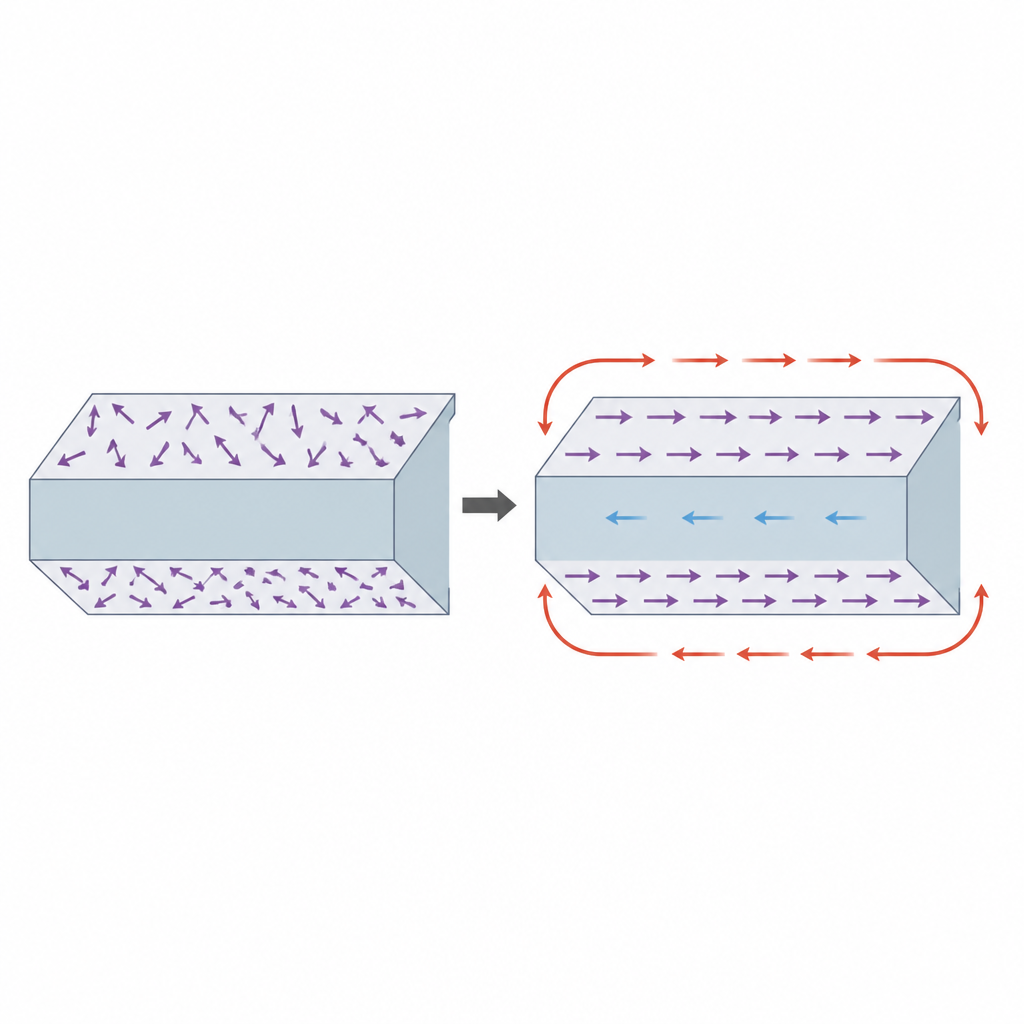
Toward low loss cryogenic memory
In simple terms, the study shows that a gentle, lossless current can switch a sheet of tiny surface magnets on and off in a controllable, non volatile way, as long as the material remains superconducting. This current written magnetization, mediated by supercurrents rather than ordinary electrons, could form the basis of cryogenic memory elements that consume far less power than existing magnetic devices. While practical applications will require cleaner, thinner films and reliable electrical readout schemes, the work confirms a long standing theoretical idea and opens a path toward integrating superconducting logic with magnetic storage in future low energy computers.
Citation: Xiang, B., He, Q., Lin, Y. et al. Supercurrent-controlled spontaneous ferromagnetism of magnetic impurities in a spin-orbit-coupled superconductor. Nat Commun 17, 4294 (2026). https://doi.org/10.1038/s41467-026-70968-1
Keywords: superconducting spintronics, ferromagnetism, spin orbit coupling, cryogenic memory, FeSeTe