Clear Sky Science · en
Nanoscale greenhouse effect for promoting solar-driven CO2 reduction with water to CH4
Turning Sunlight, Air, and Water into Fuel
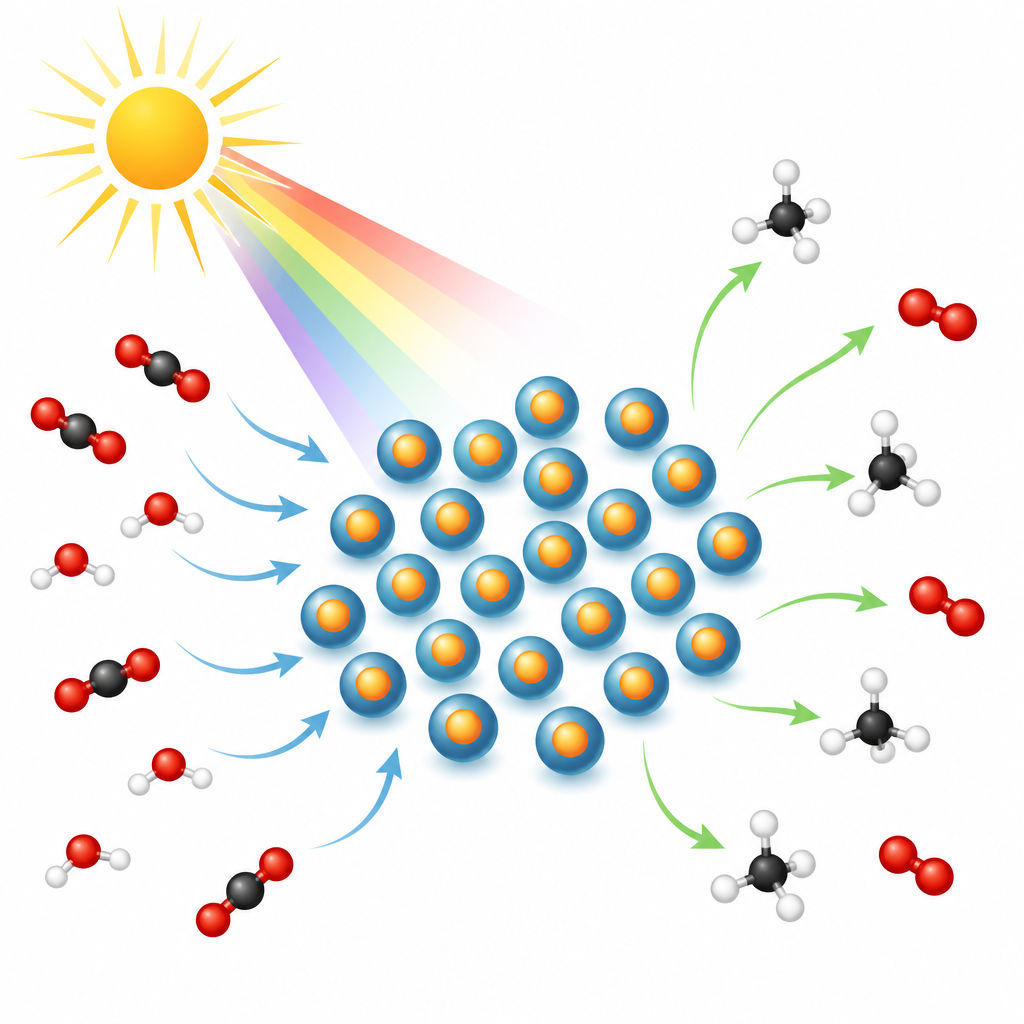
Sunlight is our most abundant energy source, yet we still struggle to store it in convenient fuels. This study explores a tiny engineered particle that captures a wider range of sunlight to turn carbon dioxide from the air and water vapor into methane, the main ingredient of natural gas. By mimicking the way a greenhouse traps warmth, the researchers build a “nanoscale greenhouse” that concentrates light and heat where the reaction happens, pointing toward cleaner ways to make solar fuels and reduce reliance on fossil resources.
Why Solar Fuel Devices Waste Most Sunlight
Most existing light driven catalysts for turning carbon dioxide and water into fuels only use the most energetic parts of sunlight, in the ultraviolet and visible ranges. More than half of the Sun’s energy, however, arrives as near infrared light, which is lower in energy and usually passes through catalysts unused. On top of that, the chemical steps that turn carbon dioxide into energy rich molecules like methane are slow and complex, involving multiple electrons and protons. As a result, typical systems are inefficient, struggle to make a single desired product, and are hard to scale for practical carbon neutral fuel production.
A Tiny Greenhouse Built from Two Materials
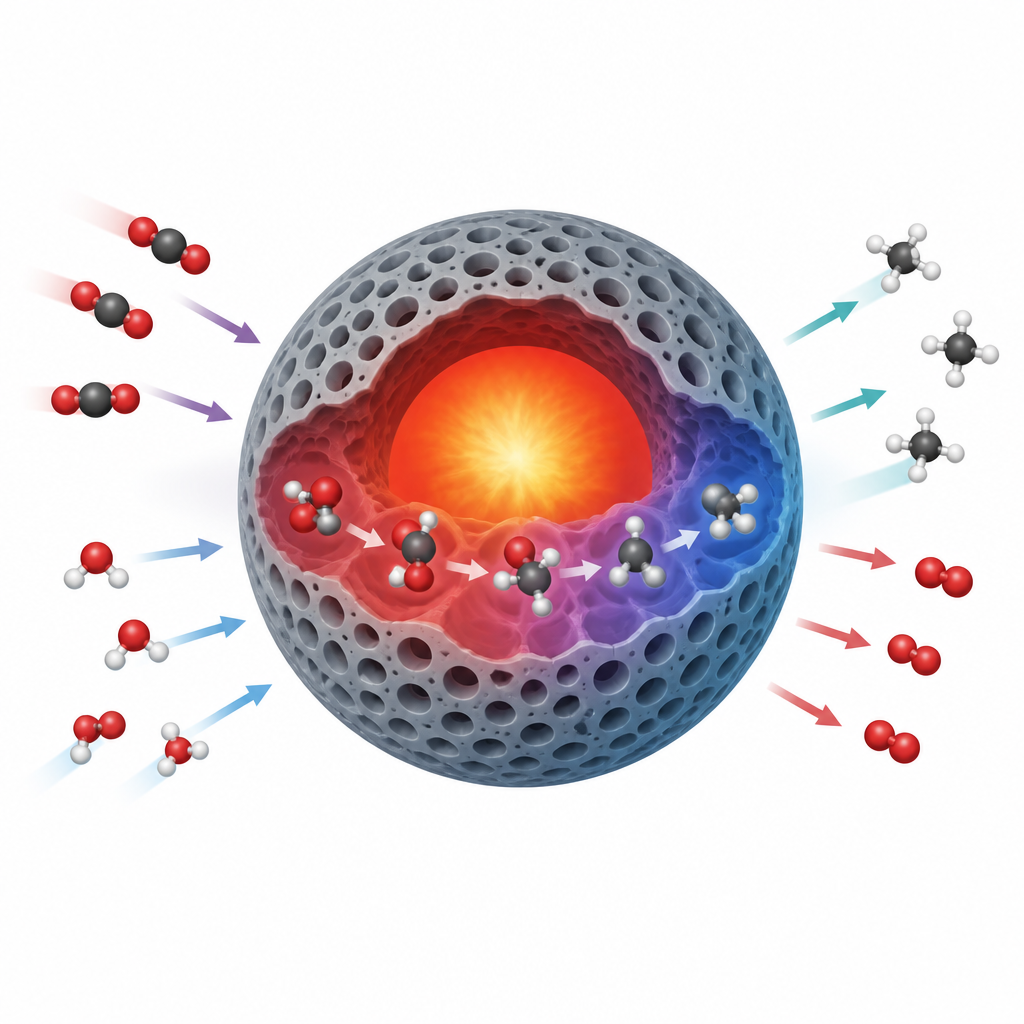
To tackle these limits, the team designed a two layer nanoparticle with a metal core and an oxide shell. The inner core is made of metallic bismuth, which behaves like a tiny antenna for a broad span of light, including the hard to use near infrared region. When bismuth absorbs this light, it produces energetic “hot” electrons and converts light energy into localized heat. Surrounding this core is a loose, porous shell of iron oxide that is rich in missing oxygen atoms, known as vacancies. This shell acts like both a thermal blanket, holding heat near the reaction sites, and a catalytic bed where carbon dioxide and water molecules land, are activated, and converted into new chemicals.
Capturing Light as Both Electricity and Heat
The nanoscale greenhouse works by combining two effects that normally are studied separately. Higher energy ultraviolet and visible light is mostly absorbed in the iron oxide shell, where it creates electron–hole pairs that help drive reactions. Lower energy near infrared light is mainly absorbed in the bismuth core, building up hot electrons and strong local heating. Because of the tight contact between core and shell, the hot electrons quickly move into the shell and collect near the oxygen vacancy sites, while the shell slows the escape of heat to the surroundings. Measurements and computer simulations show that this design not only raises the local temperature well above the bulk surface, but also lengthens the lifetime of the useful charge carriers, giving them more time to push the chemistry forward.
From Carbon Dioxide to Methane Inside the Shell
Detailed experiments and calculations reveal how this structure steers the reaction from carbon dioxide toward methane rather than simpler products such as carbon monoxide. The oxygen vacancies in the shell bind and bend carbon dioxide molecules, making them easier to hydrogenate step by step. The incoming hot electrons from the core fill these sites, while water supplies the protons and also releases oxygen gas to close the redox cycle. Infrared spectroscopy detects a sequence of reaction fragments on the surface, including forms of carbon–oxygen and carbon–hydrogen groups, that match a pathway toward deeply reduced methane. Theoretical energy maps confirm that at the bismuth–iron oxide interface, the hardest early step in activating carbon dioxide requires less input energy, and later steps favor further hydrogenation instead of letting carbon monoxide escape.
What This Means for Future Solar Fuels
In practical tests under simulated sunlight and without any external heating, the nanoscale greenhouse particles reach methane production rates much higher than comparable systems that contain no precious metals, while keeping side reactions like hydrogen formation to very low levels. The catalyst remains stable over many hours and even after a long rest period, thanks to the protective outer shell that prevents the bismuth core from clumping or degrading at elevated temperatures. For non specialists, the key message is that carefully engineered nano structures can use almost the entire solar spectrum and couple light driven charges with self generated heat to make cleaner fuels from carbon dioxide and water, hinting at new routes toward artificial photosynthesis and solar based chemical manufacturing.
Citation: Kang, X., Jiang, M., Lv, J. et al. Nanoscale greenhouse effect for promoting solar-driven CO2 reduction with water to CH4. Nat Commun 17, 4567 (2026). https://doi.org/10.1038/s41467-026-70960-9
Keywords: solar fuels, CO2 reduction, photocatalysis, methane production, nanostructured catalysts