Clear Sky Science · en
Coexisting kagome and heavy fermion flat bands in YbCr6Ge6
Why this strange metal matters
Materials in which electrons slow down and bunch together can host unusual states of matter, from unconventional superconductors to topological insulators. This study investigates a crystal called YbCr6Ge6, where two very different ways of slowing electrons down come together in the same place, creating a new playground for exploring exotic quantum behaviors that may help us better control electrons for future technologies.
A lattice that traps electrons
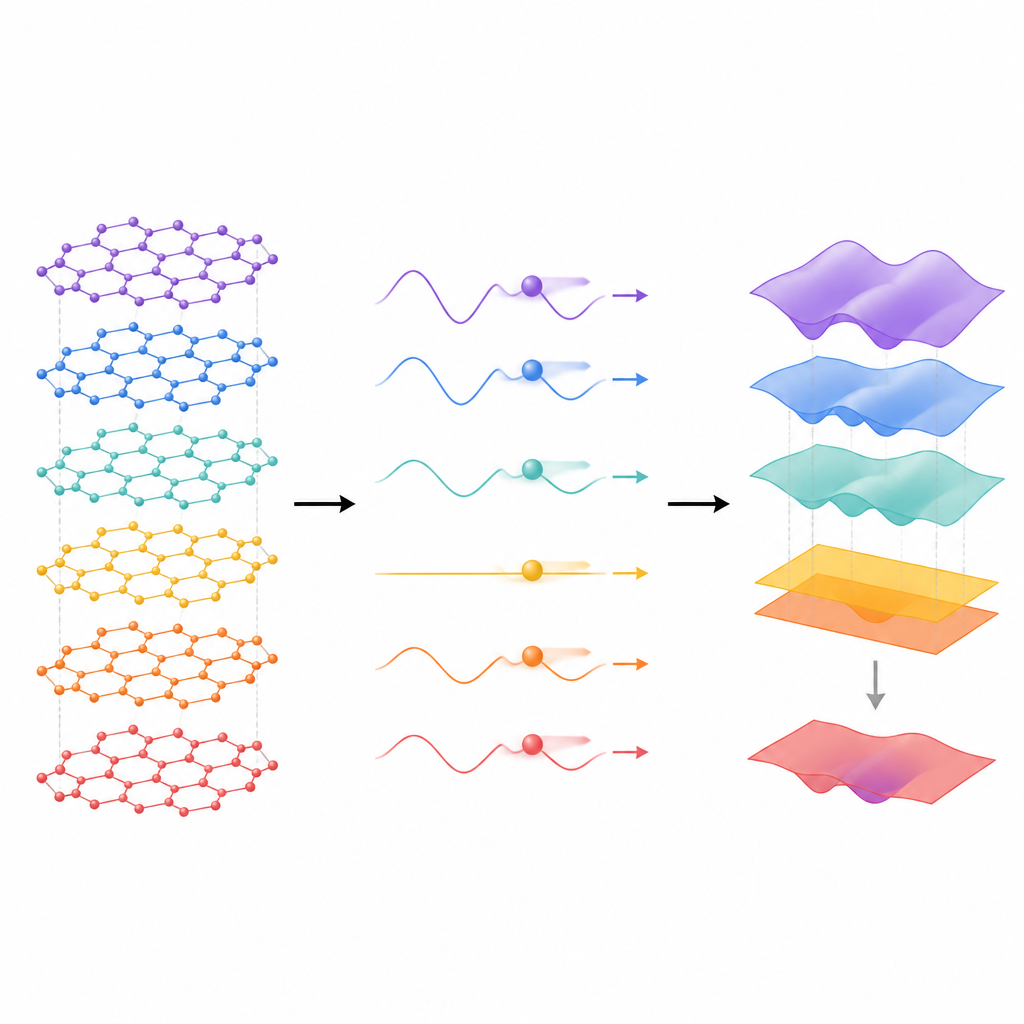
At the heart of YbCr6Ge6 lies a kagome lattice, a two dimensional network of corner sharing triangles built from chromium atoms. This geometry naturally frustrates the motion of electrons, producing special energy levels known as flat bands where electrons have almost no kinetic energy. Because many electron states pile up at the same energy, even modest interactions can have an outsized effect, making flat band systems fertile ground for unusual phases such as unconventional superconductivity, charge order, and exotic magnetism. In this compound the kagome flat band lies right at the Fermi level, the energy that determines how electrons participate in low temperature behavior.
Heavy electrons from hidden moments
YbCr6Ge6 is not just a kagome metal; it also contains ytterbium atoms between the kagome layers. The 4f electrons on ytterbium are localized and behave like tiny magnetic moments at high temperature. As the material is cooled, these local moments begin to interact with the mobile electrons in the kagome layers through a process known as Kondo hybridization. This interaction produces very heavy electron like quasiparticles and a second kind of flat band that extends throughout momentum space. Angle resolved photoemission spectroscopy, which images how electrons disperse in energy and momentum, reveals a momentum independent flat feature near the Fermi level that appears only at low temperature and is tied to the ytterbium sites, signaling the formation of Kondo resonance states.
Two flat bands sharing the same stage
The key finding is that the kagome flat band arising from chromium orbitals and the heavy fermion flat band from ytterbium coexist near the Fermi level within the experimental resolution. Detailed comparison between photoemission data and advanced calculations that combine density functional theory with dynamical mean field theory shows that the Yb 4f states are strongly renormalized by correlations and line up in energy with the kagome flat band as the system becomes coherent on cooling. The chromium bands also narrow, indicating that strong interactions affect not only the localized f electrons but also the conduction states of the kagome network. Together these effects create a landscape in which two types of flat electronic states overlap and influence each other.
Topology enters the picture
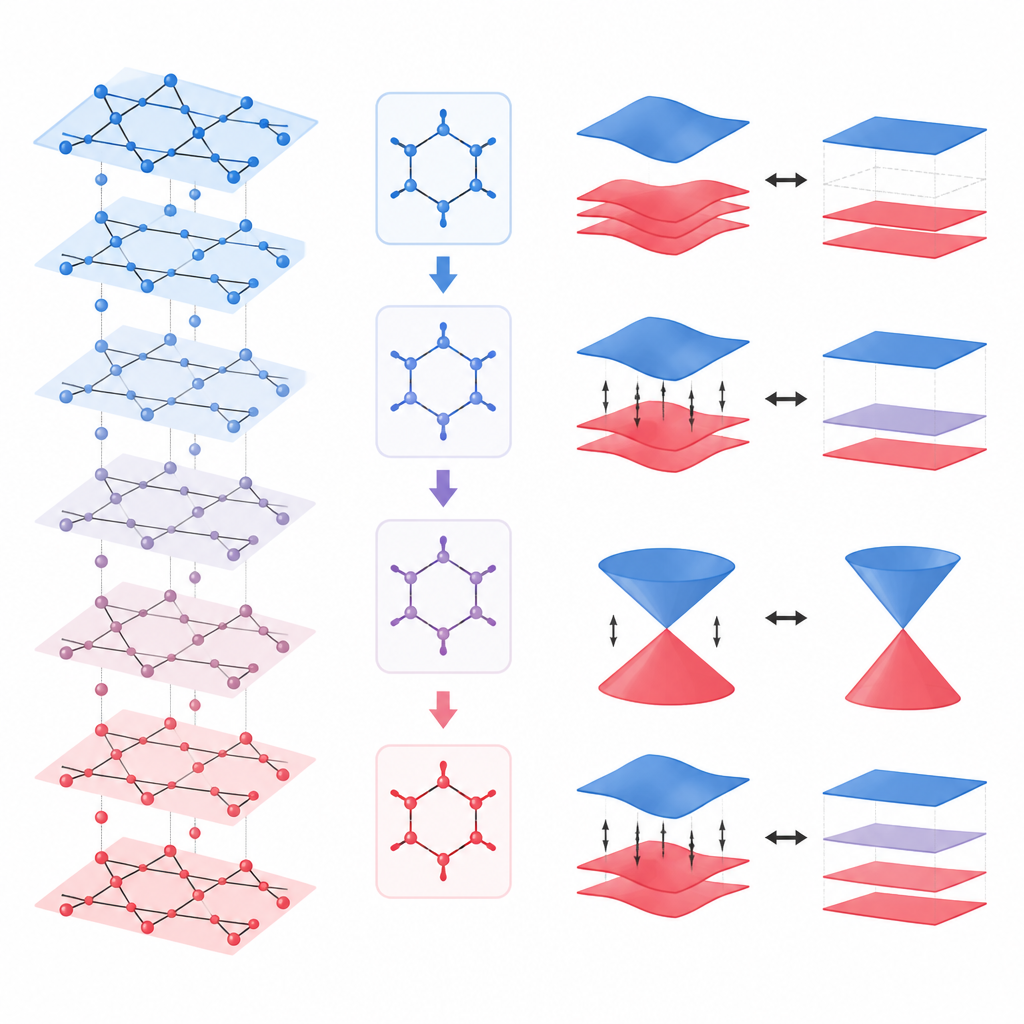
Because the crystal structure of YbCr6Ge6 respects inversion, mirror, and rotational symmetries, the combined band structure of kagome and Kondo derived states acquires nontrivial topological character. Theory shows that symmetry rules prevent the ytterbium and chromium bands from mixing along specific high symmetry directions in momentum space, forcing Dirac like crossings to remain gapless even as hybridization gaps open elsewhere. A careful analysis of parity eigenvalues at symmetry points indicates that different small shifts of the electron filling would place the system into weak or strong topological Kondo insulating regimes, or into a Dirac–Kondo semimetal phase in which heavy fermion Dirac quasiparticles coexist with insulating gaps.
What it all means
By demonstrating that a single material hosts both kagome flat bands and heavy fermion flat bands, and that their interplay produces symmetry protected topological features, this work identifies YbCr6Ge6 as a prototype topological heavy fermion system. For a lay reader, the message is that electrons in this crystal can be simultaneously slowed by geometry and by local magnetic moments, and that the way these effects weave together is governed by the symmetries of the lattice. This combination provides a versatile platform for exploring how strongly interacting, slow moving electrons can give rise to new quantum states that may ultimately inform future electronic and quantum information devices.
Citation: Lee, H., Lyi, C., Lee, T. et al. Coexisting kagome and heavy fermion flat bands in YbCr6Ge6. Nat Commun 17, 4165 (2026). https://doi.org/10.1038/s41467-026-70958-3
Keywords: kagome lattice, flat bands, heavy fermions, topological Kondo insulator, Dirac semimetal