Clear Sky Science · en
Intrinsic mechanisms and microenvironmental cues fine-tune plasticity of esophageal progenitors
When Heartburn Changes the Food Pipe
Chronic heartburn is more than a nuisance; over time, the harsh mix of acid and bile that washes into the lower esophagus can persuade its lining cells to reinvent themselves. This shape‑shifting helps the tissue cope with injury but can also set the stage for dangerous precancerous changes. This study explores how cells in the esophagus decide whether to stay put in their original identity or switch careers and how common medicines might gently push them toward the safer path.
Cells That Can Change Their Minds
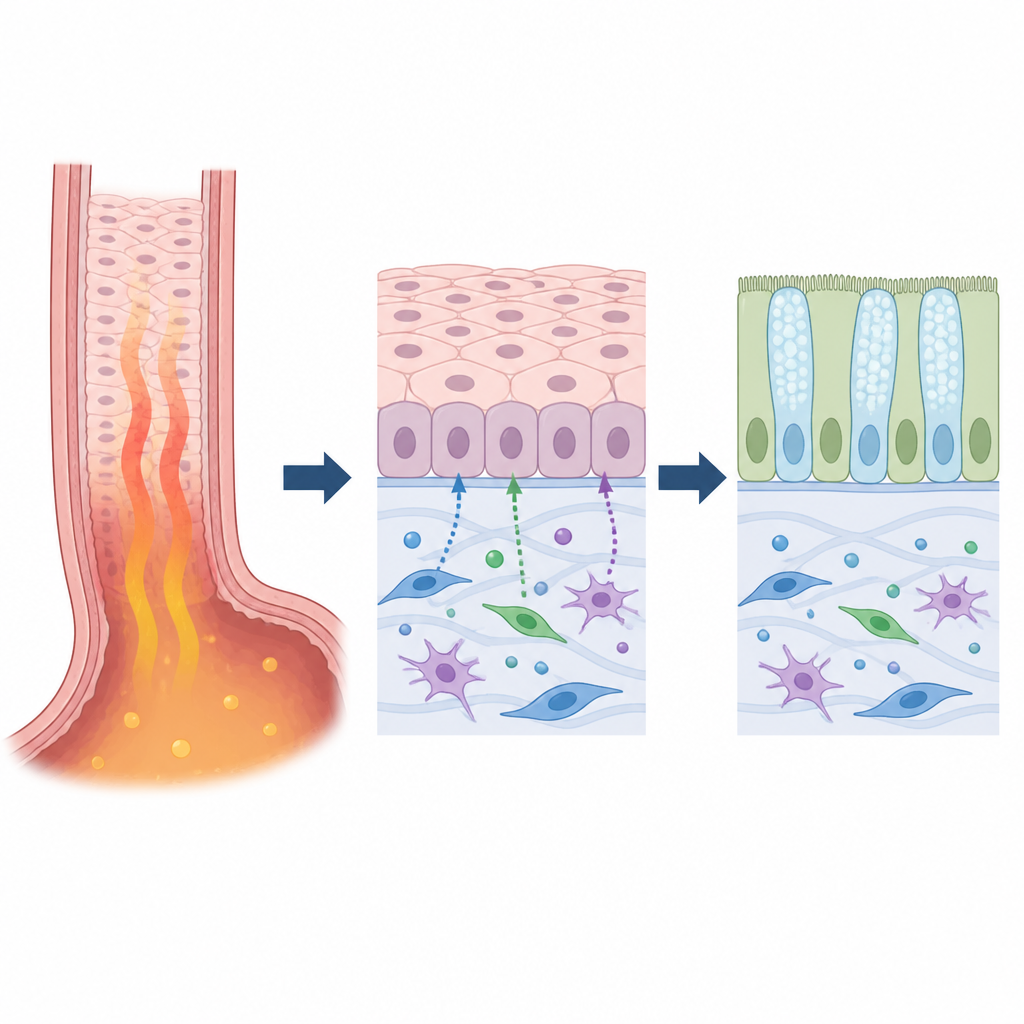
The inner surface of a healthy esophagus is built from flat, layered cells similar to skin. Under chronic irritation, some of these squamous cells can be replaced by taller, column‑shaped cells that resemble those in the intestine. This swap, called metaplasia, can protect against acid but also increases the risk of Barrett’s esophagus and, eventually, cancer. Earlier work showed that a developmental signal named Hedgehog, normally quiet in the adult esophagus, can be switched back on by long‑lasting reflux. When this happens, a gene called Sox9 lights up in certain progenitor cells, making them more flexible and prone to adopt columnar traits. The new study asks how this signal reaches Sox9 and what keeps that plastic state in check.
How the Neighborhood Talks to Esophageal Cells
Using mouse models, single‑cell RNA sequencing, and organoids grown from both mouse and human esophagus, the researchers show that Hedgehog does not flip Sox9 on directly. Instead, it remodels the local neighborhood around progenitor cells. Activated epithelial cells and surrounding fibroblasts alter the extracellular matrix and boost receptors and integrins that sense a family of signals called TGF‑beta and BMP. Immune cells in the area supply much of the TGF‑beta ligand. This combination leads to strong activation of TGF‑beta signaling inside basal progenitors, which in turn drives Sox9 production and nudges cells toward a more junction‑like, metaplasia‑prone identity, marked by proteins such as Keratin 7.
Fine Tuning by Partner Signals
In organoids, adding TGF‑beta alone was enough to raise Sox9 levels and start reprogramming esophageal cells away from their squamous fate. BMP signals, by contrast, could not start Sox9 on their own but made the TGF‑beta effect stronger and suppressed genes linked to normal squamous differentiation. When TGF‑beta and BMP were combined, organoids quickly adopted a gene profile similar to specialized progenitors found at the squamo‑columnar junction, the natural border between the esophagus and the stomach where metaplasia often arises. These cells kept some original features, such as the stem cell marker p63, but gained junction‑like traits, suggesting they were poised between healthy repair and risky transformation.
A Cell’s Internal Brake: COX‑2 and Common Painkillers
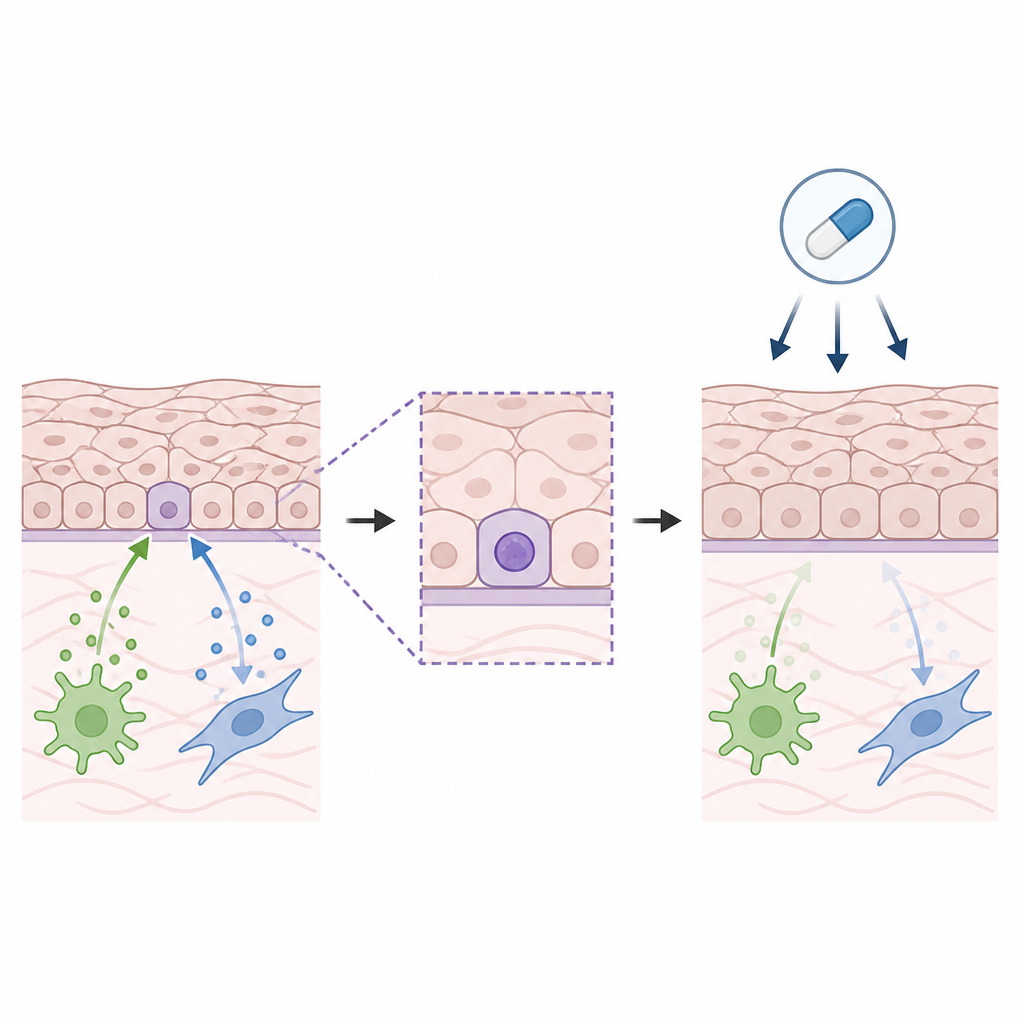
The team also uncovered an internal, cell‑autonomous lever that controls Sox9. When Hedgehog was activated in mice, esophageal epithelial cells sharply increased production of COX‑2, an enzyme best known for driving inflammation and as a target of many non‑steroidal anti‑inflammatory drugs (NSAIDs). Treating the mice with ibuprofen almost completely erased Sox9 protein and its partner marker Keratin 7 in the esophageal lining, even though the underlying Hedgehog and TGF‑beta signals were still detectable. In organoids, ibuprofen and a more selective COX‑2 inhibitor, celecoxib, prevented TGF‑beta/BMP from maintaining Sox9 protein, not by lowering its gene activity but by making the protein less stable and more prone to degradation.
What This Means for People With Chronic Reflux
Taken together, the work outlines a two‑layer system that governs how esophageal progenitor cells respond to chronic injury. Signals from the surrounding tissue activate TGF‑beta and BMP pathways that switch on Sox9 and loosen cell identity, while COX‑2 inside the cells helps keep Sox9 protein in place. Blocking COX‑2 with commonly used drugs can tilt the balance back toward the original squamous lining, at least in laboratory models from mice and humans. Although this is not a treatment guideline, it offers proof of concept that controlling cell plasticity itself, rather than only removing damaged tissue, could one day complement existing therapies aimed at preventing or treating metaplasia in patients with severe reflux.
Citation: Descampe, L., Dassy, B., Charara, F. et al. Intrinsic mechanisms and microenvironmental cues fine-tune plasticity of esophageal progenitors. Nat Commun 17, 4268 (2026). https://doi.org/10.1038/s41467-026-70957-4
Keywords: esophagus, cell plasticity, metaplasia, TGF-beta BMP signaling, COX-2 inhibitors