Clear Sky Science · en
Multi-layered marble for hydrogel encapsulation
Why wrapping soft gels matters
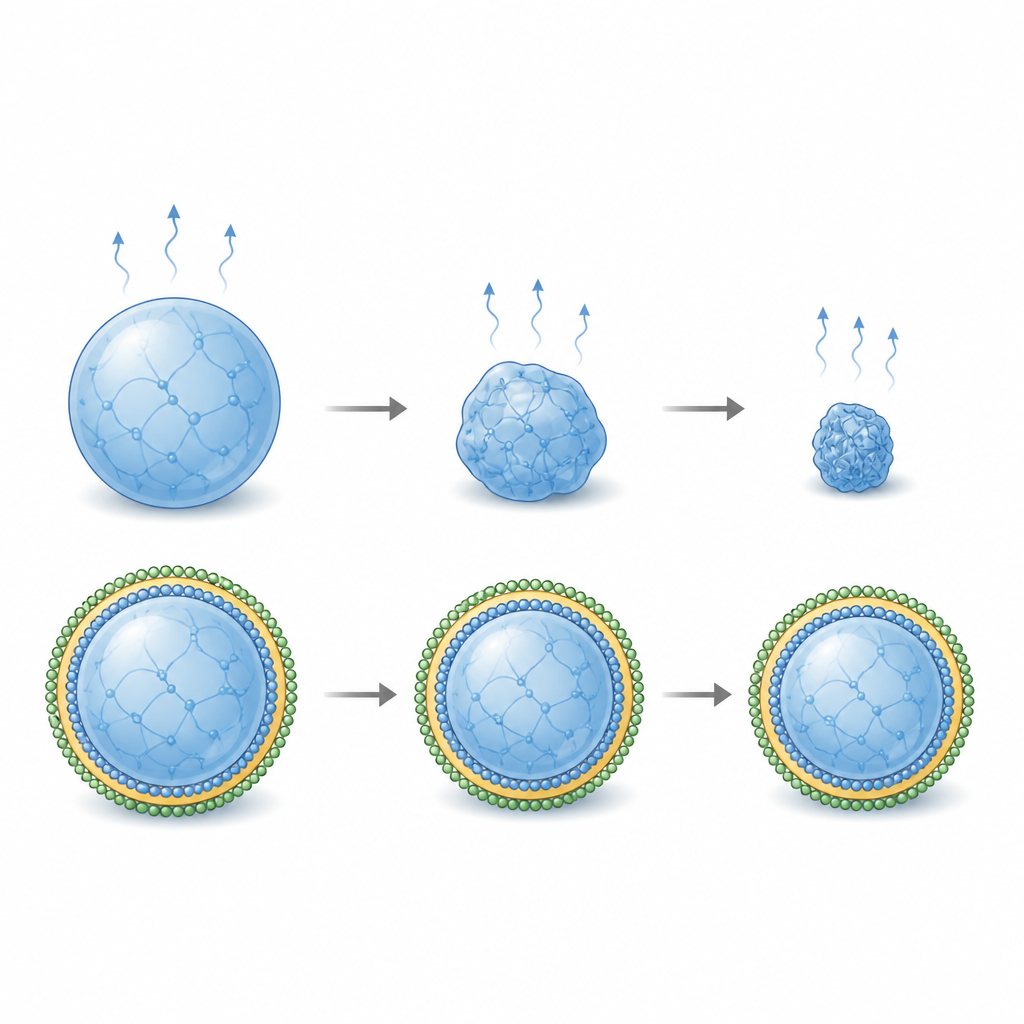
From soft robots to cosmetic patches and cell-filled scaffolds, many emerging technologies rely on squishy, water-rich materials called hydrogels. Their weakness is the same thing that makes them useful: because they are mostly water, they dry out quickly and are easily damaged by their surroundings. This study introduces a simple way to wrap hydrogels in a protective "skin" that keeps them moist and functional in air and even in harsh liquids, opening doors to longer lasting soft devices and living cell systems outside the lab.
A fruit-inspired protective skin
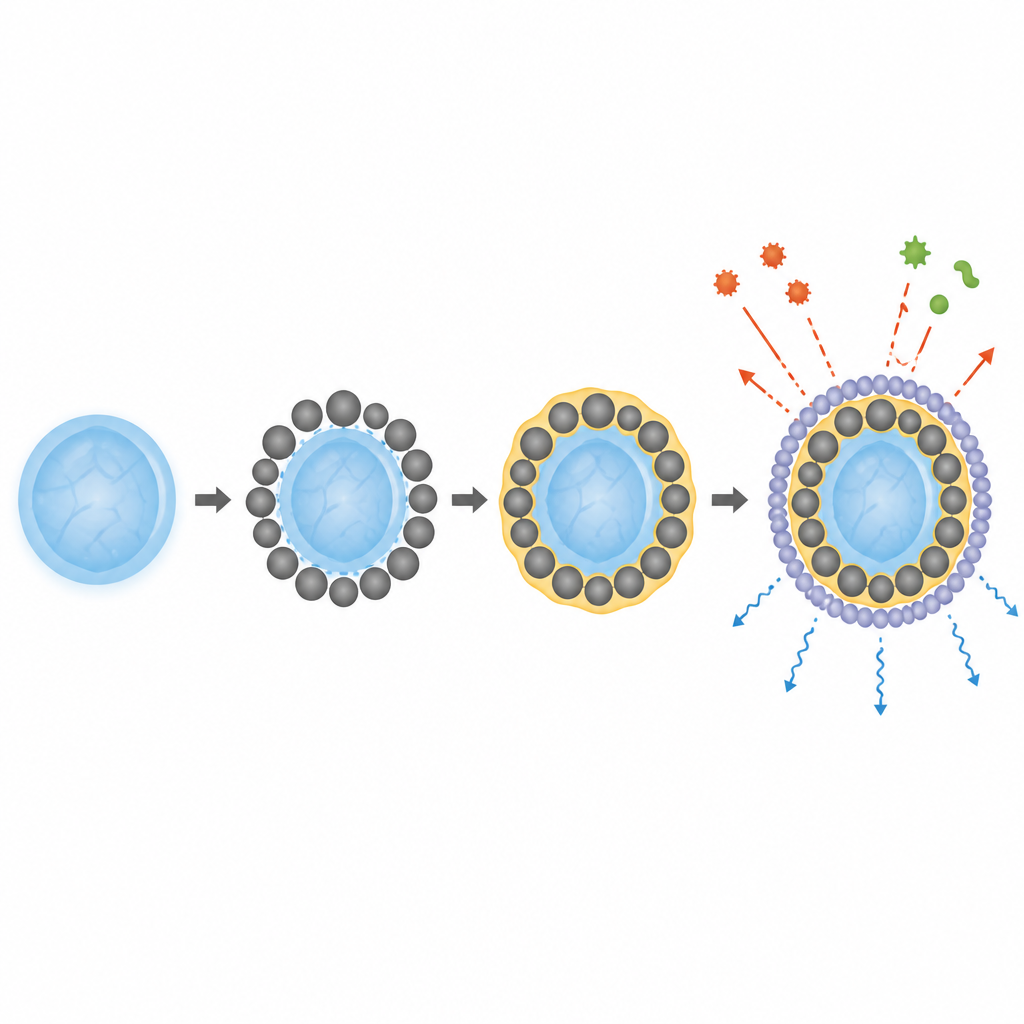
The authors take inspiration from nature, where fruits and animal skin use oily outer layers to shield delicate, water-filled tissue inside. They adapt a concept known as a liquid marble, in which a droplet is coated with tiny water-repelling particles so it can roll around without wetting a surface. Building on this idea, they design a multi-layered marble shell for hydrogels. First, relatively large particles whose surfaces like both water and oil stick to the moist gel surface, forming a loose jacket. Oil poured over this jacket is drawn into the gaps between particles and spreads into a thin, continuous film. Finally, a second coat of smaller, highly oil-repelling particles locks the oil layer in place and turns the outside back into a solid-feeling surface.
How the marble shell keeps water inside
This three-layer shell acts like a flexible raincoat for the gel. The inner particle layer helps oil wet the otherwise stubborn, water-soaked surface, while the outer layer stops the oil from leaking away. The researchers show that the oil is pulled between particles by capillary forces and a subtle "meniscus pumping" effect, allowing it to cover the entire gel without special equipment or harsh processing. Once formed, the shell traps water vapor, so the gel barely shrinks even after days in dry air. In tests with several common oils and many different gel chemistries, the coated gels retained most of their weight, while uncoated gels shriveled within hours. Even gels shaped into letters kept their original form when protected by the shell.
Soft, long-lived, and still accessible
Unlike many previous coatings that rely on thick or stiff plastics, this shell stays mostly liquid and mobile, so it hardly changes how the gel bends or stretches. Mechanical tests show that freshly wrapped gels feel almost as soft as bare ones, but, unlike unprotected samples, they do not stiffen over a week in air. The mobile shell can also heal itself after being pierced. A fine needle can inject new ingredients into the gel, and when it is removed the oily layers flow back together, restoring the barrier. The team demonstrates this by turning a wrapped gel into a tiny chemical "factory" in which enzymes fixed inside the gel process sugar injected from outside, visibly changing color while the shell reseals around it.
From flexible coat to solid armor
For situations that demand more toughness, the middle oil layer can be turned into a solid. The researchers either crosslink a light-sensitive oil into a plastic-like film or use warm wax that later cools and hardens. This rigid version creates a grape-like structure, with a firm, water-shedding shell around a soft interior. It can support weight, float as a small boat steered by a magnet, and block dyes and solvents, including ethanol, from reaching the gel. Remarkably, when living skin cells are embedded in a gel and wrapped in this hardened shell, they survive exposure to ethanol that instantly kills cells in unprotected gels, because the solvent cannot penetrate the coating.
What this means for future soft devices
By combining simple steps and ingredients, the multi-layered marble shell offers a general way to protect almost any hydrogel without sacrificing its softness or function. The coating can be tuned from fluid to rigid, removed without damage, and even opened and reclosed for on-demand access. For a lay reader, the key message is that we now have a fruit-skin-like wrapping for water-rich materials: it keeps them from drying out, shields them from harsh environments, and still lets us interact with what is inside. This could help soft robots work longer in air, enable portable cell-based systems, and support tiny self-contained reactors for chemical and biological processes.
Citation: Kim, H., Jang, S.Y., Lee, J.E. et al. Multi-layered marble for hydrogel encapsulation. Nat Commun 17, 4375 (2026). https://doi.org/10.1038/s41467-026-70955-6
Keywords: hydrogel encapsulation, liquid marble, anti-dehydration, soft actuators, cell storage