Clear Sky Science · en
A single-atom potential confinement strategy for stabilizing rhodium nanocatalysts in methane oxidation
Cleaning up methane from engines
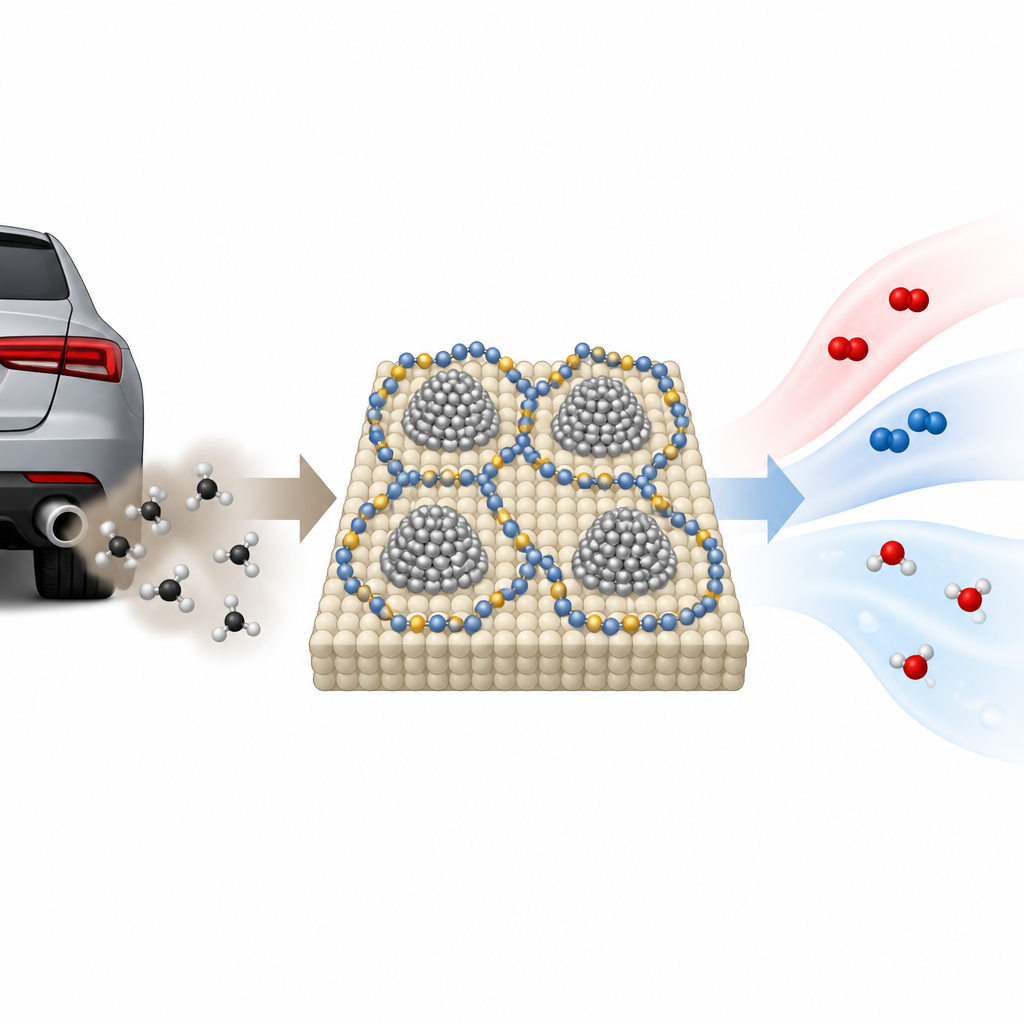
Car and truck exhaust does not just contain carbon dioxide; it can also carry unburned methane, a powerful greenhouse gas. To remove methane before it reaches the air, automakers rely on tiny metal particles called catalysts. These particles work hard in hot, oxygen rich exhaust, but the same harsh conditions that make them useful also tend to wear them out. This study explores a simple way to keep such catalysts in shape for longer so they can better help clean the air.
Why tiny metal particles matter
Modern exhaust cleanup systems often use noble metals like rhodium in the form of nanoparticles, clusters only a few billionths of a meter across. Their small size gives them many active surface spots where methane can land and react. However, when these particles operate at the high temperatures and shifting gas mixtures found in real engines, they tend to change their structure. They can clump into larger, less active chunks, or they can fall apart into isolated single atoms scattered on the support material. In both cases, the original high activity is lost, and more of the expensive metal is needed to do the same job.
Turning a weakness into a shield
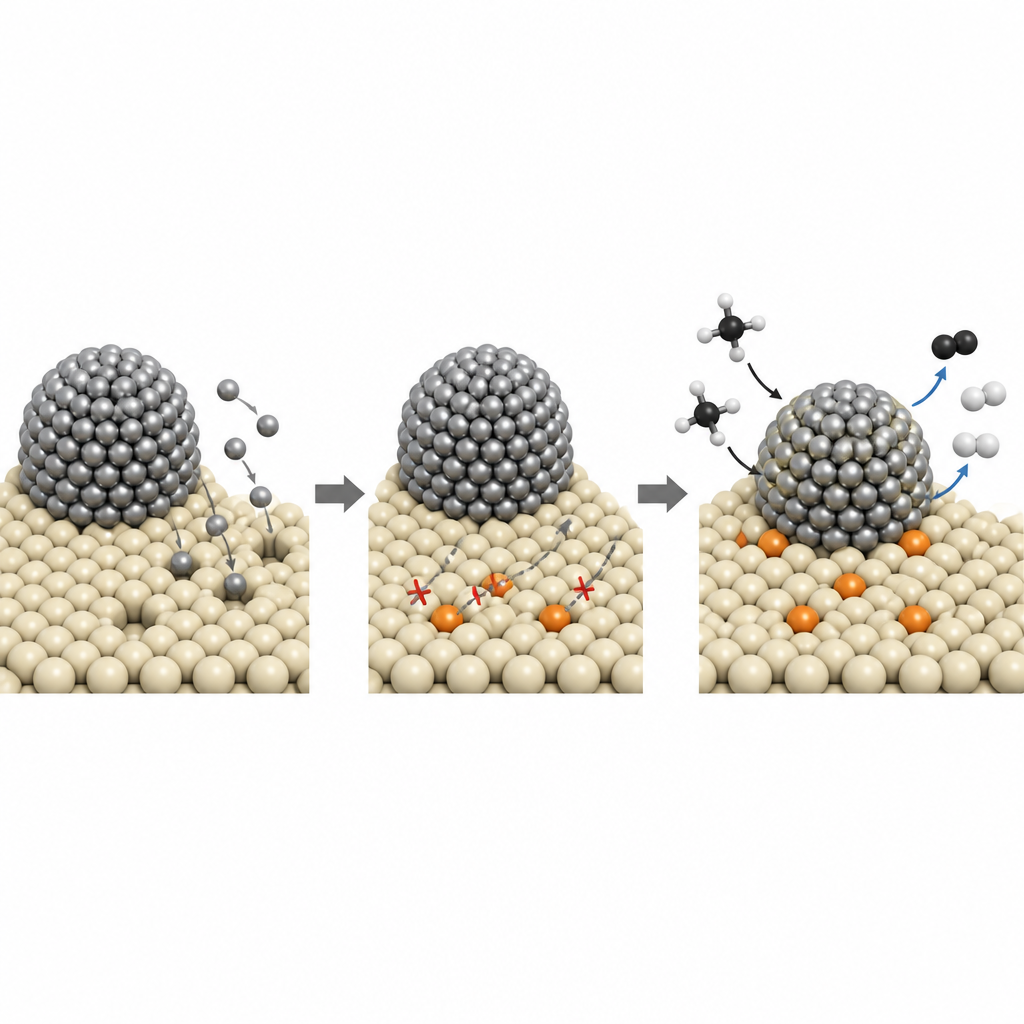
The authors realized that the tendency of single metal atoms to lock into tiny defects on the surface of the support could be used in a different way. Normally, when a nanoparticle sheds atoms, those atoms travel across the surface and settle into these defects, becoming very stable single atom sites. Here, the team asked what would happen if they filled those defect spots in advance with other atoms. Computer calculations showed that once a vacancy site is already occupied by a single atom, it becomes energetically unfavorable for extra rhodium atoms to settle there. In effect, a ring of pre anchored atoms around the nanoparticles builds an invisible energy fence that discourages more atoms from escaping and getting trapped.
Watching catalysts survive the heat
To test this idea, the researchers built rhodium on cerium oxide catalysts with and without this single atom confinement. In some samples, they first anchored single rhodium or cheaper zirconium atoms into surface defects, then placed rhodium nanoparticles on top. All the catalysts initially lit off methane around 200 degrees Celsius, similar to leading commercial materials. The real difference appeared after heating them to 800 degrees Celsius in gas mixtures that mimic engine exhaust. Using advanced electron microscopes that can operate under reacting conditions, the team saw that ordinary catalysts lost their nanoparticles; the metal had dispersed into isolated atoms. In contrast, the catalysts with pre anchored single atoms retained their nanoparticle structure and kept their low temperature activity after aging.
How nanoparticles and single atoms behave differently
Beyond simply tracking structure, the study probed why nanoparticles and single atoms perform so differently. Using quantum mechanical calculations, the authors showed that rhodium nanoparticles on cerium oxide behave like small pieces of metal, with electrons that can move easily through the cluster. This electronic flexibility helps them split the first carbon hydrogen bond in methane with a relatively low energy barrier, which is crucial for starting the reaction at moderate temperature. By contrast, isolated rhodium atoms bound in defects interact strongly with the support and do not accept electrons from methane as readily; the surrounding cerium atoms end up doing more of the work. As a result, methane activation over pure single atom sites requires higher temperatures and resembles the behavior of the bare support rather than a metal catalyst.
Making cleaner air more affordable
Because rhodium is expensive, the team explored whether less costly metals could provide the protective fence while rhodium nanoparticles do the actual chemistry. They showed that single zirconium atoms anchored in the same way also block nanoparticle breakup and preserve methane conversion, even after severe heating. This suggests that the single atoms mainly act as guardians of the surface rather than as active reaction centers. The overall picture is that carefully placed single atoms reshape the energy landscape at the catalyst surface so that nanoparticles remain intact, active, and efficient. For non specialists, the takeaway is that by learning how individual atoms move and settle on surfaces, researchers can design smarter catalysts that clean engine exhaust more effectively and last longer, without simply pouring in more precious metals.
Citation: Xu, C., Wang, ZQ., Qin, T. et al. A single-atom potential confinement strategy for stabilizing rhodium nanocatalysts in methane oxidation. Nat Commun 17, 4459 (2026). https://doi.org/10.1038/s41467-026-70954-7
Keywords: methane oxidation, rhodium nanoparticles, single-atom catalysts, ceria support, exhaust emission control