Clear Sky Science · en
Small-molecule binding and sensing with a designed protein family
Why building custom molecule catchers matters
Our bodies and environment are full of small molecules, from stress hormones like cortisol to drugs and pollutants. Measuring these tiny chemicals usually requires complex lab tests built around natural proteins found by trial and error. This study shows that it is now possible to design new proteins from scratch that latch onto chosen small molecules and convert that binding into a clear, usable signal. Such made-to-order "molecule catchers" could eventually power quick tests for health, safety, and research.
Designing a new family of tiny pockets
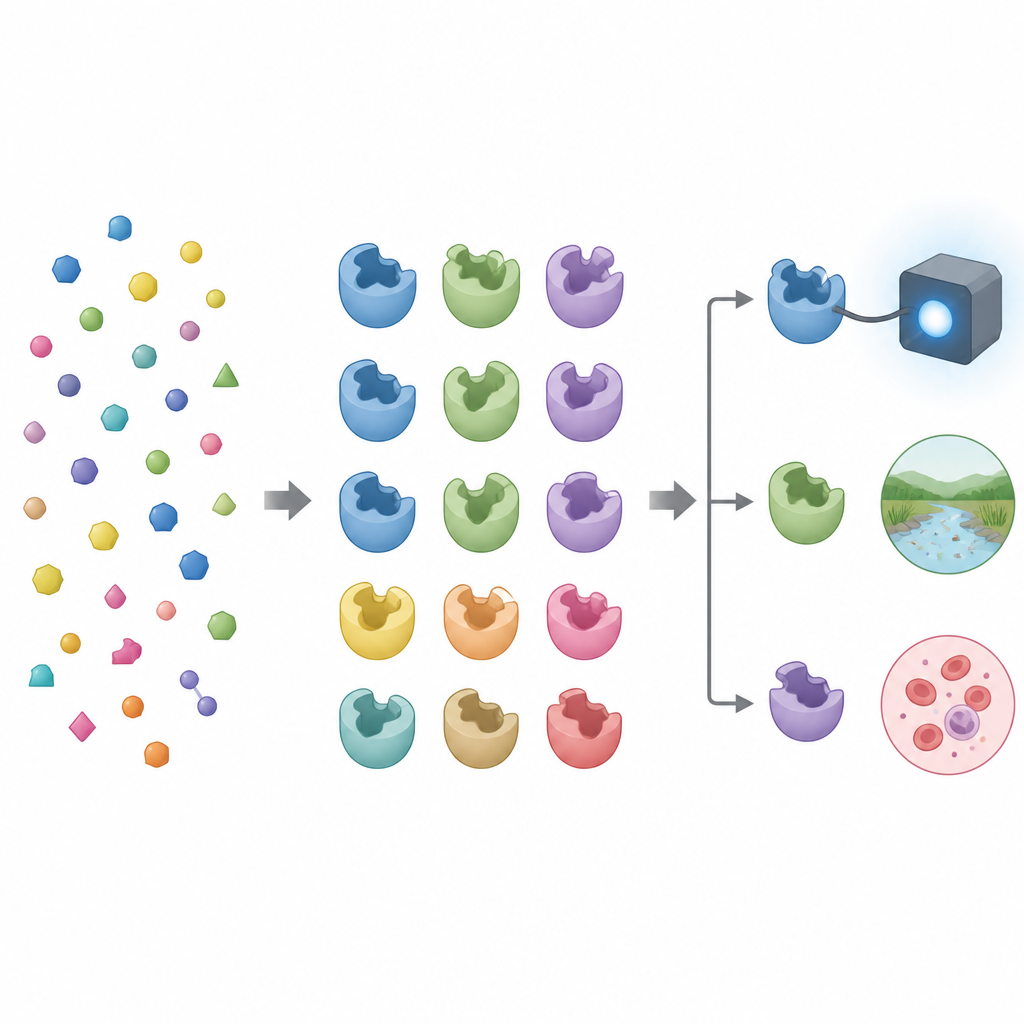
The researchers began by focusing on a natural protein shape known for having a roomy inner pocket. Instead of copying existing examples, they used deep learning and physics-based tools to dream up more than ten thousand new proteins with this same basic shape but with pockets of many sizes and contours. These pockets were kept compact and simple so they could be reused like building blocks. The goal was to create a flexible family of protein shells that could be tuned to fit many different small molecules.
Teaching proteins to grab specific molecules
Next, the team asked which of these new pockets could tightly hold real-world targets, including a stress hormone, blood-thinning drugs, a muscle relaxant, an anti-cancer compound, and a related hormone. Computer programs first placed three-dimensional models of each molecule into the pockets, searching for a snug fit and favorable chemical contacts. A second set of neural networks then suggested the exact amino acid sequences that would fold into the desired pockets while forming strong hydrogen bonds and other interactions with each target. From tens of thousands of designs, the best candidates were selected using energy calculations and structure predictions.
Testing the catchers in living cells and test tubes
To see which designs worked in practice, the scientists displayed the proteins on the surface of yeast cells and flowed in fluorescent versions of the target molecules. After several rounds of sorting, they recovered dozens of designed proteins that bound each target. Purified versions of the most promising binders showed nanomolar to micromolar binding strengths, meaning they grabbed their molecules very tightly. Structural studies using X-ray crystallography revealed that, in some cases, the real protein–molecule complexes matched the computer designs with nearly atom-by-atom precision, confirming that the design strategy was highly accurate.
Turning a binding event into a useful signal
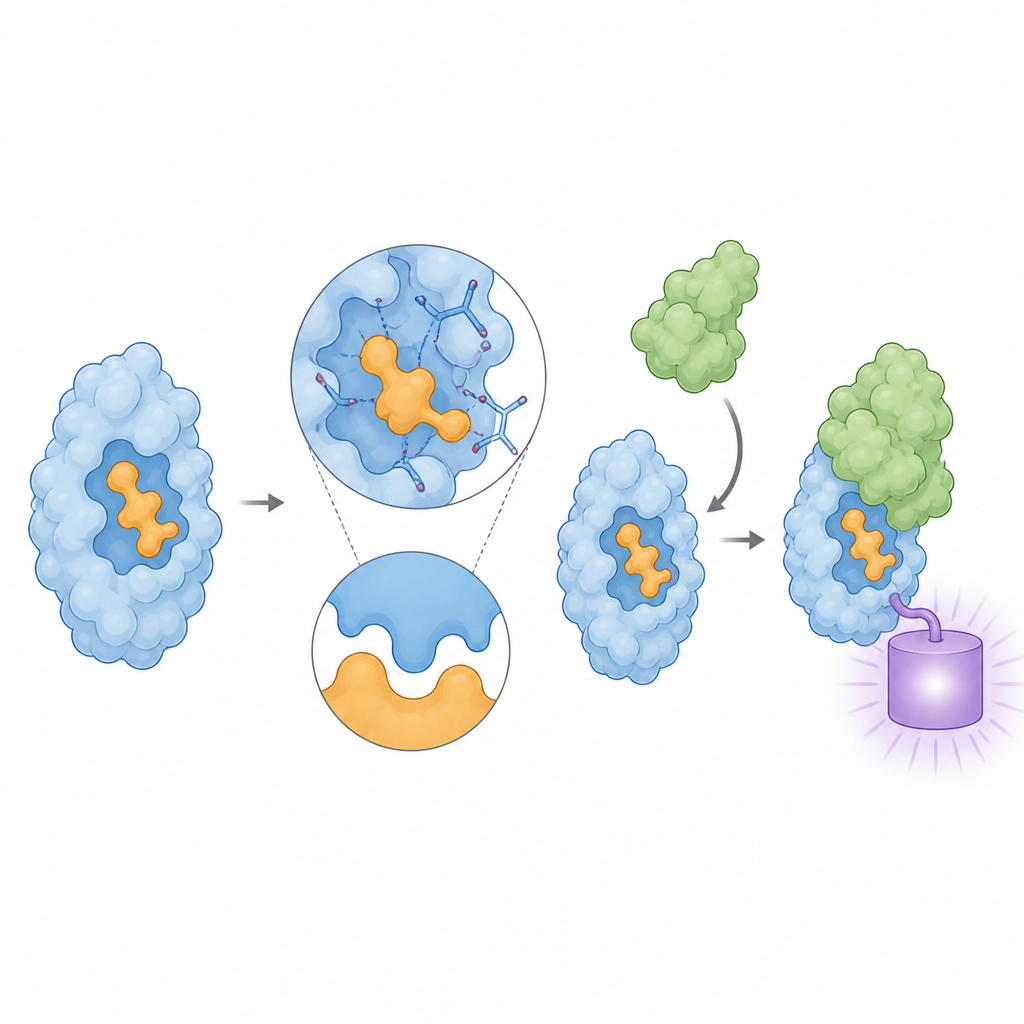
Binding alone is not enough for sensing; the protein must also trigger a readable output. The team focused on their best cortisol binder and improved it further with targeted mutations, achieving sensitivity in the range of hormone levels found in human blood. They then engineered a second small protein that only attaches when cortisol is nestled in the first protein’s pocket. When these two proteins were fused to halves of a split light-producing enzyme, the presence of cortisol drew the halves together and switched on a bright signal. This simple, modular setup acted as a prototype biosensor for cortisol.
What this work means for future tests
The study demonstrates that researchers can now design whole families of proteins that recognize chosen small molecules with high precision and convert that recognition into a measurable change. Although sensitivity and specificity still need improvement for some targets, especially very similar or very greasy molecules, the approach lays groundwork for customizable sensors. In the future, it may be possible to create rapid tests for a wide variety of hormones, drugs, and environmental chemicals simply by redesigning the pocket and connections within this versatile protein family.
Citation: Lee, G.R., Pellock, S.J., Norn, C. et al. Small-molecule binding and sensing with a designed protein family. Nat Commun 17, 4533 (2026). https://doi.org/10.1038/s41467-026-70953-8
Keywords: protein design, small molecule sensing, biosensor, cortisol detection, deep learning