Clear Sky Science · en
Ultrasensitive photodetectors enabled by pressure-induced atomic-level optimization of graphene-based heterojunctions
Seeing More with Less Light
Imagine a camera or robot hand that can clearly sense its surroundings using only the light of dawn or even dim moonlight. This study introduces a new kind of light sensor that does exactly that, by combining very thin carbon-based sheets with dye-like molecules and gently squeezing them together. The result is a soft, flexible device that can detect extremely weak light and subtle touch, opening the door to smarter electronic skin for robots, low-light imaging, and other advanced sensing tools.
A New Way to Build Light Sensors
Light sensors, or photodetectors, turn light into electrical signals and are used in everything from medical imaging to night vision and self-driving cars. Designers want these devices to respond strongly even when the incoming light is very faint. The researchers tackled this challenge using a simple but clever design: they mixed flat copper phthalocyanine molecules, which are very good at absorbing light, with equally flat sheets of graphene oxide, a carbon-based material that can carry away electrical charges. When these ingredients dry together, they form a thin, layered membrane that can be wired up as a photodetector.
Gently Squeezing Atoms into Place
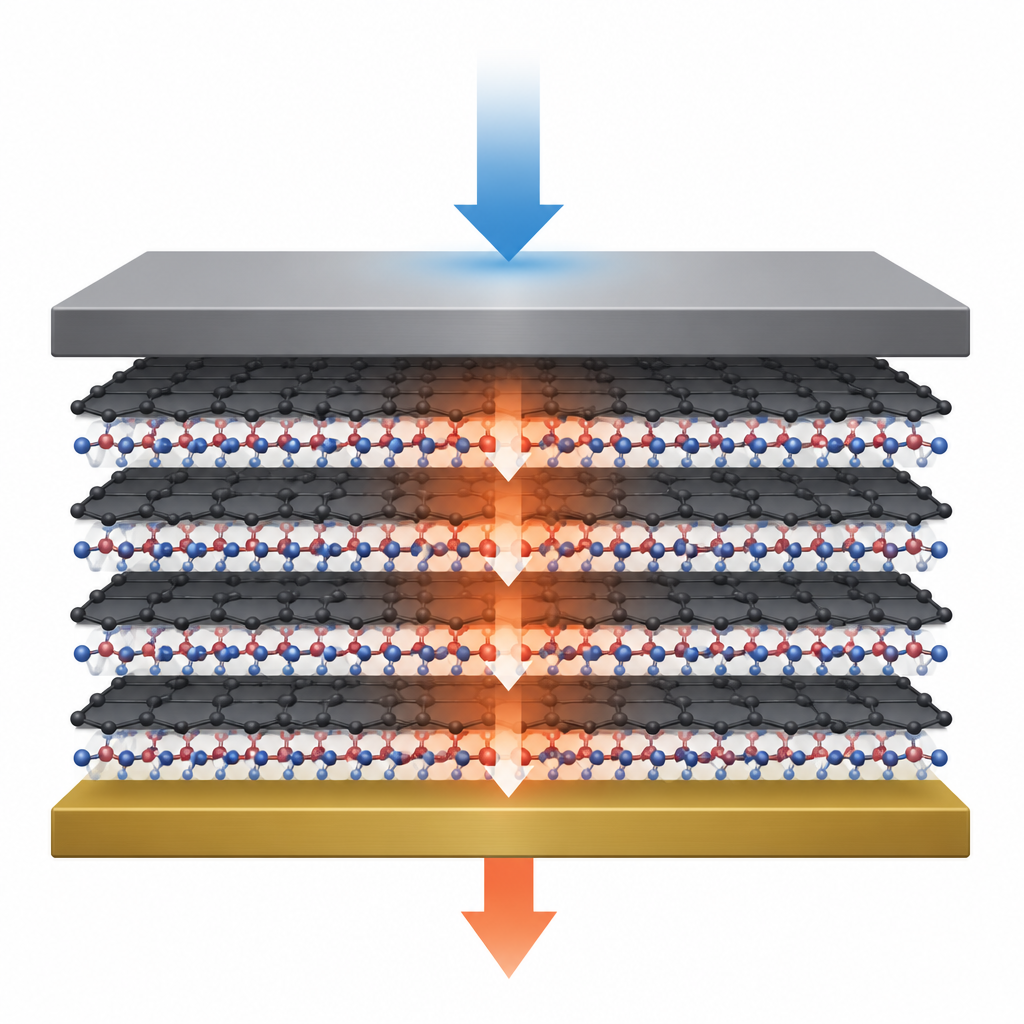
The key twist is that the team improved the device performance not by changing its chemistry, but by physically pressing on the membrane. Because both the light-absorbing molecules and the graphene oxide sheets are flat, a modest pressure comparable to a few times normal air pressure pushes them closer together and makes the layers pack more tightly. X-ray measurements and electron microscopy showed that the spacing between layers shrinks and that more of the flat rings in the molecules stack neatly against the carbon sheets. This tighter stacking improves how easily electrical charges can hop from molecule to sheet and then move through the whole structure.
From Tiny Charge Jumps to Huge Signals
To see what happens inside the material after it absorbs light, the researchers used ultrafast laser techniques and computer simulations. These showed that, once pressed, charges are created and transferred across the layers in trillionths of a second, and they move more efficiently between sheets. Calculations confirmed that at shorter distances the electronic states of the molecules and sheets blend together, forming smoother pathways for charge flow. In practical tests, this translated into a light response more than one hundred thousand to one million times stronger than the unpressed version, with a detectable limit down to about one ten-billionth of a watt of light. The device also responds much faster, switching on and off in microseconds.
Turning Sensors into Electronic Skin
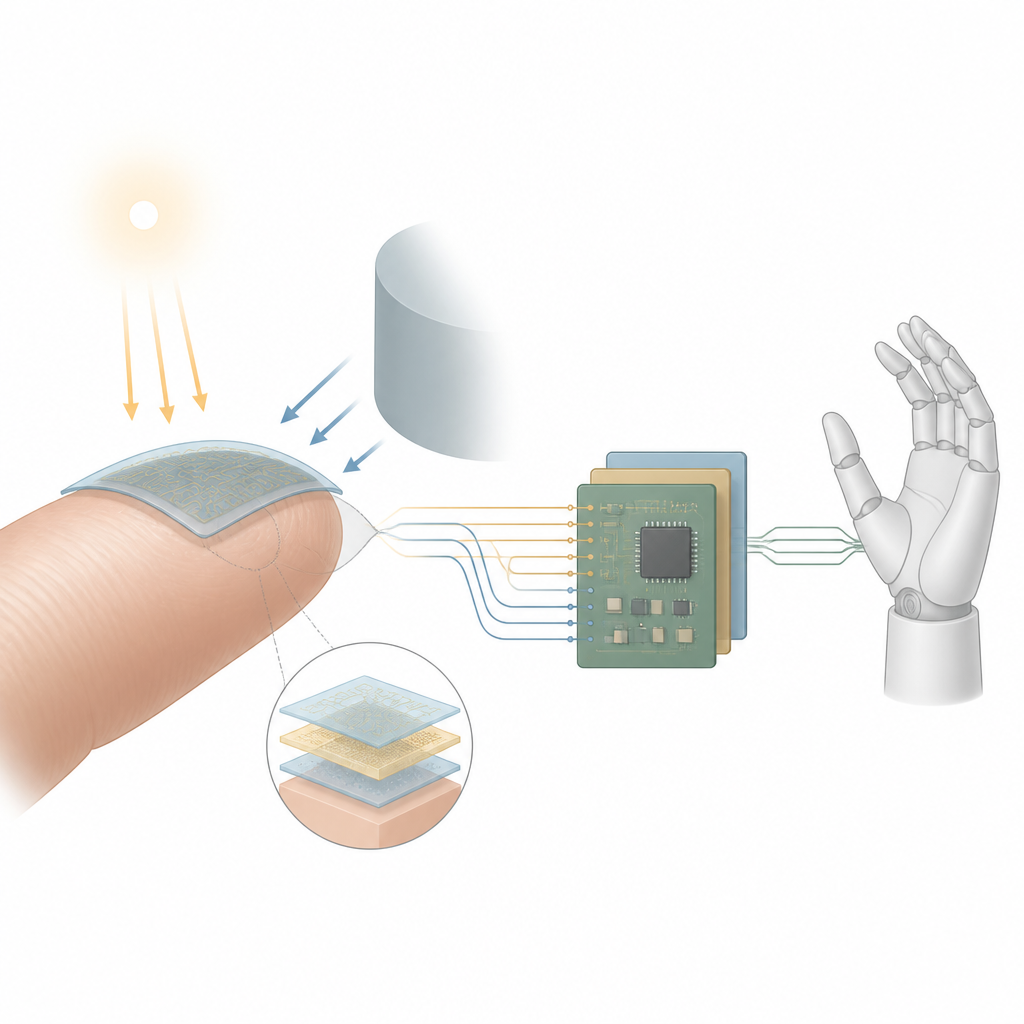
Because the membrane is thin and bendable, the team built it into a flexible patch that can act as electronic skin. This patch can work in two modes at once. Without touching anything, it can notice when an object approaches because the object blocks some of the incoming light, changing the sensor’s current. When the patch makes contact, the same layered material also responds to pressure, giving an extra jump in signal. In tests under dim room-like light and even under moonlight-like levels, the electronic skin could sense object distance, shape, and hardness, and guide a robotic hand to gently approach, grasp, and release delicate items like a banana or an egg without crushing them.
Why This Matters
This work shows that carefully squeezing a layered material can tune its structure at the level of individual molecules and dramatically boost how well it converts light into electrical signals. The result is an ultrasensitive yet simple photodetector that works across a wide range of colors and light strengths, all while remaining flexible enough to act as electronic skin. Because the fabrication uses straightforward drop-casting and moderate pressure, the same idea could be scaled up and adapted to other molecule and carbon combinations, helping create future low-light cameras, smart robots, and other devices that can sense their surroundings with very little energy.
Citation: Fang, Z., Wang, J., Liu, W. et al. Ultrasensitive photodetectors enabled by pressure-induced atomic-level optimization of graphene-based heterojunctions. Nat Commun 17, 4339 (2026). https://doi.org/10.1038/s41467-026-70950-x
Keywords: photodetector, graphene oxide, electronic skin, low light sensing, flexible electronics