Clear Sky Science · en
Room temperature collective blinking and photon bunching from CsPbBr3 quantum dot superlattice
Light that Blinks in Unison
Quantum technologies such as secure communication and advanced sensing rely on special forms of light made of carefully correlated photons. This study shows that tiny crystals called perovskite quantum dots, when neatly packed into ordered clusters, can act together to emit bursts of light with unusual timing at ordinary room temperature, opening a path toward more practical quantum light sources.
Tiny Building Blocks, Ordered into a Bigger Structure
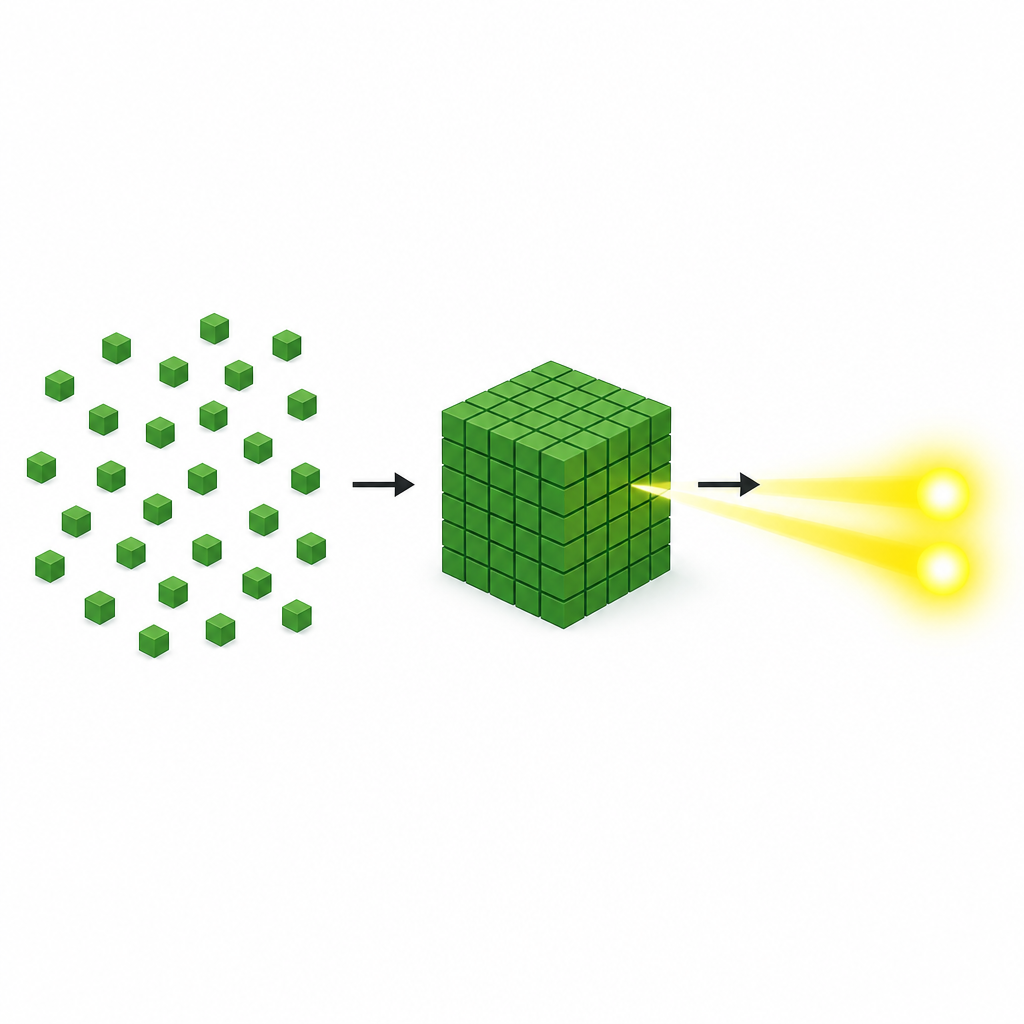
The researchers work with cesium lead bromide quantum dots, nanometer-sized crystals that already serve as bright light sources in many experiments. Instead of studying them one by one, the team lets these dots self-assemble into orderly cubes, known as superlattices, that measure only 100 to 500 nanometers across, smaller than the wavelength of visible light. Microscopy and color measurements show that these particles are not single large crystals but regular arrays of many nearly identical dots, each still behaving as a confined quantum object.
When Many Emitters Behave Like One
Under gentle ultraviolet illumination, single superlattices do something surprising. Their brightness jumps between a very bright state and a dim “grey” state, much like a single blinking quantum dot, but now the whole structure brightens and dims together. More than ninety five percent of the superlattices display this collective blinking, and the bright state can emit over one hundred times more light than a single dot. Random clumps of dots of similar overall size do not show this behavior, which indicates that the ordered structure lets the many emitters act in a coordinated way instead of independently.
Photon Pairs and a Hidden Emission Hotspot
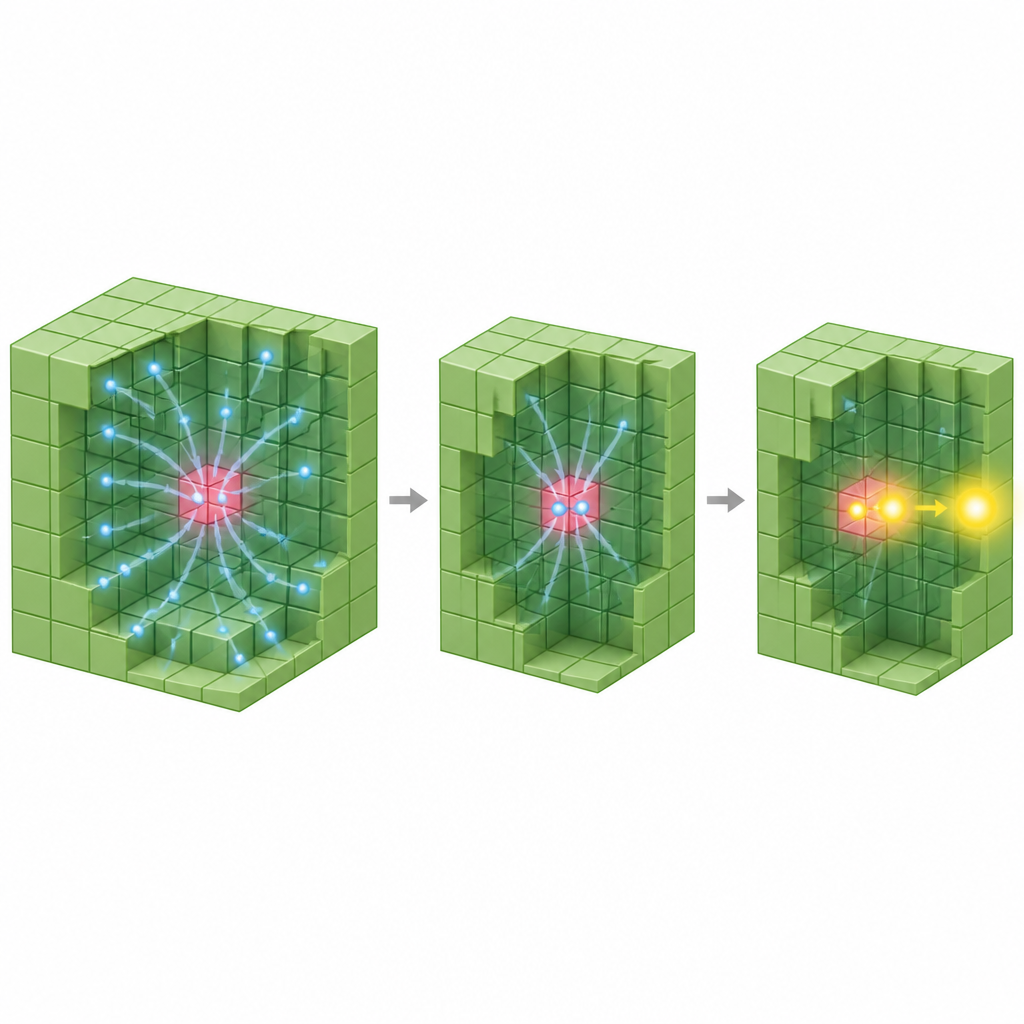
To probe how the light leaves these superlattices, the team measures the arrival times of individual photons. They find that photons tend to come in closely spaced pairs, a feature known as photon bunching, and the strength of this effect can reach nearly four times the random level. High resolution imaging reveals that, although light is absorbed throughout the superlattice, most of the emission comes from a tiny region only twenty to thirty nanometers across inside the cube. This suggests that energy moves through the structure and is funneled into a single low energy site that acts as a common emission center for the whole assembly.
Energy Migration and Cascade Emission
Based on timing, power dependence, and color data, the authors propose a detailed picture of what happens inside the superlattice. When light is absorbed, individual excitations are created in many dots and then migrate through the array until they reach the localized emission site. There, the local density of excitations can become high enough for pairs of excitations, called biexcitons, to form. These biexcitons relax in two steps, emitting a photon at each step in a rapid cascade. This cascade naturally produces photon bunching, and its strength decreases as the excitation power rises, exactly as observed in the experiments and distinct from other collective effects such as superfluorescence.
Why This Matters for Future Quantum Devices
In simple terms, the study shows that carefully arranged clusters of perovskite quantum dots can gather energy from across their volume and release it from a tiny internal hotspot, where paired excitations generate closely timed photon pairs even at room temperature. This collective behavior, combining energy funneling, synchronized blinking, and cascade emission, makes such superlattices an attractive platform for creating practical quantum light sources and for exploring how many tiny emitters can be made to behave as a single, tunable quantum system.
Citation: Tan, Q., Seth, S., Louis, B. et al. Room temperature collective blinking and photon bunching from CsPbBr3 quantum dot superlattice. Nat Commun 17, 4536 (2026). https://doi.org/10.1038/s41467-026-70931-0
Keywords: quantum dots, perovskite superlattices, photon bunching, exciton migration, quantum light sources
See more on the researcher's website: http://vacha.mat.mac.titech.ac.jp/