Clear Sky Science · en
Mad1 facilitates α5 integrin trafficking from the Golgi to promote abscission during cytokinesis
How cells finish the job of dividing
Every second, countless cells in our bodies split in two. This process must be flawless, because failed division can create abnormal cells that contribute to disease, including cancer. This study uncovers how a well-known cell cycle protein, Mad1, teams up with a cell “grip” molecule called α5 integrin to help cells complete the final pinch that separates one cell into two.
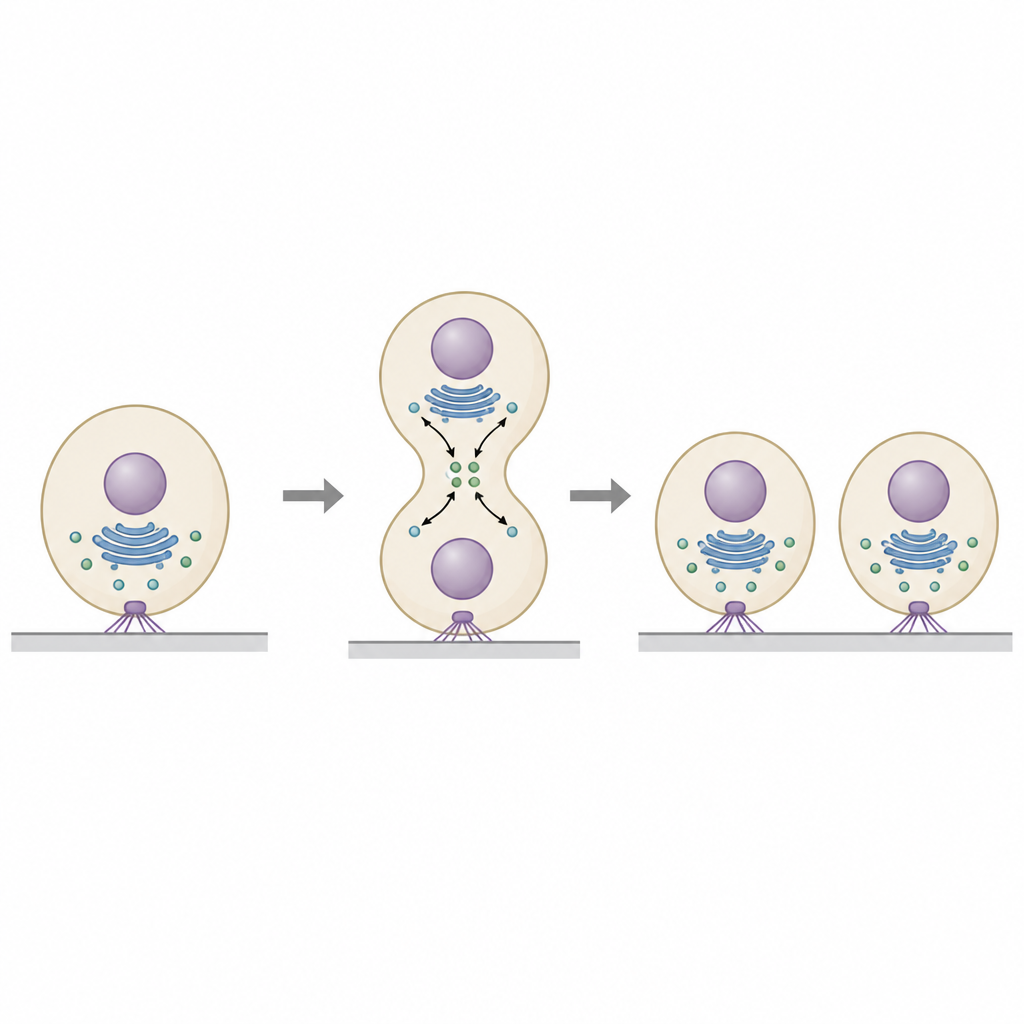
The final pinch in cell division
Cell division has two main stages: mitosis, when the genetic material is separated, and cytokinesis, when the cell itself splits. During cytokinesis, the cell forms a narrow bridge that connects the two newborn cells. Eventually this bridge must be cut in a step called abscission. The researchers found that when cells have lower levels of Mad1 or of α5 integrin, they can start this process normally and the bridge forms on time, but the last step often fails. Instead of separating, the bridge regresses and the two masses of genetic material end up inside one enlarged cell with two nuclei, a sign of failed division.
A traffic problem inside the cell
Mad1 is best known as part of the “spindle checkpoint,” which makes sure chromosomes are properly attached before a cell exits mitosis. Earlier work had also spotted Mad1 at the Golgi, a central shipping hub that prepares newly made proteins for delivery to the cell surface. In this study, the team shows that Mad1 does not simply sit there: it helps move α5 integrin out of the Golgi and onto the cell surface. When Mad1 is reduced, α5 integrin piles up at the Golgi and reaches the outer membrane more slowly, even though other cargo proteins are not delayed. The scientists pinpoint an internal segment of Mad1, about 300 amino acids long and dubbed “Mad1-Golgi,” that is both necessary and sufficient for targeting Mad1 to the Golgi and for restoring this specific trafficking step when Mad1 is missing.
Why cell grip matters for splitting
Integrins act like molecular hands that allow cells to grab onto the surrounding scaffold, known as the extracellular matrix. α5 integrin pairs with another subunit, β1, to bind the matrix protein fibronectin. This study reveals that α5 integrin is not only important for cell movement but also for cell division. When the researchers depleted α5 integrin or knocked out its gene in several human cell types, the rate of failed cytokinesis rose sharply. Time-lapse movies showed that furrow formation and early bridge shaping were normal, but the final cut was delayed or failed. Newly delivered α5 integrin was seen accumulating near the midbody, the dense region at the center of the bridge, and this localization depended on Mad1. The same region of Mad1 that targets it to the Golgi also appears at the midbody, suggesting a direct role in steering α5 integrin to this strategic site.
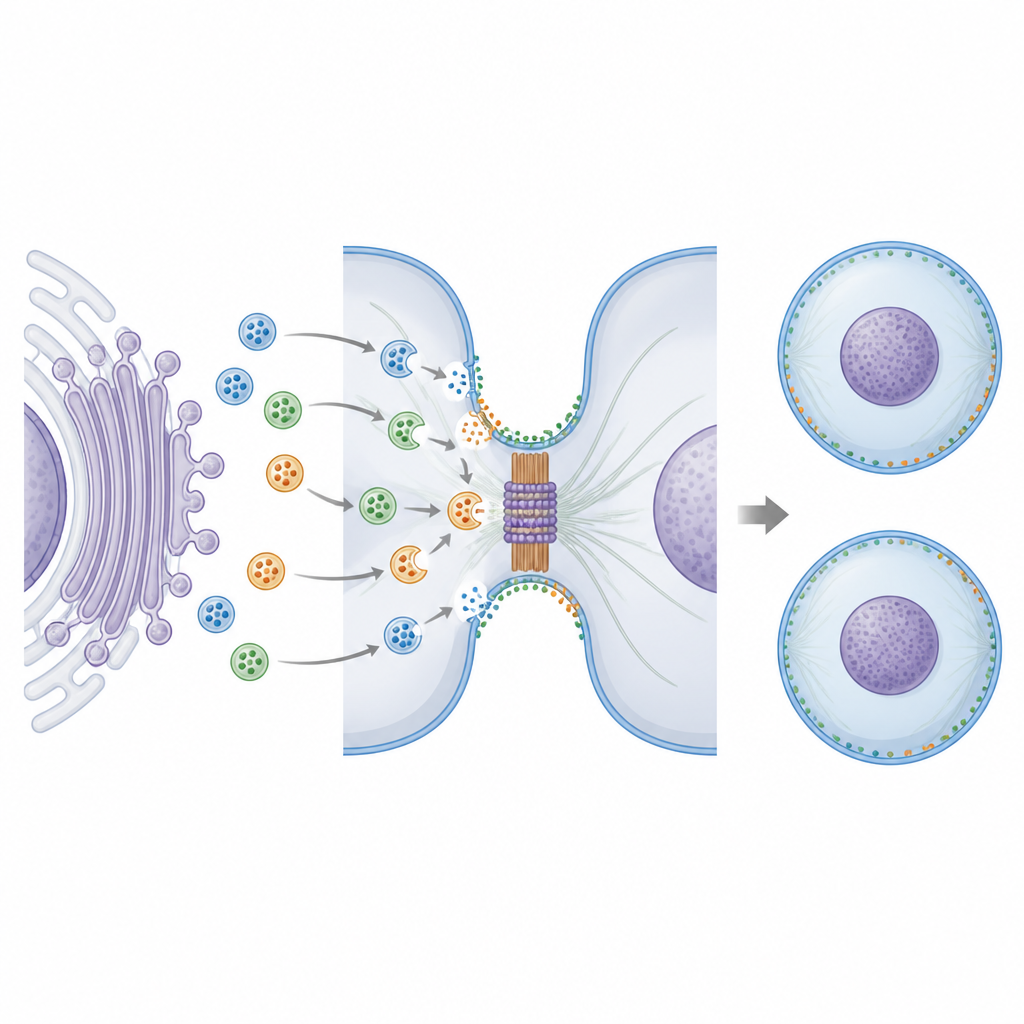
A teamwork pathway that relies on attachment
The authors also explored when this Mad1–α5 pathway matters most. In cells that grow attached to a surface, division can rely on traction forces generated by adhesive contacts, in addition to the tightening of an internal contractile ring. By testing cells on different coatings and in low-attachment conditions, the team showed that Mad1 and α5 integrin are specifically required when cells use adhesion-based traction to divide. When cells grew without being anchored, or when they relied on other integrins that bind collagen instead of fibronectin, loss of Mad1 or α5 integrin did not noticeably worsen division. Additional experiments showed that increasing α5 integrin levels could compensate for the lack of Mad1, restoring both successful division and α5 integrin build-up at the midbody.
What this means for health and disease
In plain terms, this work shows that Mad1 helps cells complete their final split by ensuring a steady supply of α5 integrin to the cell surface and to the division bridge. Without this targeted delivery, cells cannot generate the right traction at the midbody region and the last step of cytokinesis often fails, leaving behind enlarged, abnormal cells. Because α5 integrin is already linked to cancer cell spread and poor outcomes, understanding how Mad1 controls its traffic may open new routes to subtly dial down integrin activity. Such strategies could, in the future, help limit both faulty cell division and the invasive behavior of tumor cells.
Citation: Sam, D.K., Grems, G., Audhya, A. et al. Mad1 facilitates α5 integrin trafficking from the Golgi to promote abscission during cytokinesis. Nat Commun 17, 4615 (2026). https://doi.org/10.1038/s41467-026-70928-9
Keywords: Mad1, α5 integrin, cytokinesis, cell adhesion, Golgi trafficking