Clear Sky Science · en
Room temperature photochemical synthesis of metal–organic frameworks for enhanced photocatalysis
Cool Chemistry with Everyday Light
Most chemical factories need heat, pressure, and time. This study shows a different path: using ordinary visible light at room temperature to build tiny, sponge-like crystals called metal–organic frameworks. These materials can speed up useful reactions, such as turning alcohols into more valuable chemicals or splitting water to make hydrogen fuel. By swapping hot ovens for lamps, the researchers not only save energy, they also gain finer control over the shape and internal structure of these crystals, which in turn boosts their performance.
Why These Tiny Sponges Matter
Metal–organic frameworks, or MOFs, are highly ordered networks built from metal atoms and carbon-based linkers. Think of them as scaffolds with enormous inner surface areas and precisely shaped pores where reactions can take place. Because of this, MOFs are promising tools for cleaning pollutants, capturing carbon dioxide, disinfecting water, and driving solar-powered reactions. But their usefulness depends strongly on how they are made. Conventional methods rely on heating liquid mixtures for many hours, which can damage sensitive metals, create defects, and lock the structure into less desirable forms.
Swapping Heat for Light
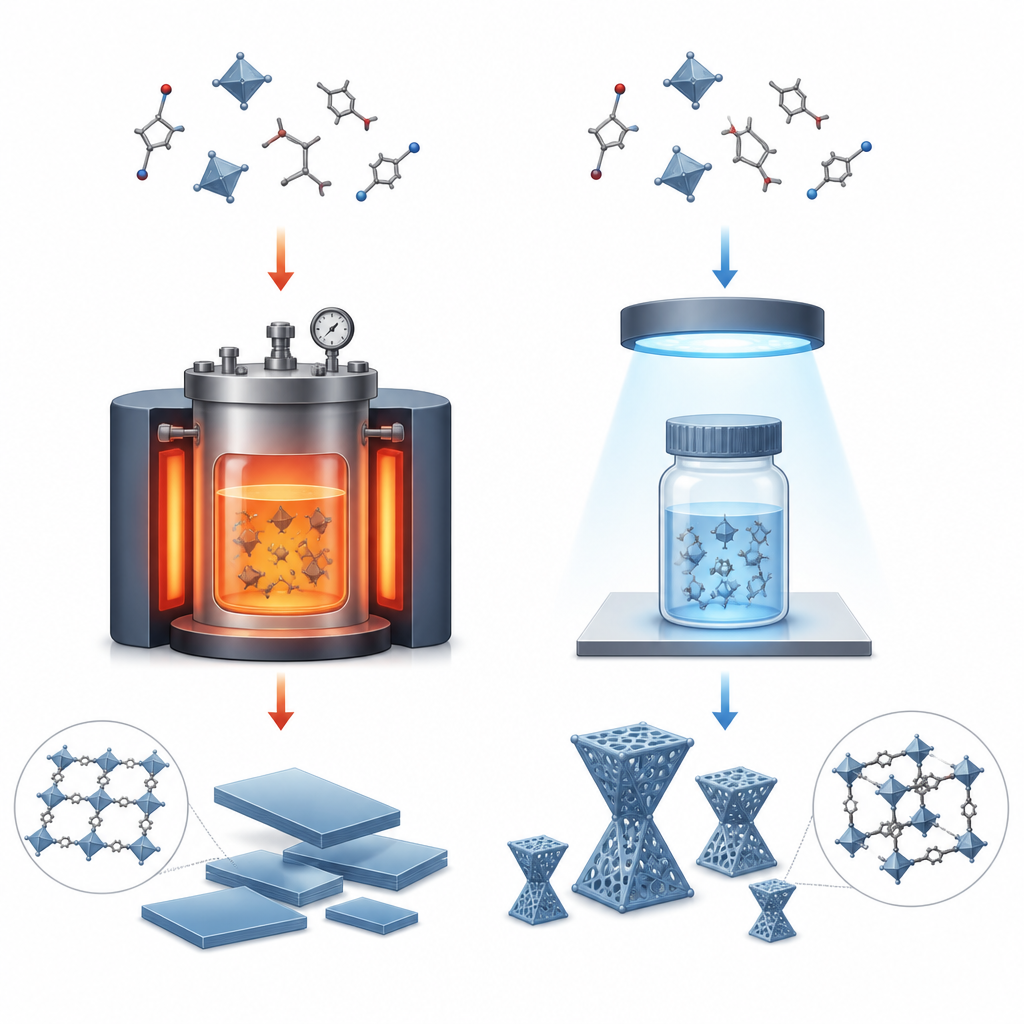
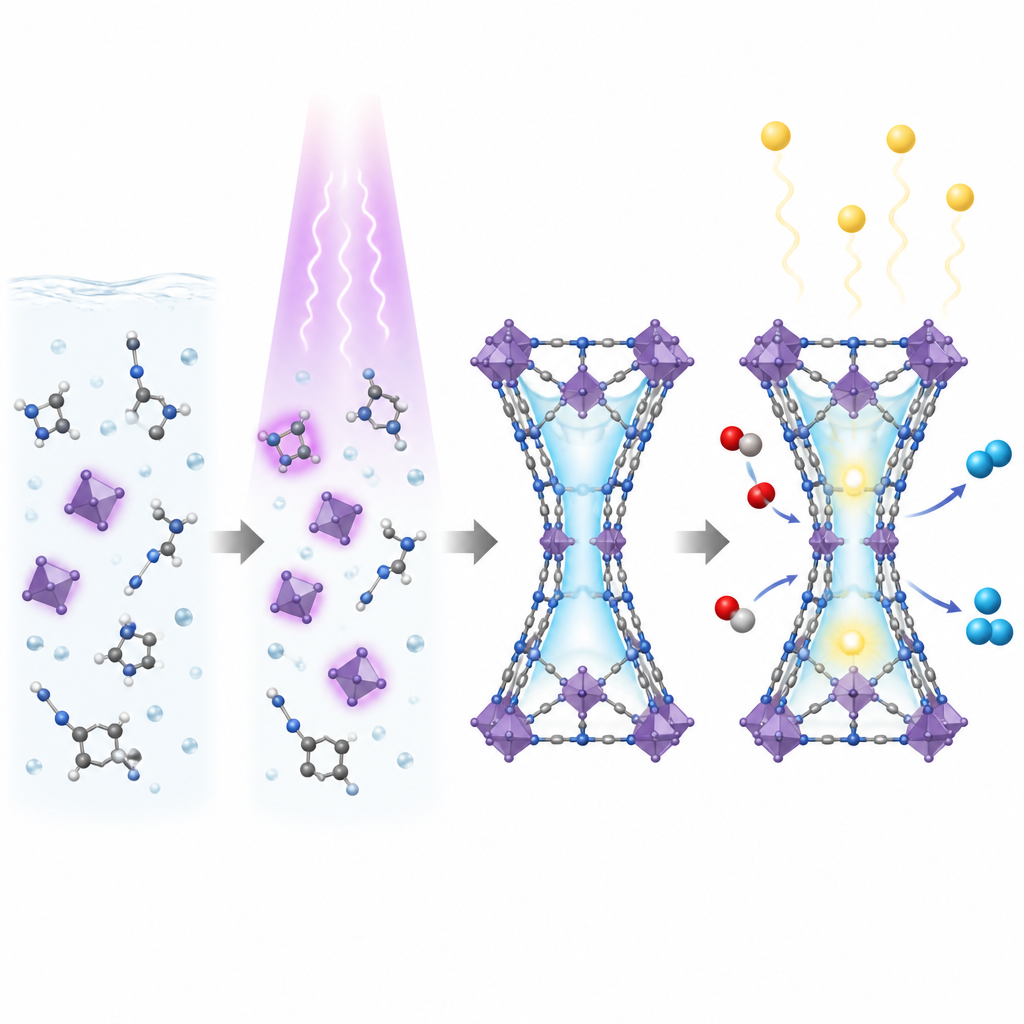
The team developed a way to grow a cobalt-based MOF at just 15 degrees Celsius using visible light, instead of heating it close to the boiling point of water. They chose a special ring-shaped organic molecule that not only helps build the framework but also absorbs light and becomes electronically excited. When a violet-blue lamp shines on the mixture, these excited building blocks guide how the metals and linkers snap together. In a few hours, the light-driven route reaches similar or higher yields than the traditional hot method, yet avoids the harsh conditions that can over-oxidize metals or warp the framework.
Shaping Crystals and Their Inner Workings
Under light, the same starting ingredients assemble into a very different architecture. Instead of flat sheets, the new method yields three-dimensional particles shaped like tiny hourglasses, with layered interiors and slightly less dense ends. Detailed imaging and spectroscopy show that, in these light-made crystals, the metal ions bond to the outer arms of the organic rings but leave the central “core” unoccupied. This subtle change means the framework is more open and loosely packed, with more space for a second organic pillar to hold layers apart. Computer simulations support this picture, revealing looser packing and different growth patterns under light compared with heat.
Holding Up Under Heat and Doing More Work
Despite being made at low temperature, the light-grown MOF is surprisingly robust. It keeps its shape in solvents and withstands higher temperatures than its heat-made cousin before breaking down. Under a microscope equipped with a tiny laser heater, the light-grown particles stay intact while the conventional ones fragment into smaller bits. When tested as a photocatalyst, the new material performs better: it converts benzyl alcohol into benzaldehyde more efficiently and generates hydrogen gas under light, whereas the conventional version does not produce detectable hydrogen. The researchers link this to the preserved organic cores, which can relay both electrons and protons more effectively, and to the larger internal surface and pores that ease the movement of molecules.
A General and Greener Path Forward
The authors also show that their light-based strategy is not limited to a single compound. Using similar conditions, they prepare several well-known MOFs with copper, cobalt, and zinc that match the structures of their heat-made counterparts. They even succeed using a solar simulator and natural sunlight, though with somewhat lower yields, highlighting the method’s potential for sustainable scale-up. A basic economic assessment suggests that, while solvent use must be optimized, the energy savings and compatibility with continuous-flow reactors make photochemical MOF synthesis an attractive route for industry.
What This Means for Future Materials
In plain terms, the study proves that beams of light can do more than just power solar panels; they can also choreograph how atoms arrange themselves into complex, useful solids. By choosing the right light-absorbing linkers, chemists can tune where metals bind and how crystals grow, leading to materials that are sturdier and better at harvesting light for chemical reactions. This light-guided approach points to a cleaner, more precise way to design and manufacture the next generation of porous catalysts and separation materials.
Citation: Wang, Y., Guan, J., Kumar, K. et al. Room temperature photochemical synthesis of metal–organic frameworks for enhanced photocatalysis. Nat Commun 17, 4274 (2026). https://doi.org/10.1038/s41467-026-70927-w
Keywords: metal organic frameworks, photochemical synthesis, photocatalysis, visible light chemistry, green materials
See more on the researcher's website: https://inrs.ca/en/research/professors/dongling-ma/