Clear Sky Science · en
Future rooftop photovoltaics will weaken carbon mitigation but offer promising water and land benefits
Solar on the roof, not in the field
As more cities turn to solar power, a key question arises: where should all those panels go? This study looks at what happens when China puts more solar panels on existing rooftops instead of building new power plants on open land, and how that choice affects climate, water, and land over the coming decades.
Finding room for solar in crowded cities
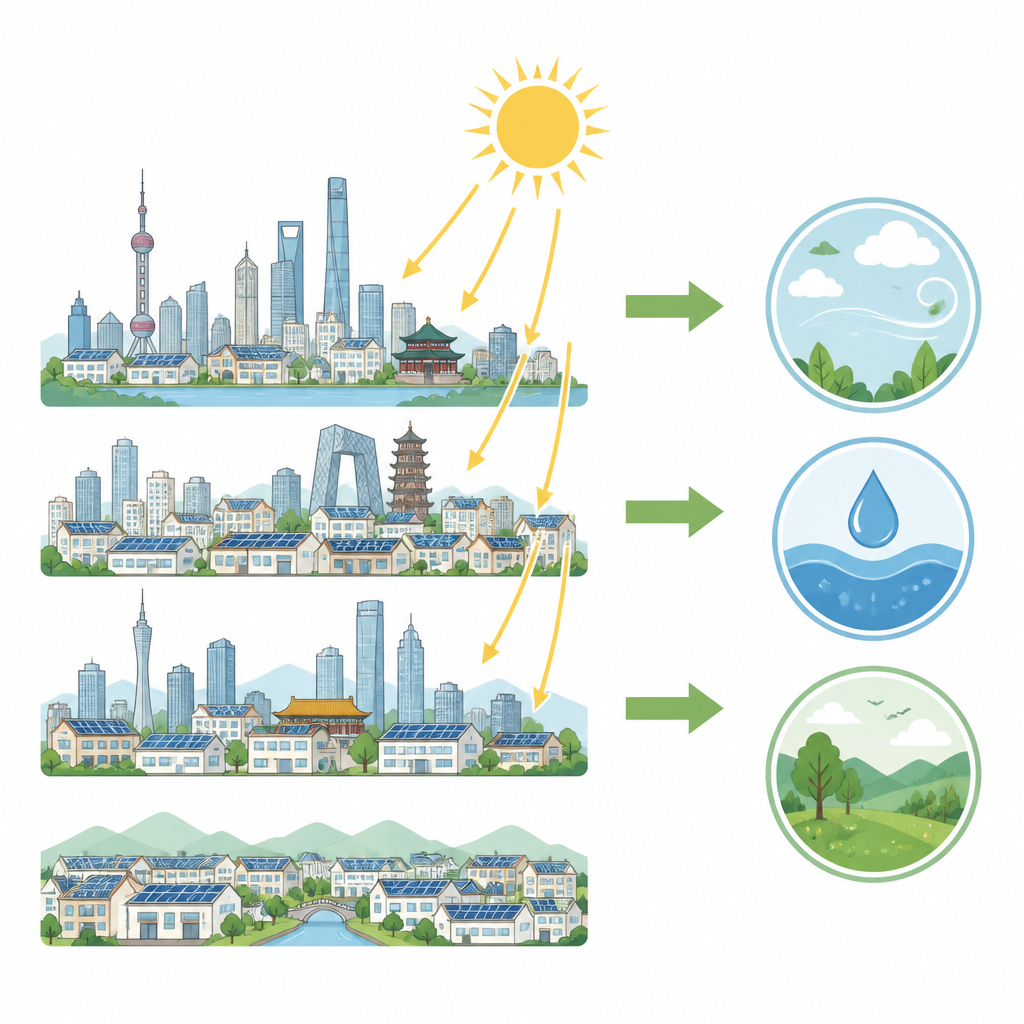
The researchers built a detailed picture of rooftop space across 349 Chinese cities, using satellite data and machine learning to estimate how much roof area is suitable for solar panels. They considered not only dense downtowns but also the wider municipal territories, or hinterlands, that surround them. They found about 33,290 square kilometers of usable roof area nationwide, with most of it outside city cores. In many cities, these outer areas hold far greater rooftop potential than the built-up center, meaning that the true solar opportunity lies beyond the familiar skyline.
How rooftop solar stacks up against the grid
To understand the wider impacts, the team compared rooftop solar with each city’s existing electricity mix, which still leans heavily on coal, large dams, and other centralized plants. They traced the full life cycle of rooftop systems, from material extraction and panel manufacturing through installation, cleaning, and eventual recycling or disposal. On average, each kilowatt-hour of rooftop electricity avoided far more greenhouse gas emissions, used less water, and occupied less land than the local power mix it would replace. These benefits varied widely by region: coal-heavy provinces saw the largest climate gains, hydro-heavy regions saw the biggest water savings, and places that rely more on biomass reaped the greatest land savings.
Looking ahead to mid-century
The study then asked how these tradeoffs might change as both cities and power systems evolve toward 2050 under different socioeconomic and climate futures. Across 15 combined scenarios, rooftop solar area was projected to grow by roughly 9 to 35 percent compared with 2020, with the fastest growth in economically strong eastern coastal cities. Under a middle-of-the-road scenario, China’s rooftop systems could reach about 8.2 terawatts of capacity by mid-century, roughly doubling today’s potential. Even after accounting for uncertain factors such as changing sunlight, panel efficiency, and future recycling, most cities remained able to cover a large share of their own electricity needs in theory.
Shifting value from carbon to water and land
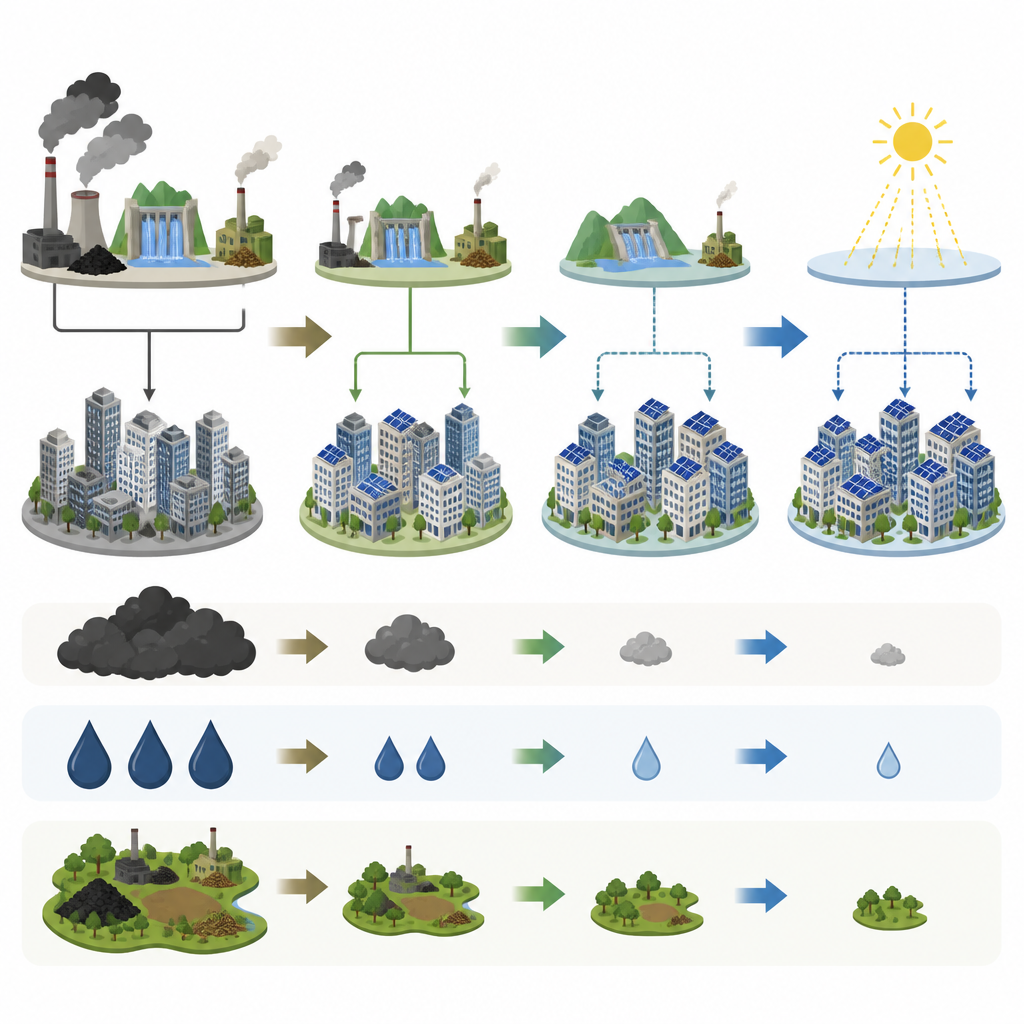
However, the picture changes once the rest of the grid cleans up. As China adds more large solar and wind farms and cuts back on coal and gas, the carbon advantage of each new rooftop panel shrinks, because it is replacing cleaner electricity than before. The study finds that the climate benefit per unit of rooftop power declines steadily from the 2020s to 2050. At the same time, the advantages for water and land either hold steady or grow, since rooftop systems continue to spare rivers from extra withdrawals and landscapes from new power plants and fuel extraction. Nationally, under the middle scenario, carbon savings from rooftop solar peak around 2035 to 2040, while water and land savings keep rising throughout the period.
Why city-by-city planning matters
Economic factors also shape where rooftop solar makes the most sense. By including roof rental costs along with equipment and upkeep, the authors found that solar power on roofs is already as cheap as or cheaper than retail grid electricity in all 349 cities, but the time needed to recover the upfront investment varies a lot. Some inland provinces have long payback periods due to low electricity prices or weaker sunshine, while parts of the northeast and southwest combine strong environmental benefits with relatively low costs. The study suggests steering faster deployment toward cities that offer both high potential and strong benefits, while using targeted policies, storage, and grid upgrades to unlock value in harder locations.
What this means for everyday life
For a layperson, the main message is that putting solar panels on roofs is not just about cutting carbon. In China, widespread rooftop solar could help many cities meet their own power needs while easing pressure on rivers and farmland. As the national power system becomes cleaner, rooftops will play a smaller role in climate mitigation but a growing one in saving water and land. Thoughtful, place-based planning can turn these quiet surfaces above our heads into long-term assets for both people and the environment.
Citation: Yuan, Q., Meng, F., Hu, Y. et al. Future rooftop photovoltaics will weaken carbon mitigation but offer promising water and land benefits. Nat Commun 17, 4417 (2026). https://doi.org/10.1038/s41467-026-70923-0
Keywords: rooftop solar, photovoltaics, urban energy, water use, land use