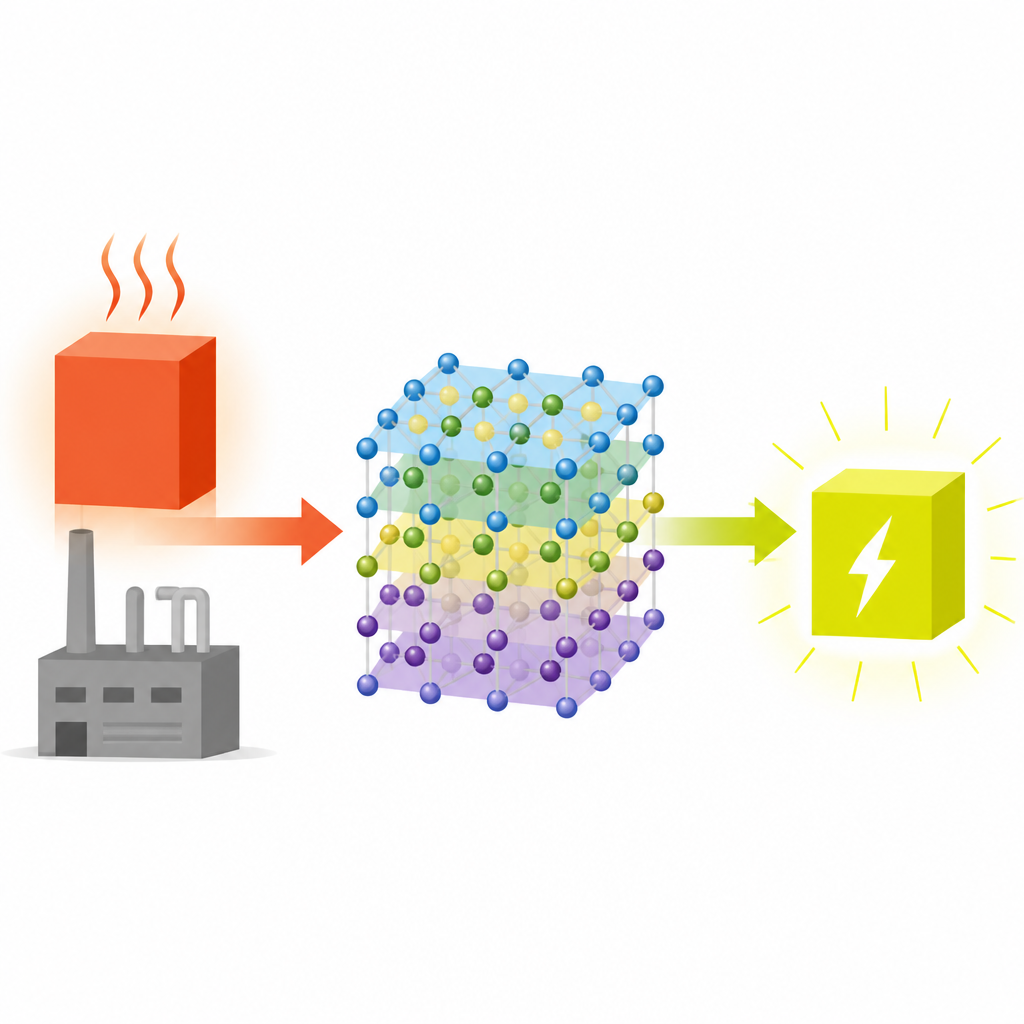
Every day, engines, factories, and power plants release huge amounts of unused heat into the air. Thermoelectric materials offer a way to turn some of that waste heat directly into electricity, with no moving parts. But most of the best thermoelectric materials rely on scarce or toxic elements. This study explores how to redesign a simple salt-like material, based on manganese and tellurium, so it can harvest heat much more efficiently while remaining relatively abundant and environmentally friendly.
Why Salt-Like Crystals Struggle
Classic thermoelectric materials conduct electricity like metals while blocking heat like insulating foam. Many promising ionic compounds, which resemble salts at the atomic level, fail this test because their electrons are tightly trapped around individual atoms. In manganese telluride (MnTe), this strong ionic bonding creates a wide electronic gap and makes it hard for charges to move. At the same time, vibrations in the crystal lattice carry heat quite well, which further lowers efficiency. The challenge is to loosen the grip of these bonds so charges can flow more freely, while also slowing the flow of heat.
Gently Rewriting Atomic Connections Figure 1. How redesigned salt-like crystals turn waste heat from industry directly into electricity
The researchers tackle this problem through what they call bond engineering: carefully swapping some atoms in MnTe for other elements to change how atoms share electrons. By alloying MnTe with compounds containing germanium, silver, antimony, and tellurium, they reshape the local bonding environment. Computer simulations show that in pure MnTe, electrons sit mostly on the tellurium atoms, leaving the manganese atoms relatively bare. After the substitutions, electrons spread out more evenly between different atoms, signaling a shift from very ionic bonds toward more shared, covalent-like bonds. This change not only eases the movement of charge carriers but also drives the crystal from a hexagonal structure into a more symmetric cubic form that is better for electrical transport.
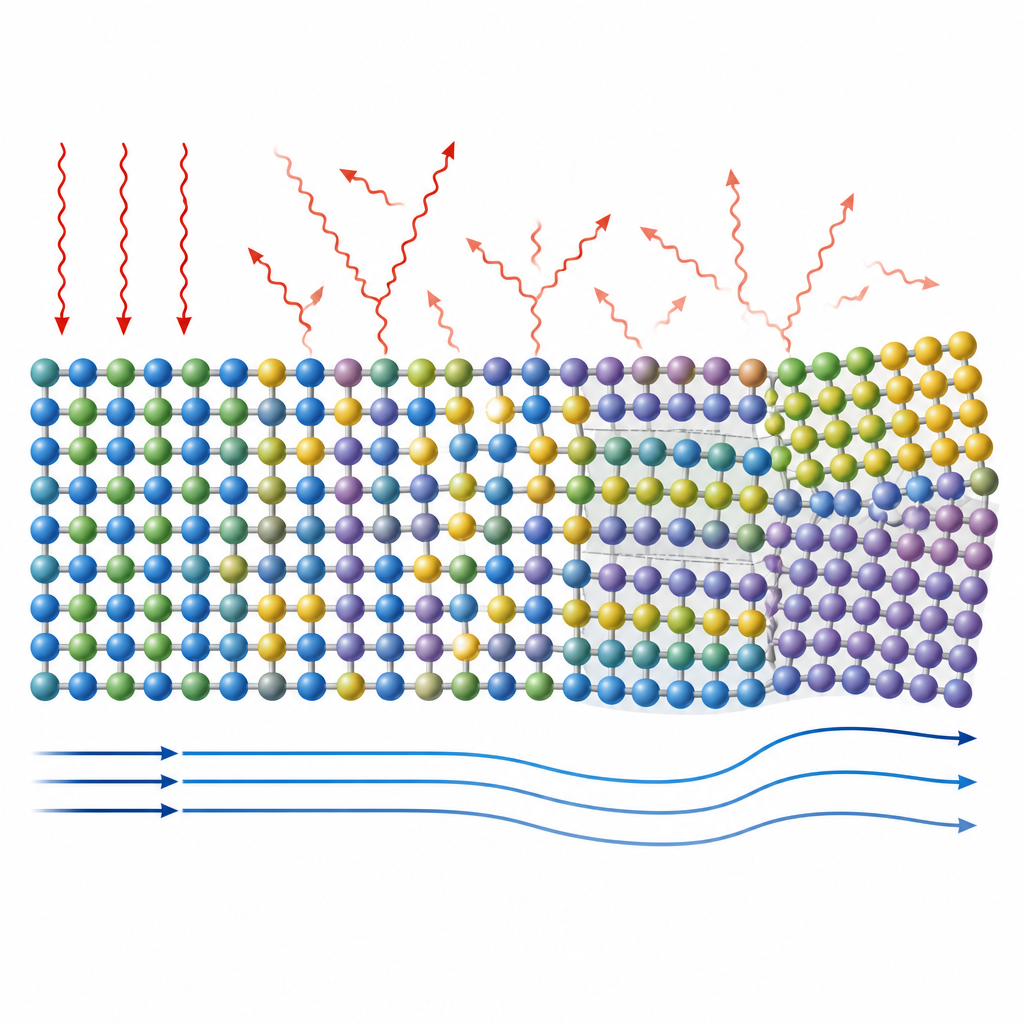
Letting Charges Run While Heat Gets Lost Figure 2. How mixing different atoms in a crystal softens bonds, scatters heat, and speeds charge flow for better energy conversion
These controlled changes in bonding have two linked payoffs. Electrically, the new cubic, multi-element material gains more charge carriers and higher mobility, so it conducts electricity much more effectively. At the same time, the reshaped energy bands near the top of the valence band increase the effective mass of the carriers in a way that boosts the Seebeck coefficient, which measures how strongly a temperature difference can drive a voltage. Thermally, the picture flips: longer, softer bonds and a dense hierarchy of defects – from tiny point defects to stacking faults and grain boundaries – act as roadblocks for vibrations that carry heat. As a result, the lattice thermal conductivity drops to very low values, helping keep heat on the “hot” side long enough to be converted into electricity.
From Better Material to Working Device
Putting these effects together, the modified MnTe-based material achieves a peak thermoelectric figure of merit, zT, of about 1.6 at 773 K and a high average zT of about 0.9 between room temperature and 773 K. These values are the highest yet reported for this family of ionic manganese telluride materials. The team then built a small thermoelectric module that combines their new p-type MnTe-based legs with established n-type and low-temperature legs. Under a temperature difference of 473 K, this device reached an energy conversion efficiency of about 11 percent, comparable to some of the best mid-temperature thermoelectric systems based on more traditional chemistries.
A New Path for Simple Compounds
In simple terms, this work shows that carefully adjusting the way atoms bond inside a crystal can turn an underperforming salt-like material into an efficient heat-to-power converter. By making electrons less localized and introducing a controlled “roughness” into the crystal, the material conducts electricity better while carrying heat less efficiently. This bond-focused design strategy could be extended to other ionic compounds, opening new options for solid-state devices that quietly recycle waste heat into useful electricity.
Citation: Li, H., Lyu, S., Li, X. et al. Chemical bonding manipulation unlocks high performance ionic-bonded thermoelectrics.
Nat Commun17, 4384 (2026). https://doi.org/10.1038/s41467-026-70922-1