Clear Sky Science · en
When bubbles bounce or stick
Why the way bubbles hit walls matters
From fizz in drinks to oxygen pumped into fish farms, bubbles constantly collide with solid surfaces. Whether they bounce off or stick affects how gases dissolve in water, how industrial reactors work, how electronic devices are cooled, and even how sea spray forms in the ocean. This study digs into the hidden physics that decide a bubble’s fate at a wall, building a map and a simple model that engineers and scientists can use to better control bubbles in real systems.
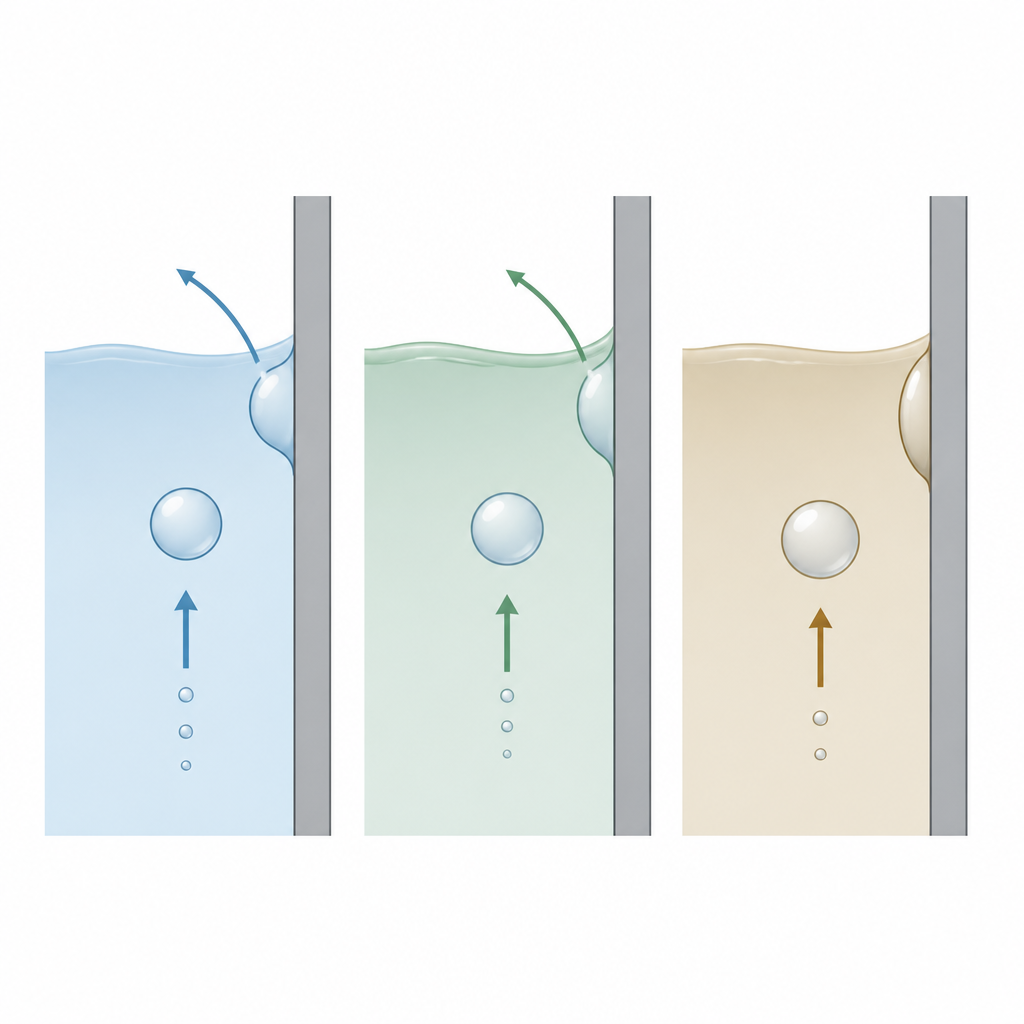
Watching bubbles in thick and thin liquids
The researchers began with a simple but carefully controlled setup: single air bubbles rising straight up in mixtures of water and glycerol, a syrupy liquid that lets them tune how “thick” the fluid is. Each bubble rose a fixed distance before hitting a smooth horizontal plate. High speed cameras captured how its top and bottom moved, and how its shape stretched and squashed during impact. Depending on the liquid thickness and bubble size, the team saw four distinct behaviors: full bounce, where the bubble cleanly detaches after impact; an underdamped non bounce, where it quivers like a soft ball but never leaves the wall; an overdamped non bounce, where it creeps to rest without overshoot; and breakup, where the bubble tears into a ring and smaller satellites.
A map of bubble behavior
To organize these outcomes, the authors used two dimensionless numbers that bundle together the effects of gravity, fluid thickness, and surface tension. By combining experiments with detailed computer simulations, they swept a huge range of bubble sizes and fluid properties and drew a “phase diagram” that shows which conditions lead to bouncing, gentle settling, or breakup. They found that whether a bubble bounces or sticks depends on a joint balance of gravity driven motion versus both viscous drag and surface tension, while the switch from underdamped to overdamped settling depends mainly on how viscous the liquid is. At high gravity driven speeds and strong surface forces, bubbles are more prone to shattering against the wall instead of rebounding or resting intact.
A simple mechanical analogy
To make sense of this rich behavior, the team built a stripped down mechanical model that treats the bubble like two masses linked by a spring and damper. The spring represents how the bubble surface stores energy when it is squashed flat against the wall, while the damper stands for the energy lost to the surrounding liquid and the thin film trapped between bubble and plate. In this picture, bouncing occurs only if the stored energy can overcome both weight and losses and push the bubble’s upper side away from the wall. By writing down and solving the equations of motion for this two mass system, the authors derived simple criteria that separate full bounce, wobbly sticking, and sluggish sticking, and showed that these match their experimental and simulation results across a wide range of conditions.
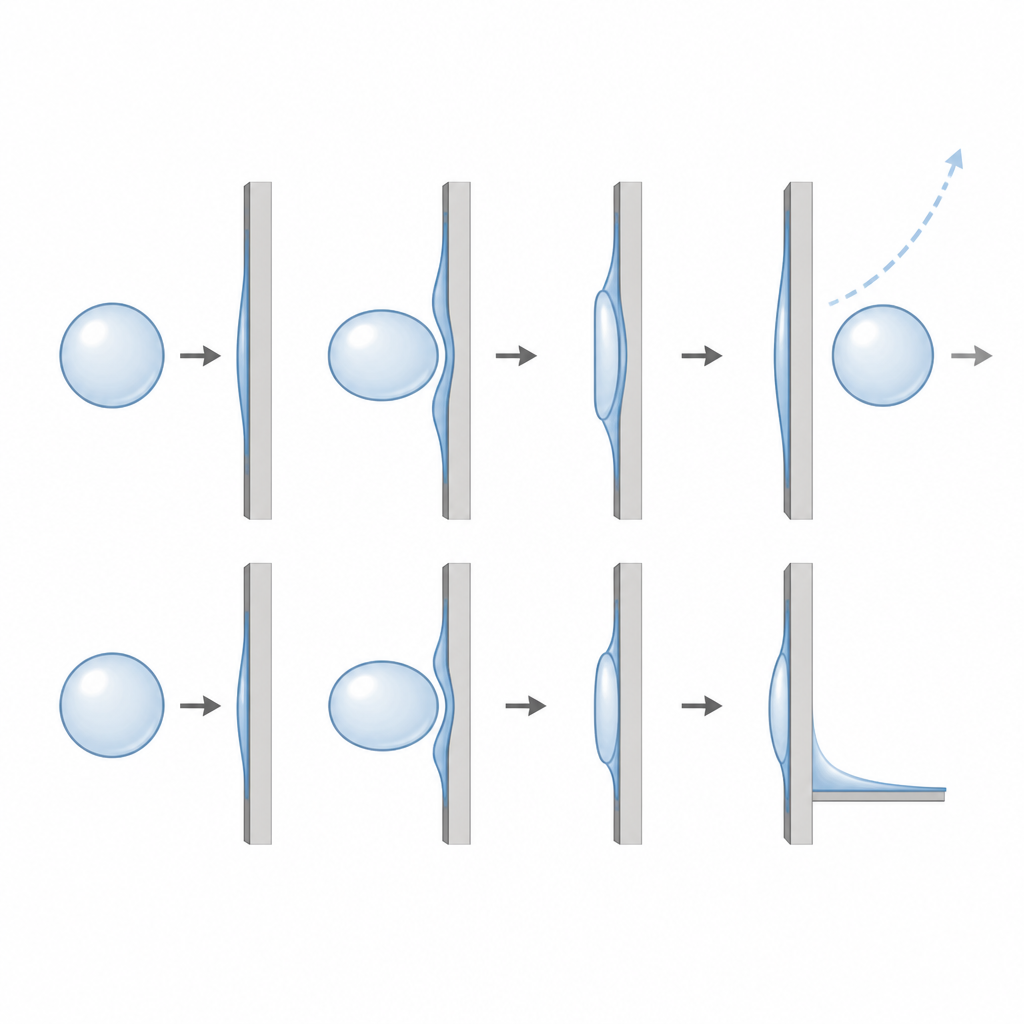
Following the energy
Beyond the mechanical analogy, the researchers tracked where energy goes during impact. At first, the bubble’s motion is mostly kinetic, with a small share stored in its height above the wall. As it deforms, that motion is converted into surface energy. If the liquid is thin and its surface tension is strong, much of that stored energy can be converted back into motion, and the bubble takes off again. In thicker liquids, or when gravity and surface tension encourage stronger flattening, more of the energy is soaked up as heat through viscous friction, especially in the squeezed liquid film. Then the bubble lacks the “budget” to pull away and either oscillates in place or settles quietly against the wall.
How starting distance changes the outcome
The team also tested how far a bubble is allowed to rise before impact, which controls how fast it is moving when it arrives. They found that once the rise distance exceeds about five bubble radii, the impact speed and hence the behavior barely change; the bubble has effectively reached a steady rise. At shorter starting distances, the bubble hits the wall more gently, shifting the boundaries between bouncing and sticking toward higher values of the control parameters. In some regions, very long rises can even destabilize the bubble’s shape so that it no longer rises straight, which alters the impact and can suppress bouncing altogether.
What this means for real world flows
In everyday and industrial flows, countless bubbles rise through liquids of varying thickness and surface chemistry and strike walls, membranes, or particles. This work shows that their fate is governed by a few key combinations of forces and can be captured by a compact mechanical model. For designers of chemical reactors, electrolysis cells, medical contrast agents, or ocean inspired bioreactors, the new phase diagram and model offer practical rules for promoting clean bubble rebound, encouraging attachment, or avoiding breakup, simply by tuning bubble size, liquid viscosity, surface tension, and the distance over which bubbles are allowed to accelerate.
Citation: Zhang, X., Xu, Z., Wang, S. et al. When bubbles bounce or stick. Nat Commun 17, 4283 (2026). https://doi.org/10.1038/s41467-026-70921-2
Keywords: bubble dynamics, fluid viscosity, surface tension, bubble wall impact, multiphase flow