Clear Sky Science · en
Dynamic ligand-vacancy engineering drives metal dimerization for efficient urea electrooxidation
Turning Waste into Useful Energy
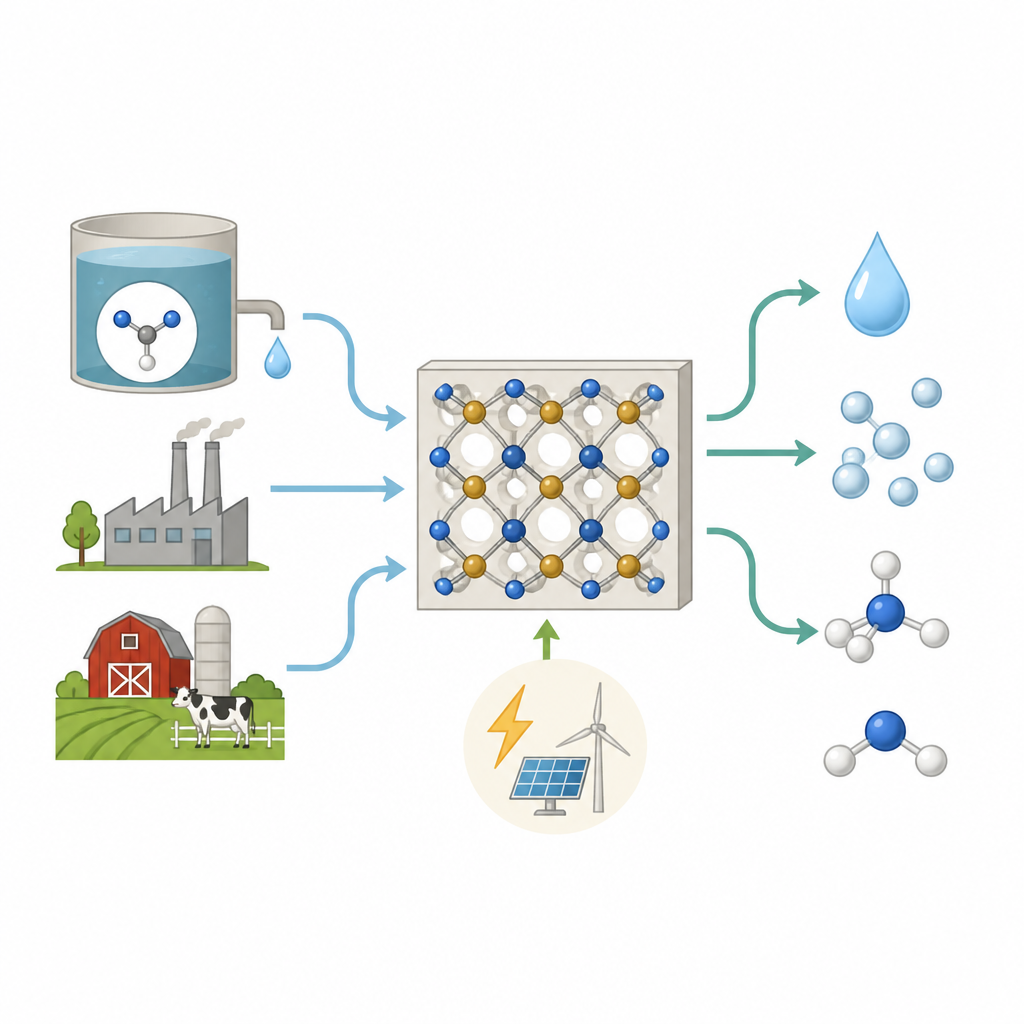
Urea is often thought of as a troublesome pollutant in wastewater, but it is also a rich source of both nitrogen and hydrogen. This study explores how to turn everyday urea from sources like industrial effluent and urine into clean hydrogen fuel while also cleaning the water. The challenge is to find a sturdy, low cost catalyst that can drive this reaction efficiently without falling apart. The researchers show how a smartly designed solid material can reorganize itself at the atomic scale during operation, staying active and stable for long periods.
Why Urea Matters for Clean Hydrogen
Splitting water into hydrogen and oxygen is a promising way to make clean fuel, but the oxygen side of the reaction usually wastes a lot of energy. Urea oxidation offers a shortcut: it needs a much lower voltage than the usual oxygen reaction and can use urea already present in waste streams. In principle, this means cheaper hydrogen, less electricity use, and removal of a common pollutant at the same time. However, most existing catalysts rely on scarce noble metals and tend to degrade under the harsh alkaline conditions needed for fast reactions, which has held back real world use.
Building a Smarter Solid Framework
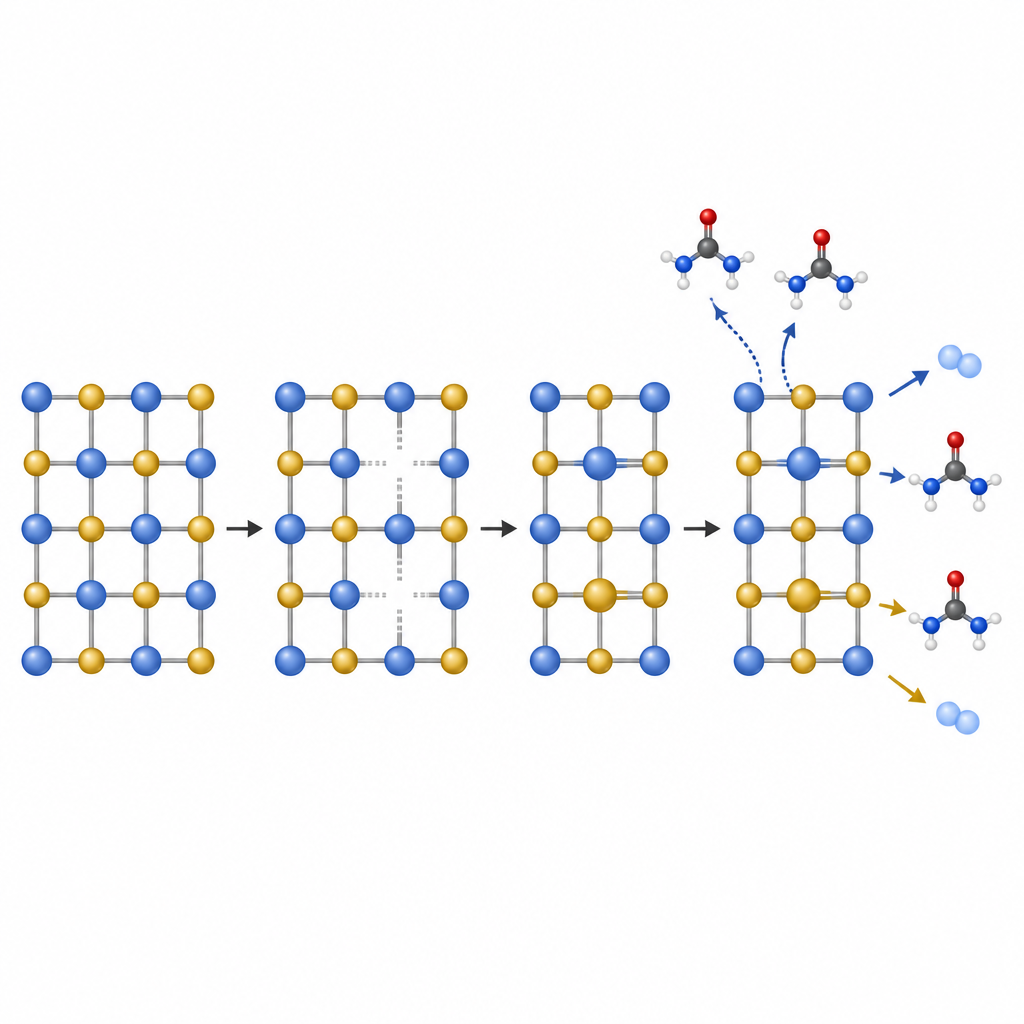
The team tackled this by working with metal organic frameworks, or MOFs, a class of porous, crystal like materials made of metal nodes linked by organic struts. MOFs offer many exposed sites for reactions but often crumble in strong alkaline solutions. Here, the researchers combined iron and cobalt into a layered MOF grown directly on nickel foam. Careful computer simulations and imaging showed that the two metals play different roles: iron forms stronger bonds to the organic struts and acts as a structural anchor, while cobalt sites are more easily modified under voltage. This mix creates a “self adaptive” environment where the material can change just enough to become a better catalyst without collapsing.
Letting Atoms Rearrange Without Falling Apart
Under operating conditions, some of the organic struts detach selectively from cobalt sites, leaving tiny empty spots called ligand vacancies. Instead of turning the whole material into a less useful oxide, these vacancies encourage neighboring metal atoms to slide closer together and form pairs, or dimers, while the overall framework shape stays intact thanks to the iron anchors. Advanced spectroscopy and calculations reveal that this subtle rearrangement shifts the electronic balance of the metal centers. The key C–N bond in adsorbed urea becomes easier to break, and the slowest step in the reaction pathway switches from a difficult chemical bond split to an easier voltage driven step involving oxygen addition to nitrogen containing fragments.
From Atomic Changes to Device Performance
These atomic level tweaks have clear practical payoffs. The optimized iron cobalt MOF, after this controlled reconstruction, reaches a set current at a notably lower voltage than standard catalysts such as iridium oxide, and it sustains high currents relevant to industrial devices for many hours with little loss of activity. In a full electrolysis cell, pairing this anode with a commercial hydrogen producing cathode cuts the energy use by about 13 percent compared with conventional water splitting at the same current. At the same time, the reaction selectively converts urea into useful nitrogen containing products like nitrite and nitrate, pointing to routes for both pollution control and chemical production.
What This Means for Future Clean Energy
In simple terms, the study shows that it is possible to design catalysts that “heal” and optimize themselves while they work, rather than wearing out. By carefully choosing two different metals and allowing controlled vacancies to appear, the researchers guide the solid into a more active, yet still robust, state. This dynamic vacancy to bond strategy offers a blueprint for making other long lasting, non precious metal catalysts for urea assisted electrolysis and related reactions. If scaled up, such materials could help turn waste rich in urea into a valuable partner for hydrogen production, easing energy demands and contributing to more sustainable chemical cycles.
Citation: Wu, M., Luo, J., Zhan, X. et al. Dynamic ligand-vacancy engineering drives metal dimerization for efficient urea electrooxidation. Nat Commun 17, 4314 (2026). https://doi.org/10.1038/s41467-026-70919-w
Keywords: urea electrooxidation, hydrogen production, electrocatalyst, metal-organic framework, wastewater treatment