Clear Sky Science · en
Anti-topological crystal and non-Abelian liquid in twisted semiconductor bilayers
Why twisting atom-thin layers matters
When two ultra-thin semiconductor sheets are stacked with a small twist, their atoms form a large, gentle interference pattern called a moiré lattice. This simple geometric trick has turned out to be a powerful way to create exotic electronic phases, from unusual magnets to quantum states that could one day store information in fundamentally new ways. This article explores how, in a twisted bilayer of the material MoTe2, electrons can organize themselves either into a rare quantum liquid with non-Abelian behavior—useful in principle for robust quantum computing—or into an equally exotic kind of electronic crystal that cancels out the underlying topology of the system.
Twisted layers and designer electron landscapes
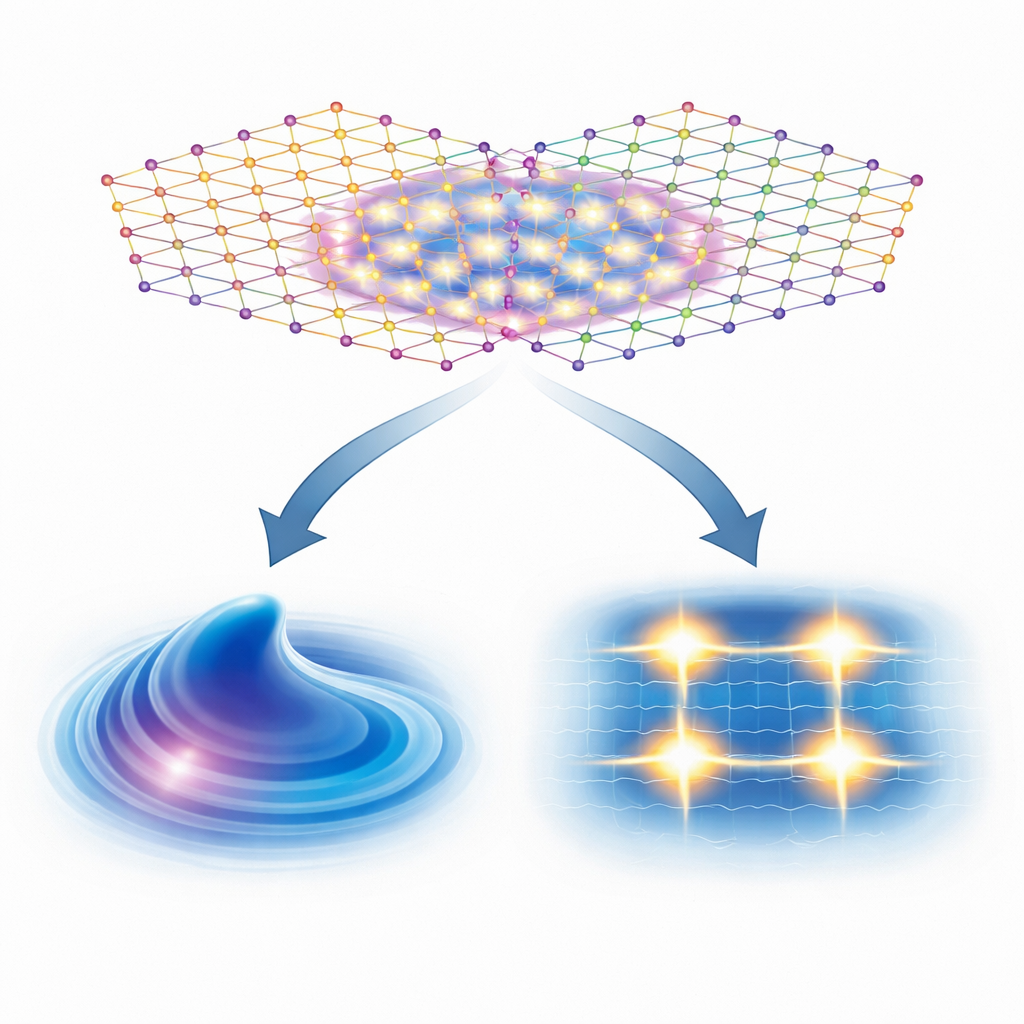
In twisted bilayer MoTe2, the overlapping lattices of the two layers create a repeating moiré pattern that dramatically reshapes how electrons move. Instead of roaming freely, electrons feel an effective magnetic-like environment and form narrow energy bands that can carry a built-in “twist” known as a Chern number. Earlier work showed that when the lowest such band is only partly filled, electrons can produce fractional quantum anomalous Hall states, where electric current flows along the edges without resistance even in zero external magnetic field. The new study asks what happens at a higher filling—specifically at half-filling of the second moiré band—where theory had predicted a delicate non-Abelian quantum liquid, a phase whose excitations store information in a non-local, braid-like fashion.
Competition between quantum liquid and electron crystal
Using powerful numerical techniques, the authors map out the possible phases of electrons in this setting as they vary the twist angle and microscopic model. In one regime, they confirm the presence of a non-Abelian fractional Chern insulator, a quantum liquid characterized by multiple nearly degenerate ground states and signatures matching so-called Pfaffian order known from higher Landau levels in strong magnetic fields. In nearby regions of twist angle, however, the electrons instead freeze into crystalline patterns: their density modulates in space, spontaneously enlarging the basic moiré unit cell into a 2 × 2 supercell. To reveal this ordering, the authors carefully redefine correlation functions so as not to wash out the crystalline signal, showing clear Bragg-like peaks and real-space patterns consistent with an electron crystal.
A crystal that erases topology
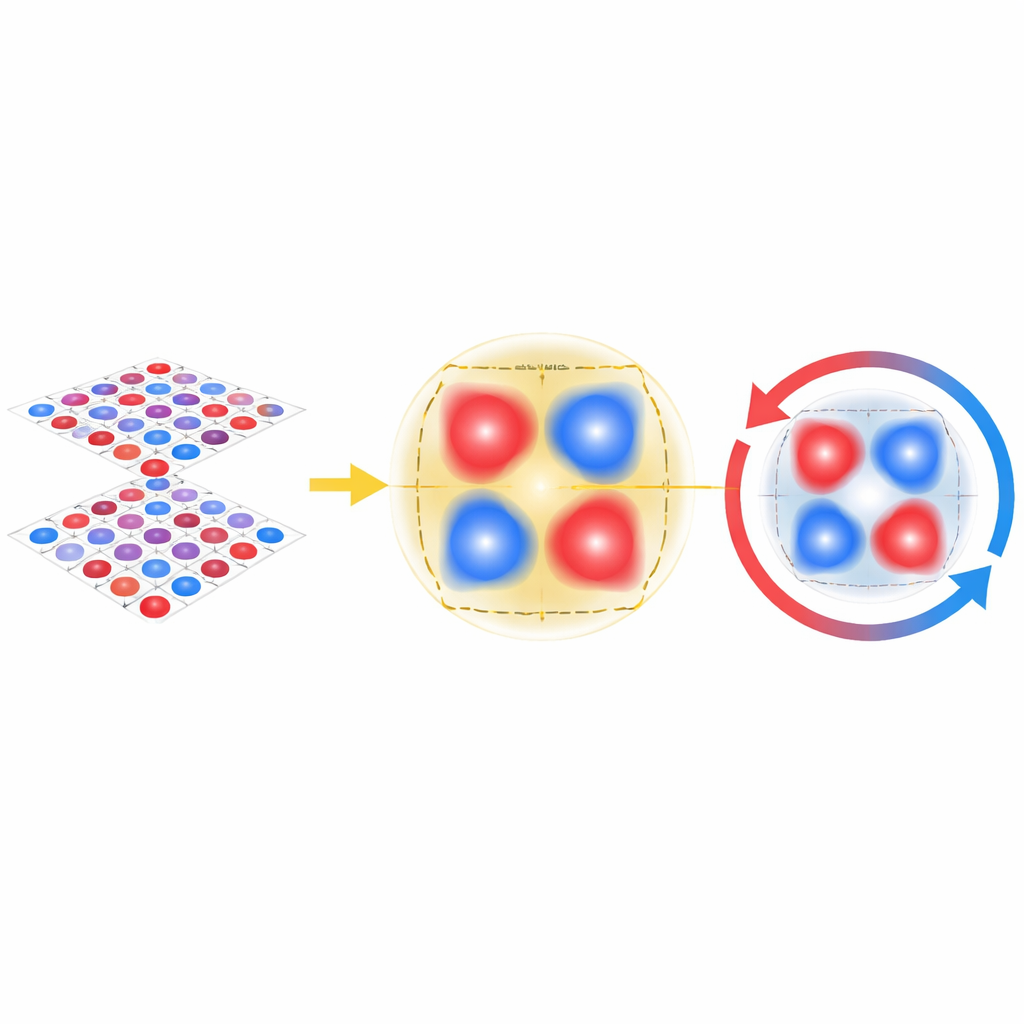
The most surprising finding is a new type of crystal the authors call an “anti-topological crystal.” In both a simplified “adiabatic” model and a more realistic continuum model of twisted MoTe2, the two lowest single-particle bands in a given valley each carry the same positive Chern number, indicating an underlying topological character. Yet at a total filling corresponding to one and a half holes per moiré unit cell, interactions reorganize the electrons so that contributions from the fully filled first band and the half-filled second band cancel. In other words, the many-body Chern number of the crystal vanishes, even though it lives inside two topological bands. Hartree–Fock calculations that keep all bands confirm a robust 2 × 2 crystal with a net Hall response of zero and show that this phase persists across band inversions that would otherwise change the band topology.
Connecting to experiments and related phases
Experiments on twisted MoTe2 have already reported an insulating state at fillings close to those studied here, as well as higher-Chern-number insulators at nearby densities. The anti-topological crystal proposed in this work offers a natural explanation for an insulating state around three-halves filling that does not exhibit a quantized Hall conductance. The authors further analyze a toy model based on a half-filled higher Landau level with a weak periodic potential. While this simpler system reproduces some of the crystal phases with nonzero Hall conductance, it fails to generate the anti-topological crystal, highlighting that this new phase relies on features specific to moiré minibands that go beyond the conventional Landau-level picture.
What this means for future quantum materials
For a non-specialist, the key message is that twisting atomically thin layers does more than just mimic familiar quantum Hall physics: it enables entirely new ways for electrons to self-organize. In twisted MoTe2, the same moiré landscape can host either a non-Abelian quantum liquid—promising for fault-tolerant quantum computation—or an anti-topological crystal that locally looks topological but globally cancels out its own Hall response. Understanding and controlling this competition will be crucial for designing devices that reliably realize desired quantum phases, and it suggests that other twisted materials with multiple topological bands may hide similar “anti-topological” states waiting to be discovered.
Citation: Reddy, A.P., Sheng, D.N., Abouelkomsan, A. et al. Anti-topological crystal and non-Abelian liquid in twisted semiconductor bilayers. Nat Commun 17, 3814 (2026). https://doi.org/10.1038/s41467-026-70916-z
Keywords: twisted bilayer MoTe2, moiré superconductors and insulators, fractional Chern insulators, electron crystals, topological quantum phases