Clear Sky Science · en
B–N–B Embedded multiple-resonance polyaromatic enabling efficient narrowband electroluminescence
Sharper colors for next generation screens
Modern phones and TVs rely on tiny organic light-emitting diodes to create bright, colorful images, but pushing these displays to show ultra-pure colors without wasting energy is still difficult. This study reports a new family of light-emitting molecules that shine in very precise shades of deep blue and blue‑green while staying highly efficient and stable, pointing the way toward crisper, more energy‑saving displays.
Why current light makers fall short
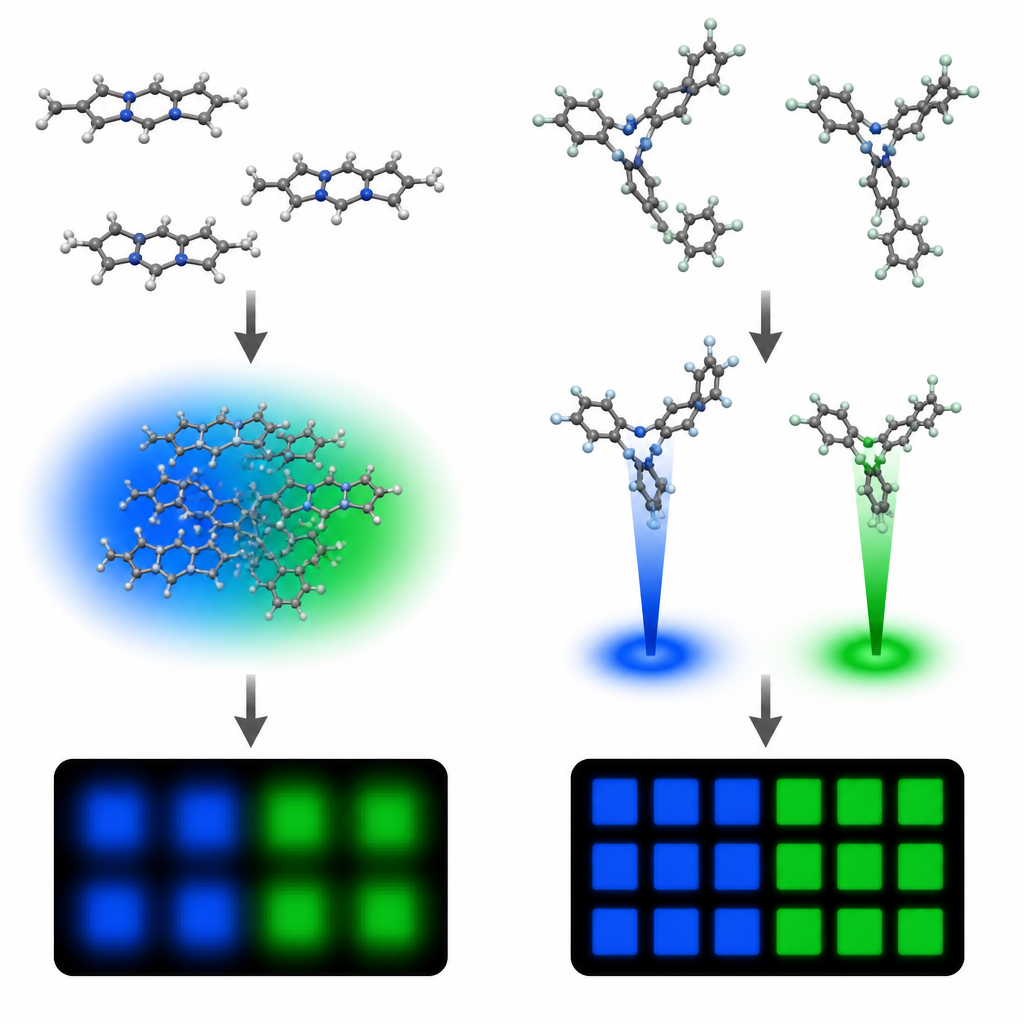
Organic display pixels are built from carbon-based molecules that glow when electricity flows through them. To meet the strict color standards for future ultra‑high‑definition formats, the emitted light must form very narrow peaks in wavelength, like a musical note played on pitch without distortion. Many of today’s best emitters use a design in which boron and nitrogen atoms subtly reshape the electron cloud in an otherwise carbon framework, giving efficient light emission. However, these molecules tend to lie flat and stack closely in solid films, which blurs their color, and their internal energy‑recycling step, needed for high efficiency, can be too slow.
A new twist in molecular design
The researchers combined two ideas into a single architecture. First, they used a pattern of boron and nitrogen atoms that naturally confines where electrons and holes sit in the molecule, producing sharply defined light colors. Second, they built in a three‑atom boron–nitrogen–boron unit that forces the overall structure to twist into a helical, corkscrew‑like shape. This twist keeps neighboring molecules from piling directly on top of each other, reducing unwanted interactions that normally broaden the spectrum. It also changes how the electrons move between energy levels, making it easier to harvest energy that would otherwise be lost.
Making complex molecules in a controllable way
Creating such intricately arranged atoms is usually a synthetic headache, often requiring harsh reagents and giving low yields. Here, the team designed a step‑by‑step way to attach boron atoms that lets nitrogen atoms steer where the new bonds form. By tuning the reaction conditions and adding a base to tame the boron reagent, they first stopped at a single‑boron intermediate, then added additional boron in a second controlled step. This lithium‑free sequence delivered the key twisted molecules in overall yields above 80 percent, and the same strategy could be extended to an even more boron‑rich version.
From molecules to bright, pure pixels
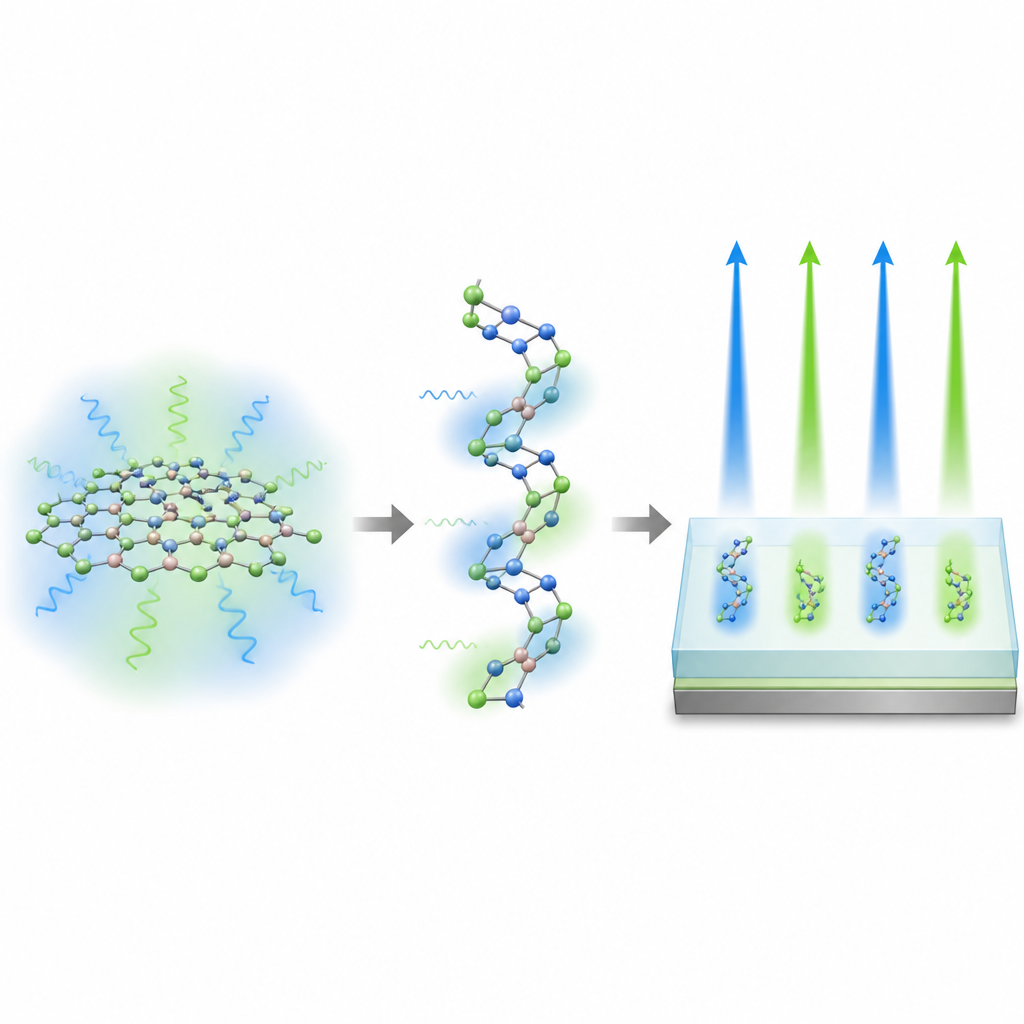
Measurements in solution and in thin films showed that the new molecules emit deep blue and blue‑green light with extremely narrow spectral widths of only about 12 to 14 nanometers, much tighter than typical organic emitters. Almost every absorbed photon is turned into light, with near‑unity quantum yields, and the internal energy‑recycling process runs fast thanks to the twisted structure. When built into test organic light‑emitting diode devices, these emitters produced external quantum efficiencies around 38 percent while maintaining very pure colors and reasonable operating lifetimes, rivaling or surpassing the best existing materials based on similar chemistry.
What this means for future displays
To a nonspecialist, the key message is that careful atomic‑level “carpentry” inside an organic molecule can simultaneously sharpen color, boost efficiency, and simplify manufacturing. By weaving a boron–nitrogen–boron unit into a twisted framework, the authors created a versatile platform for deep blue and blue‑green pixels that meet demanding color standards without relying on heavy metals. This approach suggests a practical path toward thinner, brighter, and more energy‑efficient displays for everyday devices.
Citation: Zhou, J., Meng, G., Zhang, H. et al. B–N–B Embedded multiple-resonance polyaromatic enabling efficient narrowband electroluminescence. Nat Commun 17, 4367 (2026). https://doi.org/10.1038/s41467-026-70915-0
Keywords: OLED, deep blue emission, narrowband electroluminescence, boron nitrogen molecules, thermally activated delayed fluorescence