Clear Sky Science · en
Flat band induced quasi-one-dimensional magnon transport in a two-dimensional spin lattice
Guiding Tiny Magnetic Waves
Modern electronics shuffle charges around, which wastes energy as heat. A growing idea is to send information using tiny ripples in magnetism instead. This study shows that in an ultrathin magnetic crystal called CrOCl, these magnetic ripples can be steered to flow mainly along one in-plane direction, like traffic confined to a dedicated high-speed lane. Understanding how this works could help build future chips that run cooler and pack more information into smaller spaces.
Ripples Instead of Moving Charges
In a normal wire, signals travel because electrons move. In a magnetic insulator, the atoms stay put but their tiny magnetic moments can flip in sequence, creating a traveling disturbance known as a magnon. Because no electric current flows, this kind of signal can in principle carry information with far less energy loss. Engineers would love to build circuits where magnons follow well-defined paths, but making such narrow, well-behaved channels inside a crystal has been difficult.
A Special Crystal With Built-In Lanes
The team focused on CrOCl, a layered material that can be peeled down to very thin sheets. Inside each sheet, chromium atoms form a grid, but their magnetic moments do not line up in a simple way. Along one direction, called the a-axis, neighboring spins align, forming ferromagnetic chains. Along the perpendicular b-axis, the spins alternate in a repeating pattern, creating strip-like regions of opposite alignment. This unusual pattern sets up a natural difference between the two directions, hinting that magnons might travel more easily along one axis than the other. 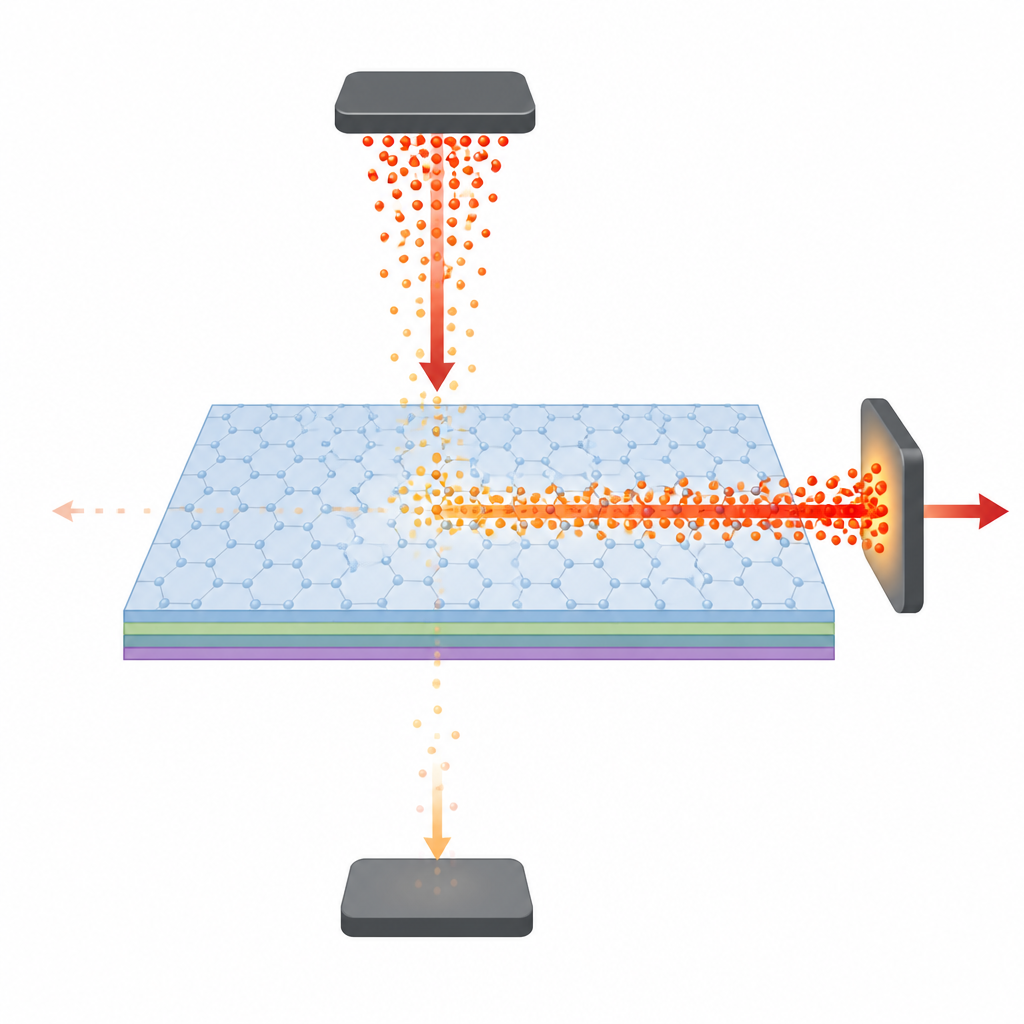
Measuring Uneven Travel of Magnons
To test this, the researchers placed thin platinum electrodes on top of CrOCl flakes. Passing an alternating current through one electrode heats it slightly and excites magnons in the underlying crystal. A second, separate electrode detects how many of those magnons reach it, by converting their spin flow back into a measurable voltage. By rotating the device and changing the distance between the injector and detector, the team mapped how far magnons could travel in different in-plane directions, magnetic fields, temperatures, and sample thicknesses.
Long-Distance Flow Along One Direction
The results were striking. Along the a-axis, magnons traveled more than 7 micrometers in thicker samples, a distance comparable to those seen in some of the best three-dimensional magnetic insulators used in magnon research. Along the b-axis, however, the signal dropped off quickly and could even vanish a few micrometers away, especially in thinner flakes. Across many devices, the diffusion length along the a-axis was roughly three to four times longer than along the b-axis. This strong contrast means that, even though the material is a two-dimensional sheet, magnons behave as if they are confined to quasi one-dimensional paths.
How Flat Bands Shape the Path
To understand the microscopic origin of this behavior, the authors built a theoretical model of the spin arrangement in CrOCl and calculated the allowed magnon energies. They found that along the b-axis the magnon band is nearly flat, meaning magnons there have very little group velocity and do not carry disturbances efficiently. Along the a-axis the band is strongly sloped, so magnons move quickly and diffuse over long distances. The repeating up-down pattern along the b-axis also introduces many domain-like regions that scatter magnons. When they computed how these features affect the diffusion length as a function of direction, the predicted anisotropy closely matched the experiments. 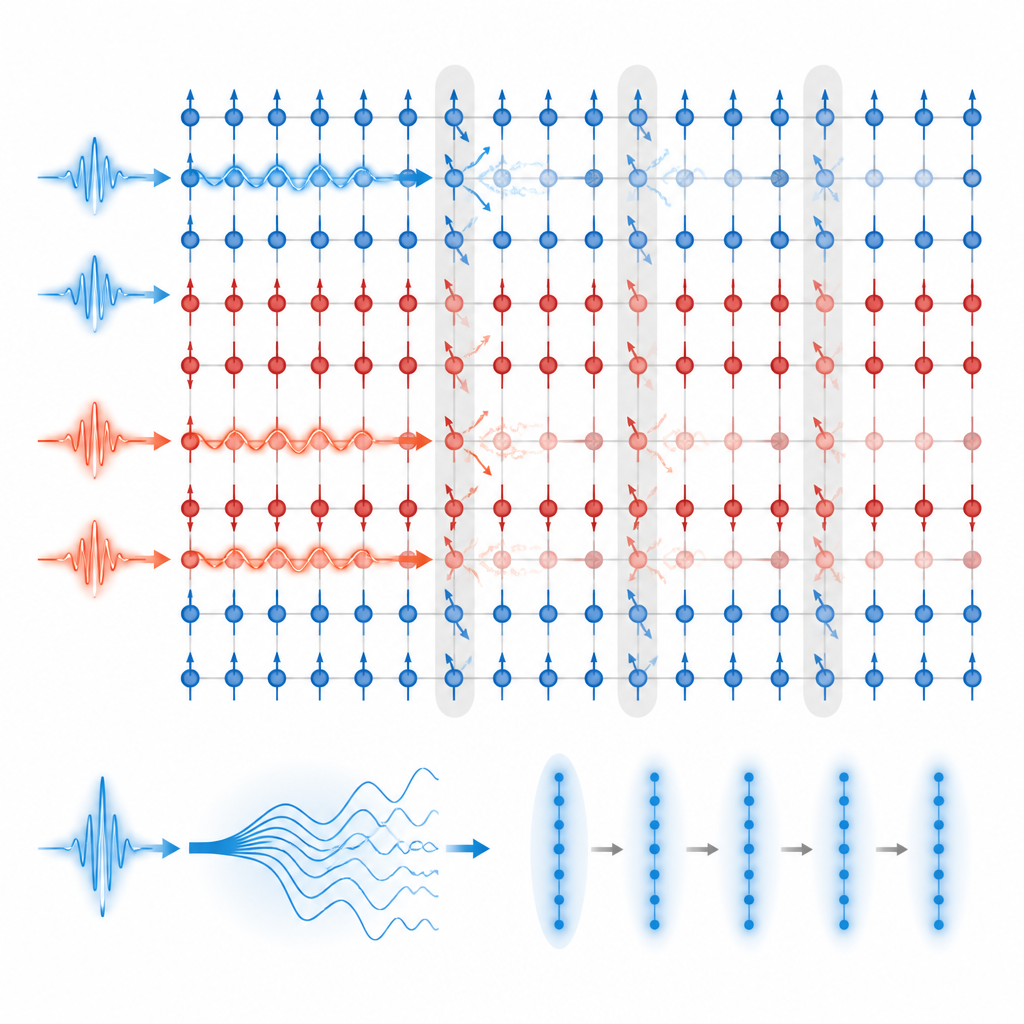
What This Means for Future Devices
For a nonspecialist, the key message is that the internal pattern of magnetism in a crystal can act like an invisible rail system that channels magnetic waves along preferred directions. In CrOCl, a combination of flat magnon bands and a stripy spin structure confines magnons to long, narrow paths while suppressing sideways leakage. Although the required temperatures are still low, this work shows how flat bands in magnetic systems can be harnessed to design energy-efficient, tightly packed magnon circuits, where information flows not by moving electrons but by guiding tiny waves of spin.
Citation: Luo, B., Chen, M., Wang, Z. et al. Flat band induced quasi-one-dimensional magnon transport in a two-dimensional spin lattice. Nat Commun 17, 4292 (2026). https://doi.org/10.1038/s41467-026-70912-3
Keywords: magnon transport, spintronics, flat bands, CrOCl, two dimensional magnets