Clear Sky Science · en
CD8+ T cells sustain vaccination-induced immunity against dissemination of contained tuberculosis in immunosuppressed hosts
Why this matters for people at risk of TB
Tuberculosis silently lurks in about a quarter of the world’s population, often held in check for years without causing symptoms. When the immune system weakens, this quiet infection can suddenly escape and damage vital organs, especially the lungs. This study asks a key question with real-world consequences: in people whose main immune defenders are crippled, such as those living with HIV, can vaccination still stop dormant tuberculosis from spreading through the body?
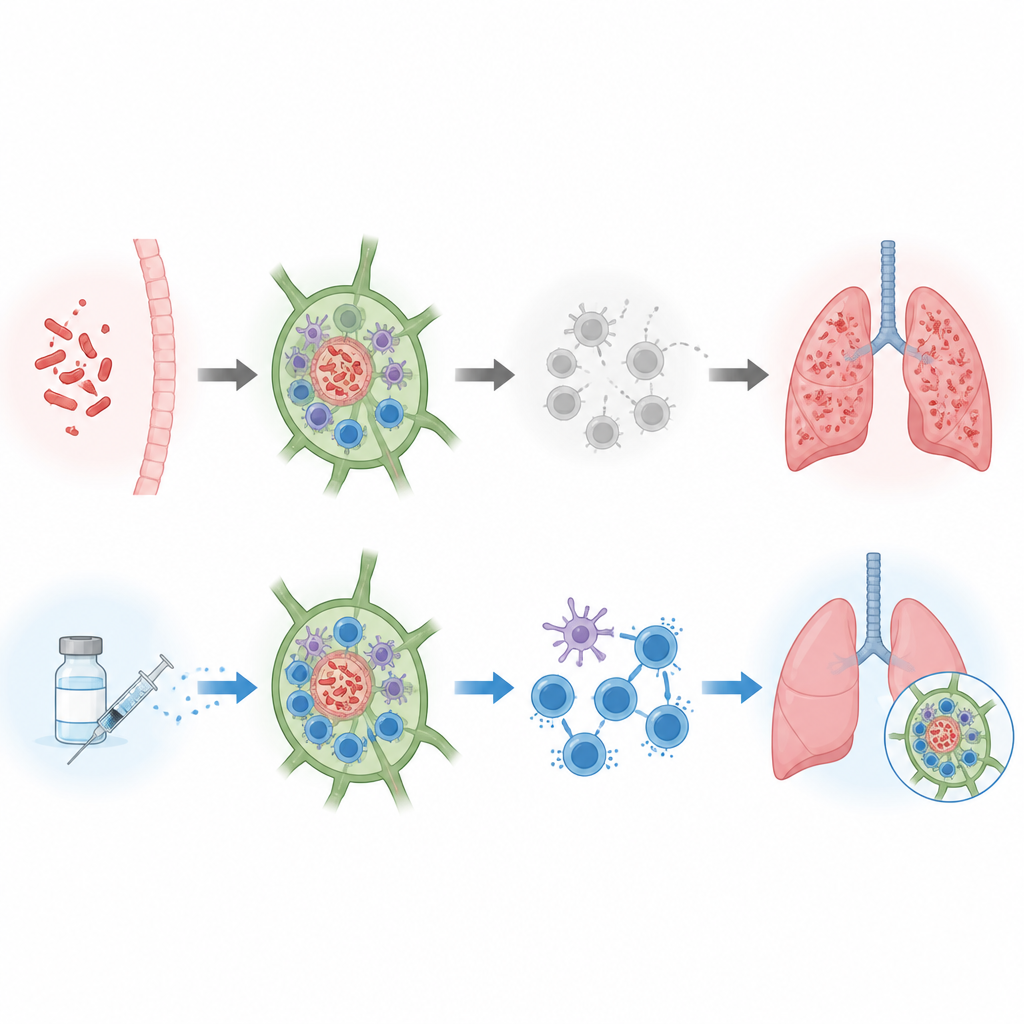
Hidden germs and a fragile balance
The bacteria that cause tuberculosis often lie contained within small structures in the body’s lymphatic system, including lymph nodes. In this study, researchers used a mouse model that closely mimics this contained state. In healthy mice, bacteria placed in the skin travel to nearby lymph nodes and usually stay put, much like a fire that has been ringed by a firebreak. When the scientists artificially removed a key group of immune cells called CD4 T cells, the bacteria broke free, spread to the lungs and other organs, and caused progressive disease. This mirrors what can happen in people whose immune systems are weakened by HIV, diabetes or medical treatments.
Vaccination holds the line even when key cells are lost
The team tested whether standard BCG vaccination and a new recombinant version could still restrain the infection once CD4 T cells were knocked out. Remarkably, both vaccines stopped or sharply reduced the spread of bacteria from lymph nodes to the lungs and other tissues, even under strong immune suppression. Microscopic examination of organs showed far less damaged tissue in vaccinated animals, and bacteria occupied much smaller areas. These findings suggest that vaccination can build a safety net that does not rely solely on CD4 T cells, offering clues for protecting people whose immune systems are compromised.
Who steps in when usual defenders are missing
To uncover which cells formed this backup defense, the researchers combined advanced imaging, spatial gene profiling and experiments in specialized mouse strains. They saw that after CD4 T cells were removed, other immune cells changed their numbers and positions around the infected areas. B cells, which make antibodies, increased in lymph nodes and gathered mostly at the outer rims of lesions. However, when the team used mice that completely lack B cells, the bacteria still remained contained, and disease did not worsen. In contrast, when both major types of T cells, CD4 and CD8, were absent, mice rapidly succumbed to widespread infection. This pointed away from B cells and toward T cells as the essential guardians.
CD8 T cells as the backup guardians
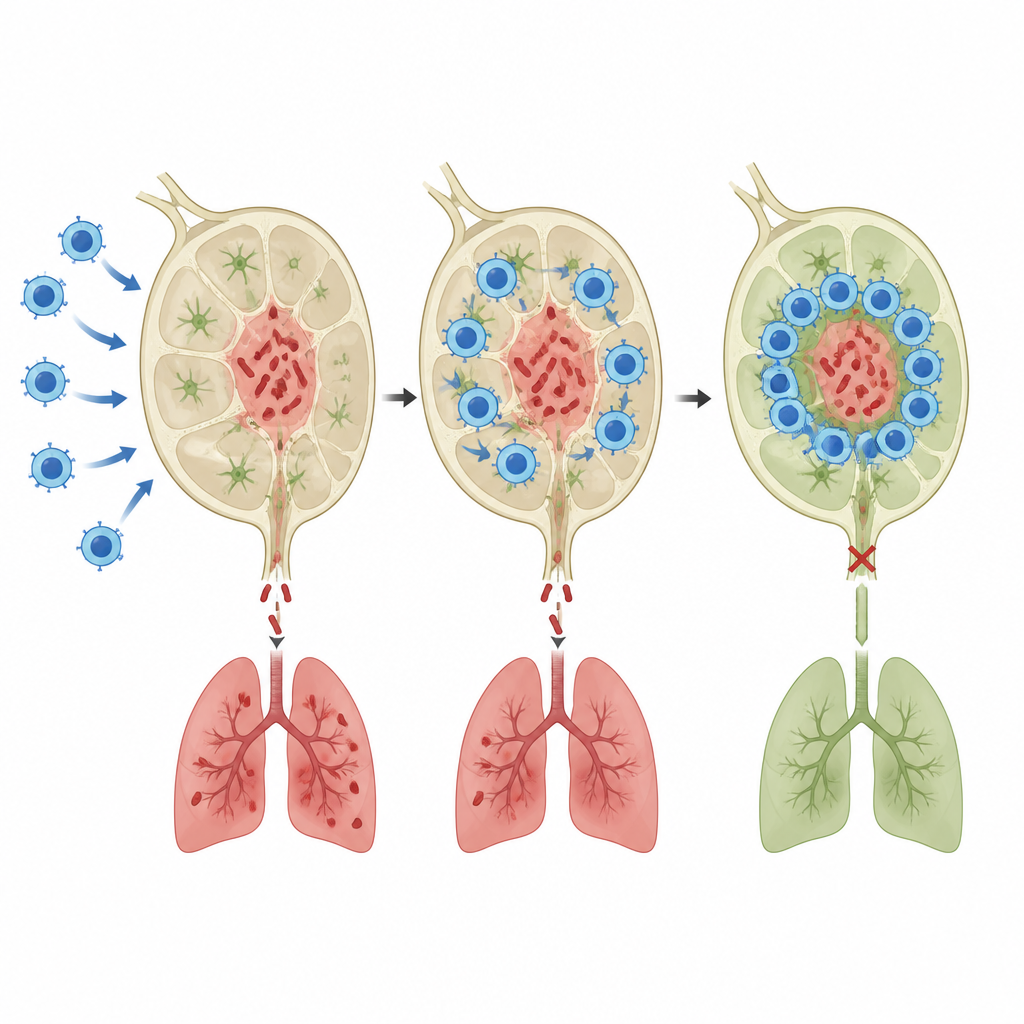
Focusing on CD8 T cells, the investigators used cell transfers and carefully targeted antibody treatments to add or remove specific immune cell types. When CD8 T cells from vaccinated donors were present, highly susceptible mice survived and kept the infection restricted to lymph nodes. Depleting CD8 T cells alone did not cause disaster, because CD4 T cells could compensate. But whenever both CD4 and CD8 T cells were missing, infection spilled over into the lungs and became lethal, regardless of vaccination. Spatial analyses showed CD8 T cells clustering near bacteria at the edge of lymph node lesions, a strategic position that likely allows them to kill infected cells before microbes escape.
What this means for people living with weakened immunity
Together, these results show that successful tuberculosis vaccination can create layered protection. If CD4 T cells fail, CD8 T cells can still step in to keep latent infection locked inside lymph nodes and prevent it from spreading to the lungs. B cells, in contrast, seem to play at most a supporting role in this setting. For people with conditions such as HIV that undermine CD4 T cells, vaccines that strongly boost CD8 T cell responses may help reduce the risk that a silent tuberculosis infection turns into active, organ-damaging disease.
Citation: Miranda-Hernandez, S., Kumar, M., Henderson, A. et al. CD8+ T cells sustain vaccination-induced immunity against dissemination of contained tuberculosis in immunosuppressed hosts. Nat Commun 17, 4476 (2026). https://doi.org/10.1038/s41467-026-70911-4
Keywords: tuberculosis, latent infection, BCG vaccine, CD8 T cells, immunosuppression