Clear Sky Science · en
Cooperativity in E. coli aspartate transcarbamoylase is tuned by allosteric breathing
How Cells Use a Molecular Balloon to Balance Their Building Blocks
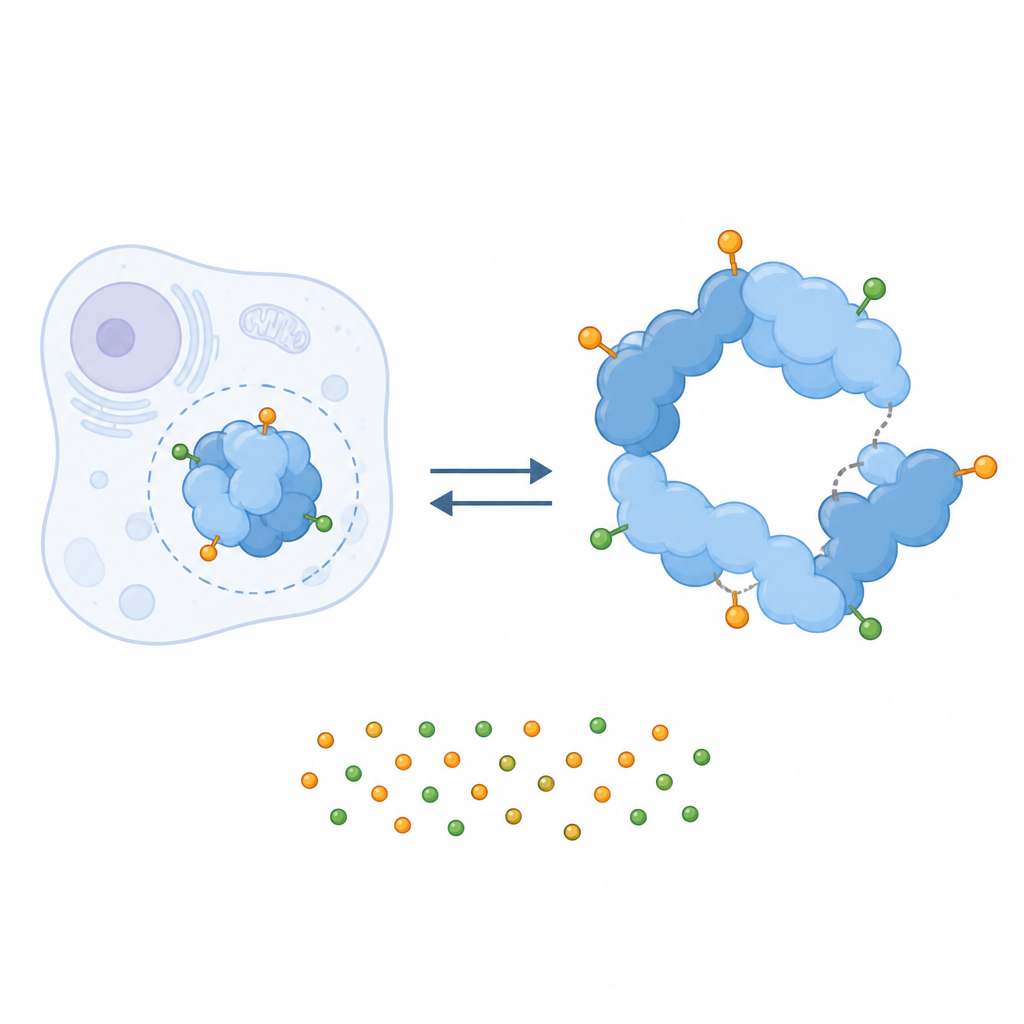
Inside every cell, a constant battle rages to keep the supply of DNA and RNA building blocks in balance. This study looks at a classic enzyme from E. coli bacteria and reveals that it behaves like a tiny breathing balloon. By expanding and contracting in response to small signaling molecules, the enzyme helps the cell decide when to slow down or speed up production of certain nucleotides, the chemical letters of genetic material.
A Key Gatekeeper for Genetic Building Blocks
The enzyme at the heart of this story is called aspartate transcarbamoylase, or ATCase. It catalyzes an early step in making pyrimidines, one of the two main families of nucleotide “letters” that make up DNA and RNA. ATCase is built from two types of subunits arranged into a large, symmetrical complex. Some subunits carry out the chemical reaction, while others serve as regulatory handles that sense nucleotide levels. For decades, ATCase has been a textbook model of allostery, where binding at one site on a protein controls activity at a distant site.
From Simple Switch to Flexible Breathing
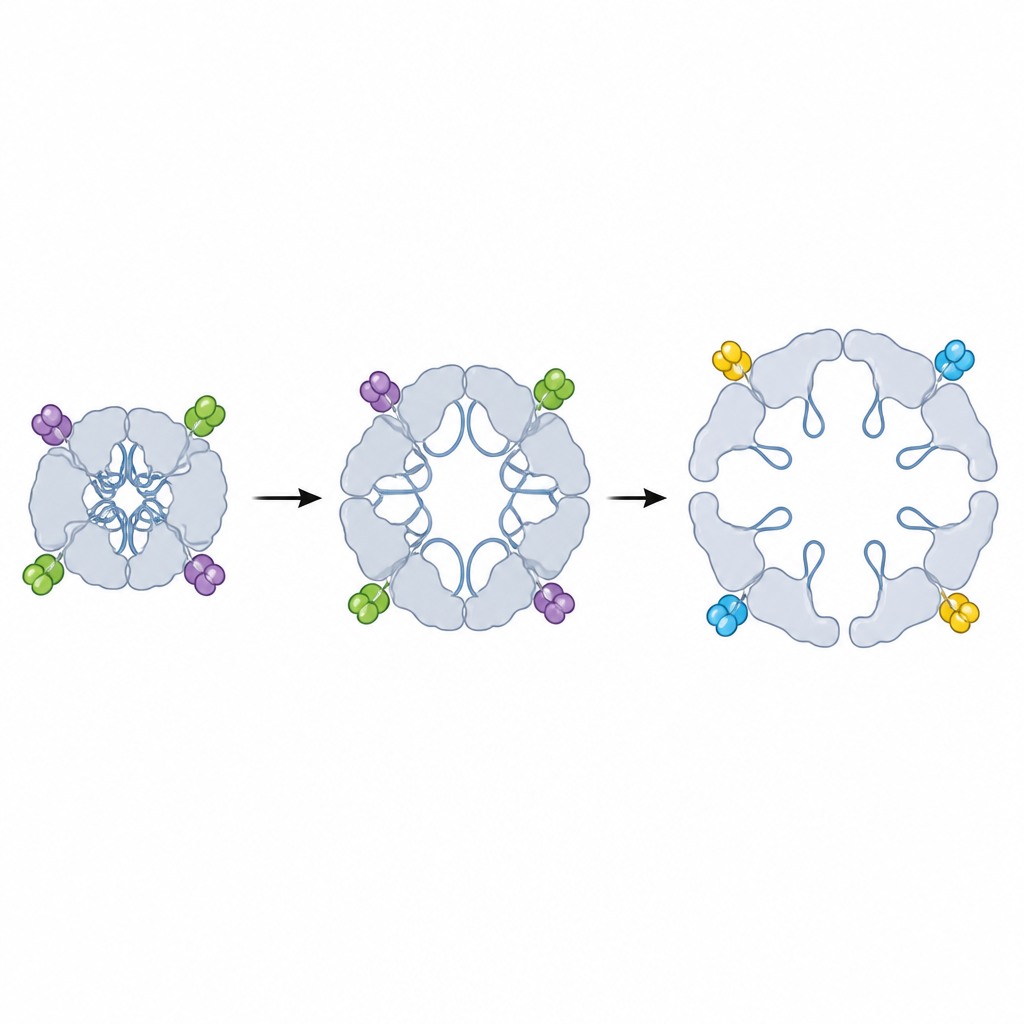
Classic models described ATCase as flipping between two fixed shapes: a tense form with low activity and a relaxed form with high activity. In this view, small nucleotide molecules simply nudged the balance between these two states. The new work shows that this picture is too simple. Using a combination of cryo electron microscopy, small angle X ray scattering, and X ray crystallography, the authors find that the relaxed form is not rigid at all. Instead, it is more like a flexible balloon that can expand and contract over a range of sizes while still remaining in an active arrangement.
How Nucleotides Squeeze or Stretch the Enzyme
The team focused on how four common ribonucleoside triphosphates influence this breathing motion. Two pyrimidines, CTP and UTP, bind together as a matched pair at each regulatory site and cause the enzyme to contract. In this squeezed state, internal loops that must move to bind the amino acid aspartate are crowded together in the central cavity. This crowding forces the enzyme’s active sites to act in a tightly coordinated way, creating strong cooperativity and making the reaction very hard to start at normal aspartate levels.
Purines Open the Gate and Loosen Cooperation
In contrast, the purines ATP and GTP also bind as a matched pair but have the opposite effect. They encourage the enzyme to expand to its widest relaxed form. In this expanded state, the key loops inside the enzyme are spread apart and can move more independently. As a result, the enzyme shows little cooperativity: aspartate can bind readily, and the reaction runs efficiently even when aspartate is not particularly abundant. Remarkably, ATP and GTP can begin to open the enzyme even before all substrates bind, allowing the enzyme to bypass its usual low activity tense form altogether.
A Breathing Mechanism that Balances Cell Needs
Putting these findings together, the authors propose that ATCase regulation works by tuning the size of this flexible balloon rather than by flipping a rigid on off switch. When pyrimidine products build up, CTP and UTP compress the enzyme and sharply reduce activity, preventing wasteful overproduction. When purine levels are high, ATP and GTP expand the enzyme and relieve this brake, helping keep pyrimidine and purine pools in balance. For a lay reader, the key message is that cells use finely tuned mechanical motions in large protein assemblies to sense their internal chemistry and adjust vital pathways in a smooth and graded way.
Citation: Miller, R.C., Patterson, M.G., Bhatt, N. et al. Cooperativity in E. coli aspartate transcarbamoylase is tuned by allosteric breathing. Nat Commun 17, 4285 (2026). https://doi.org/10.1038/s41467-026-70909-y
Keywords: allosteric regulation, enzyme cooperativity, nucleotide metabolism, cryo EM, E. coli ATCase