Clear Sky Science · en
4f-5d orbital tag-team catalysis empowers high-loading zinc–iodine batteries
Why better batteries matter for our power grid
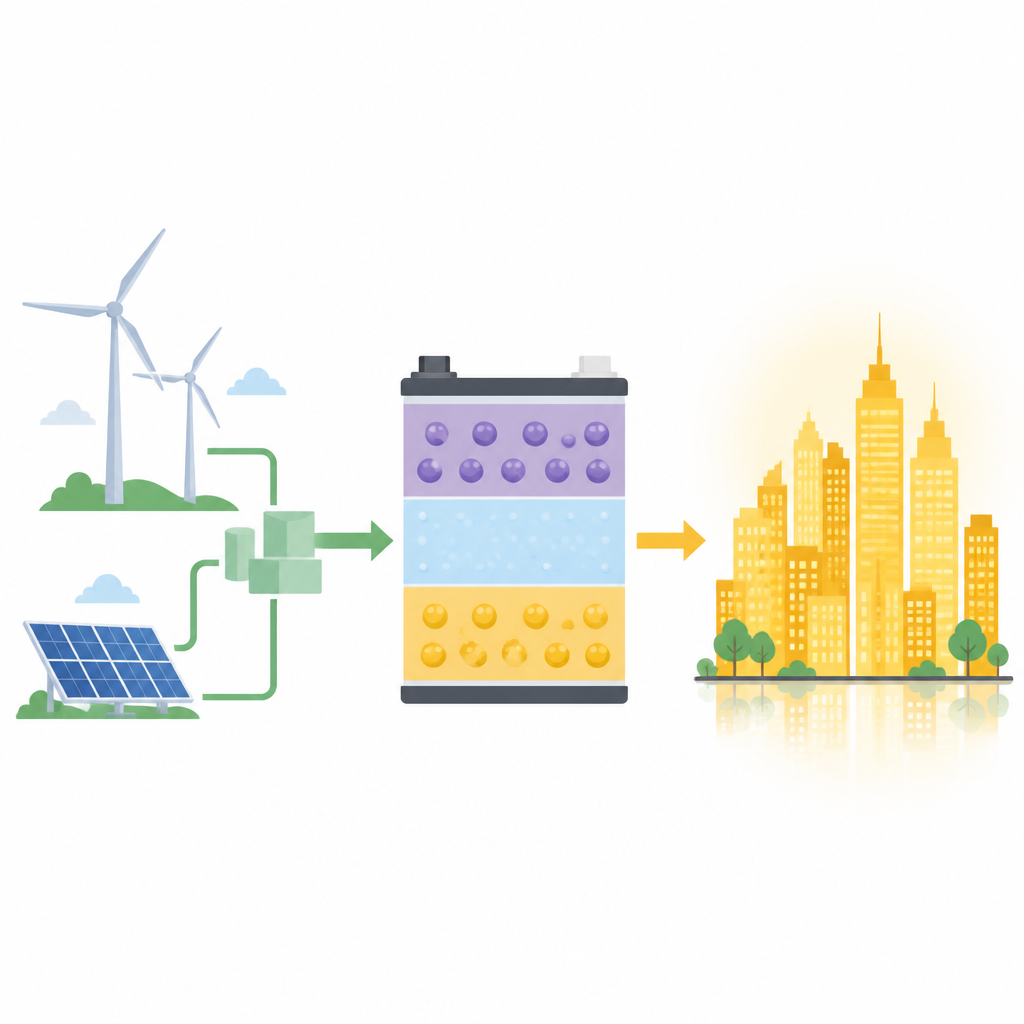
As more solar panels and wind farms feed electricity into the grid, we need large batteries that are safe, long lasting, and affordable. Zinc–iodine batteries are promising because they use water-based electrolytes and abundant elements, but they struggle when packed with enough active material for real-world power stations. This study shows how tuning the tiniest building blocks of a catalyst can unlock high-capacity zinc–iodine batteries that work reliably at industrial loadings.
The challenge of packing more energy
In zinc–iodine batteries, energy is stored when iodine on the positive side changes form as the battery charges and discharges. At low iodine amounts, this chemistry works fairly well. At the high iodine loadings needed for grid storage, however, performance quickly falls off. Intermediate iodine species drift through the electrolyte, corroding the zinc side and wasting material, a problem known as the shuttle effect. At the same time, the chemical reactions slow down, so the battery cannot charge or discharge quickly. The core difficulty is to hold on to these iodine intermediates strongly enough to stop them wandering, while still letting their bonds break and reform easily during cycling.
A new way to choose the right catalyst
The authors built a machine learning framework to search for catalysts that could both trap and activate iodine species. Instead of only tracking overall reaction energies, they focused on how the electrons in different metal atoms fill specific orbitals and how charge shifts between metal and surrounding atoms. From a large set of possible single-atom catalysts, spread across transition and rare-earth metals, the model highlighted two key numbers that describe how tightly iodine binds and how easily its bonds can be stretched. This data-driven scan pointed to cerium, a rare-earth element, as a particularly favorable center when anchored as isolated atoms in a nitrogen-doped carbon support.
Tag-team work at the atomic level
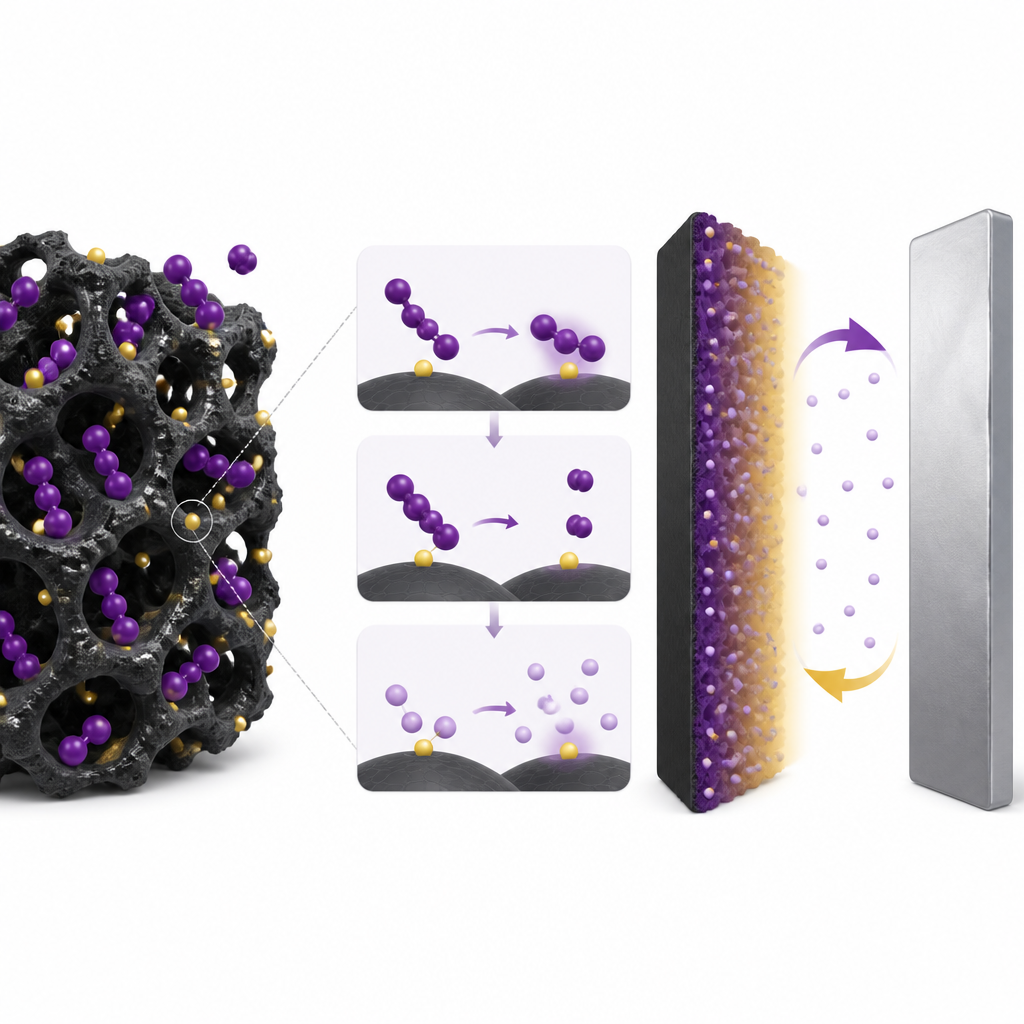
Detailed quantum calculations revealed why cerium stands out. In this material, each cerium atom sits alone in the carbon framework and offers two types of electron orbitals that share the work. One set of orbitals binds iodine intermediates firmly, helping keep them near the electrode and reducing their loss to the electrolyte. A second set of orbitals, sitting at just the right energy, pushes back against the bond between iodine atoms, making that bond easier to break and reform. This “tag-team” action lets the catalyst stabilize the reaction intermediates without freezing the chemistry, sidestepping the usual trade-off where stronger binding slows reaction turnover.
From atomic design to real devices
After synthesizing a library of single-atom catalysts, the team confirmed that cerium-based electrodes capture iodine species more completely and move charge faster than versions based on common transition metals like cobalt or niobium. Measurements showed lower reaction barriers, smaller charge-transfer resistance, and cleaner, more stable voltage profiles. Importantly, these benefits held up even when the iodine content was pushed to levels relevant for grid storage. Electrodes with cerium single atoms delivered high capacities over many thousands of cycles and maintained nearly linear growth in stored charge as more iodine was added, up to very thick electrodes.
Toward practical zinc–iodine grid batteries
The authors assembled pouch cells that resemble commercial battery formats and loaded them with very high amounts of iodine. These cells reached large areal capacities while retaining most of their performance over extended cycling and months of storage. Microscopy and spectroscopy showed that the zinc surface stayed smooth and free of heavy corrosion when paired with cerium-based positive electrodes, confirming that the shuttle problem was strongly suppressed. In simple terms, by carefully arranging how electrons sit in the catalyst at the orbital level, the researchers found a way to let iodine chemistry run fast and clean even in densely packed electrodes, bringing aqueous zinc–iodine batteries a step closer to practical grid-scale use.
Citation: Chen, M., He, Y., Li, H. et al. 4f-5d orbital tag-team catalysis empowers high-loading zinc–iodine batteries. Nat Commun 17, 4563 (2026). https://doi.org/10.1038/s41467-026-70908-z
Keywords: zinc iodine batteries, grid energy storage, single atom catalysts, cerium catalyst, machine learning materials