Clear Sky Science · en
Filamentation-assisted isolated attosecond pulse generation
Freezing Motion at a Billion-Billion Frames per Second
Many of the most important events in nature happen far faster than a camera can see: electrons shifting in atoms, charges racing through materials, and spins flipping in magnets. To watch such action directly, scientists use flashes of light that last just attoseconds—billionths of a billionth of a second. This paper reports a simple and robust way to generate such extreme flashes using a common type of industrial laser and a clever gas-filled device, potentially putting “electron-speed cameras” within easier reach of many laboratories.
Why Ultra-Short Light Flashes Matter
Attosecond pulses have transformed how researchers study matter. With them, it is possible to track how electrons move inside atoms, molecules, and solids, to follow how excitations spread, and to steer magnetic states in materials. These capabilities underpin emerging “lightwave” technologies that could someday process information at petahertz rates—far faster than today’s electronics. But to push this science forward, experimenters need attosecond pulses that are not only extremely short, but also bright, clean, and stable from shot to shot.
Turning a Workhorse Laser into an Electron-Speed Strobe
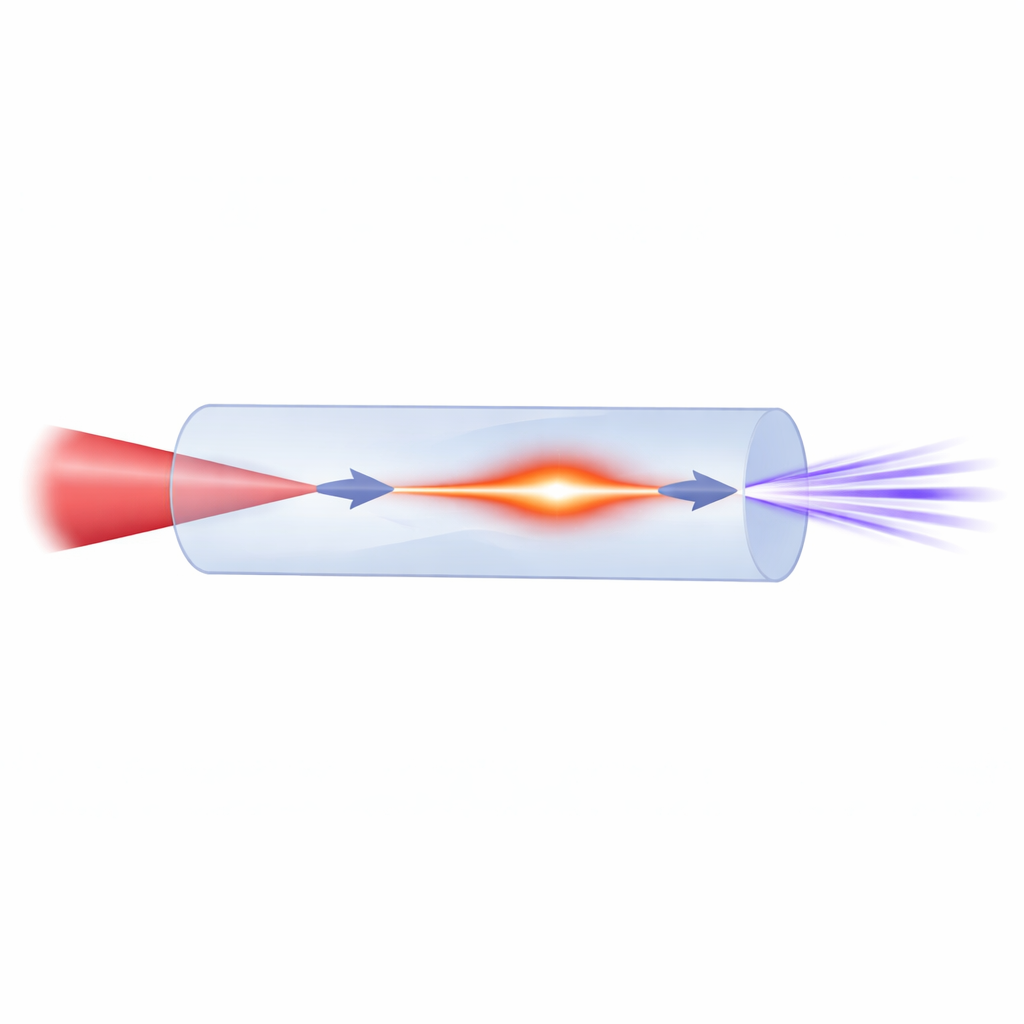
The team works with a rugged ytterbium (Yb) laser, a popular platform for high‑power femtosecond pulses. On its own, this kind of laser produces relatively long pulses, over 150 femtoseconds, which must be heavily compressed to reach the few‑cycle regime needed for attosecond work. Such strong post‑compression typically leaves behind unwanted satellite pulses and distorted wavefronts that spoil pulse quality. The authors send these already compressed, 4.7‑femtosecond infrared pulses into a long, gas‑filled chamber called a semi‑infinite gas cell. Inside this extended medium, the light and gas interact so strongly that the beam reshapes itself as it travels, forming a thin, bright “filament” of light.
How a Self-Formed Light Filament Cleans and Shortens Pulses
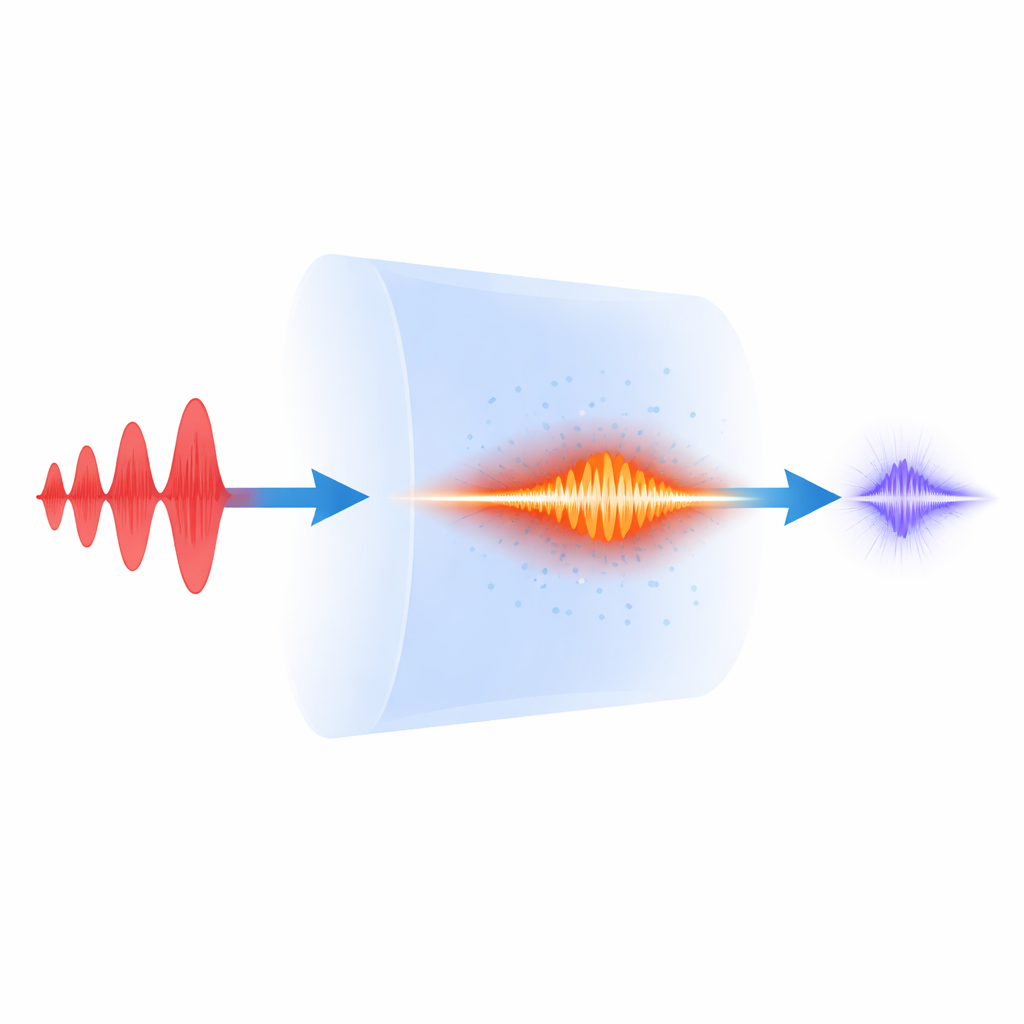
Once conditions are tuned so that the laser’s peak power closely matches a critical value set by the gas, a balance emerges between three effects: natural beam spreading, focusing by the gas itself, and defocusing by the plasma created when the gas ionizes. This balance produces a self-guided filament that keeps its size nearly constant over several millimeters. Within this narrow channel, the peak of the pulse experiences a subtle blue shift—its color moves to slightly higher frequency—while parts in front and behind shift differently. The net effect is that the central spike of the pulse becomes shorter in time and cleaner in space, shrinking from 4.7 to 3.5 femtoseconds in argon. At the same time, the outer, less useful parts of the spectrum spread out and carry only a small fraction of the energy, leaving a well‑behaved core.
From Clean Infrared Pulses to Isolated Attosecond Bursts
In this filament regime, the intense, cleaned‑up infrared pulse generates extreme‑ultraviolet light through high‑order harmonic generation, in which electrons are first freed, then driven back to their parent ions, emitting very high‑frequency radiation. Because the beam is both tightly guided and briefly compressed, the conditions for building these harmonics are satisfied only during a very short temporal window around the pulse peak. This acts as a natural gate, allowing just a single attosecond burst to form instead of a train of pulses. Measurements using attosecond “streaking” show that this approach reliably produces bright, isolated pulses: about 200 attoseconds at 65 electronvolts in argon, 69 attoseconds at 100 electronvolts in neon, and 65 attoseconds at 135 electronvolts in helium, all with good beam quality and high contrast.
A Straightforward Path to Practical Attosecond Sources
The study demonstrates that a long, gas‑filled cell operated in the filament regime can at once shorten, steady, and spatially clean a challenging infrared pulse, while simultaneously turning it into a powerful source of isolated attosecond flashes. Compared with more complex schemes that rely on intricate gating tricks or delicate optics, this method needs only a strong few‑cycle pulse and a properly tuned gas cell. Because it works with robust Yb lasers that are already common in laboratories and industry, this filament‑assisted approach offers a practical route toward widely accessible attosecond light sources for probing and ultimately controlling ultrafast processes in matter.
Citation: Chien, YE., Fernández-Galán, M., Tsai, MS. et al. Filamentation-assisted isolated attosecond pulse generation. Nat Commun 17, 3501 (2026). https://doi.org/10.1038/s41467-026-70903-4
Keywords: attosecond pulses, high-order harmonic generation, laser filamentation, ultrafast spectroscopy, semi-infinite gas cell