Clear Sky Science · en
Versatile water-floated nanostructures for three-dimensional nanotransfer printing
Printing tiny patterns onto real-world objects
Tiny patterns of metal, thousands of times thinner than a human hair, can give everyday objects new abilities, from sensing pollution to powering virtual reality. This research shows a simple way to “print” such nanostructures onto almost any surface using nothing more exotic than a shallow bath of water. By letting delicate metal meshes float and then gently scooping them up with lenses, leaves, and fibers, the team avoids harsh chemicals and heat, opening doors for safer, more versatile smart surfaces.
Why putting nanotechnology on curves is hard
Modern sensors and optical devices often rely on carefully patterned nanostructures. Traditional ways to make them fall into two camps: building them up atom by atom or carving them from solid materials. Both approaches work well on flat, rigid wafers but struggle with soft, curved, or heat-sensitive objects such as plant leaves, plastics, or skin. Existing nanotransfer printing can move patterns from a mold to a new surface, yet usually needs sticky glues, high temperatures, or toxic solvents. These steps can warp delicate substrates or leave behind unwanted residues, and rigid molds cannot easily wrap around three-dimensional shapes.
Letting metal meshes float on water
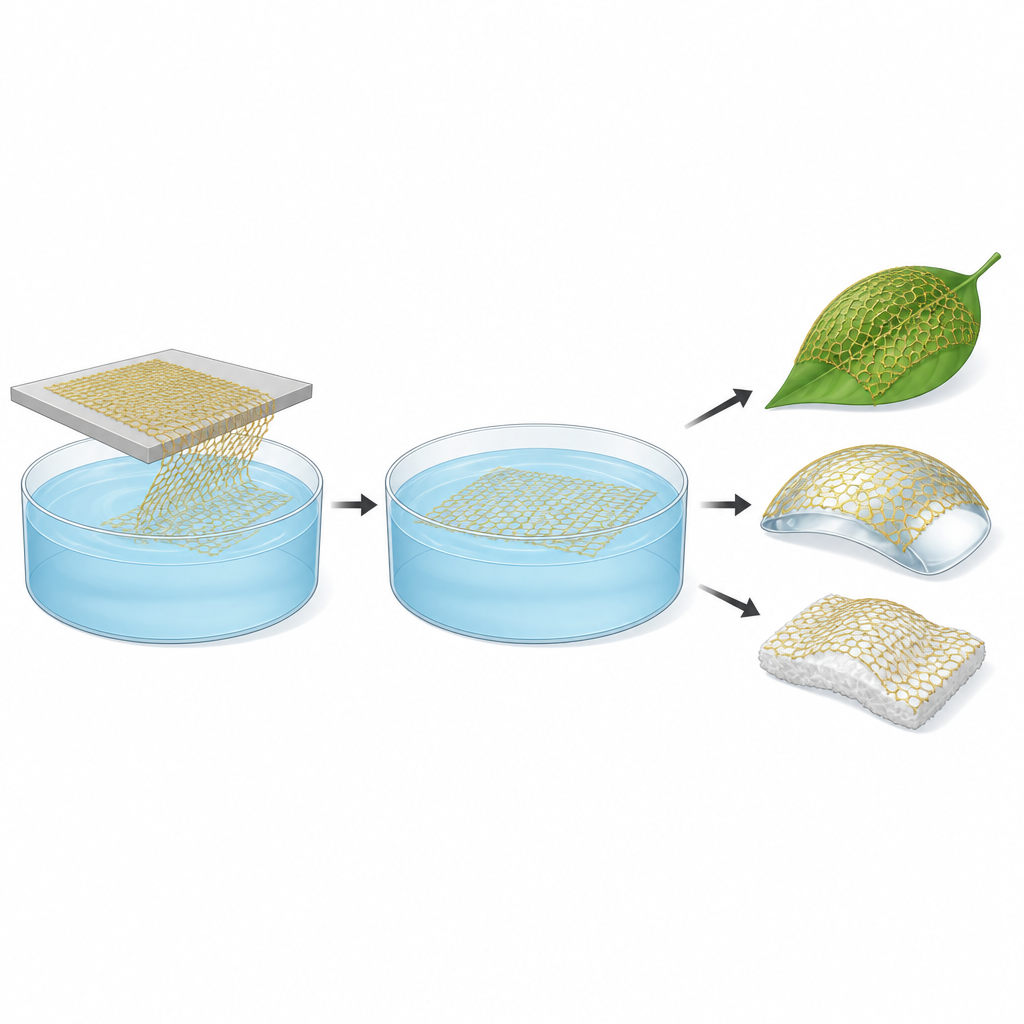
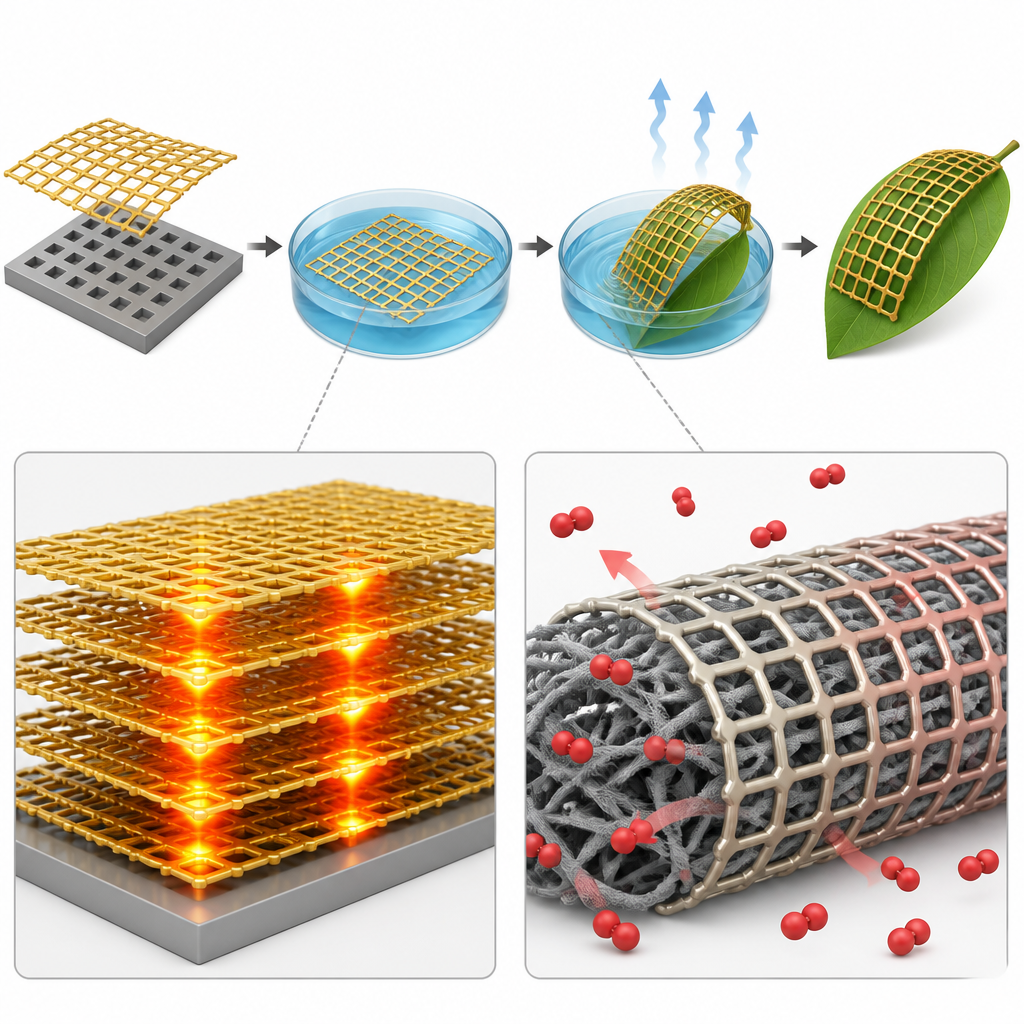
The authors draw inspiration from hydrographic printing, where printed films are floated on water and then wrapped around objects. They first create ultra-thin metal meshes on a patterned polymer mold and use plasma etching to weaken the grip between metal and mold without damaging the metal itself. When the mold is dipped into water, liquid seeps into tiny gaps and lifts the mesh free so it floats as a continuous sheet. A target object, such as a glass lens or leaf, is then slowly pushed up through the water surface to “scoop” the mesh onto itself. As the remaining water film dries, capillary forces pull the mesh tightly against the surface, bringing it close enough for van der Waals forces to hold it firmly in place without any extra glue.
Covering lenses, plants, plastics and even lotus leaves
Using this water-floated nanotransfer printing, the team successfully coats curved glass lenses, the textured surfaces of plant leaves, and rough fruits like apples and oranges. Microscopy and electrical tests show that the metal meshes stay continuous and crack-free even on steep curves and rough textures. Because the process relies on surface tension, the researchers also tune the liquid itself. Pure water works well for wettable surfaces, but highly water-repelling ones, like the back side of certain leaves, electrospun plastic fibers, and famously the superhydrophobic lotus leaf, require a mixture of water and ethanol with lower surface tension. By choosing the right mix, they can both keep the mesh afloat and allow the liquid to wet and coat even these very slippery surfaces.
Turning floating meshes into practical sensors
The method does more than just decoration; it enables functional devices. One showcase is a surface-enhanced Raman scattering (SERS) sensor, where stacked layers of gold mesh create many tiny gaps that strongly boost the light signal from molecules sitting in them. Simulations and experiments reveal that about seven stacked layers give the strongest signal. When these multilayer meshes are transferred onto leaves and fruit, they allow non-destructive detection of a common pesticide, thiram, at residue levels well below typical safety limits. In another example, palladium meshes are transferred onto breathable fiber mats to make flexible hydrogen gas sensors. Hydrogen molecules diffuse through the fibers and into the mesh, subtly changing its electrical resistance; the devices respond reliably to low hydrogen levels while ignoring other gases like carbon monoxide and nitrogen dioxide.
What this means for future smart surfaces
To a non-specialist, the key message is that intricate nano-patterns no longer need to be confined to flat, fragile chips. By letting metal meshes briefly float on a water surface and then scooping them up, this technique can dress complex everyday objects with invisible electronic and optical skins, without heat, glue, or harsh chemicals. That makes it especially attractive for uses on plants, fabrics, and potentially human skin, where preserving natural properties is crucial. While future work may refine pattern designs and layer alignment, this water-based approach offers a straightforward path toward smarter agriculture, safer gas monitoring, advanced wearable devices, and other technologies that quietly weave nanoscience into the world around us.
Citation: Kang, BH., Ha, JH., Kwon, Y. et al. Versatile water-floated nanostructures for three-dimensional nanotransfer printing. Nat Commun 17, 4588 (2026). https://doi.org/10.1038/s41467-026-70902-5
Keywords: nanotransfer printing, nanomesh sensors, surface enhanced Raman, hydrogen gas sensing, 3D smart surfaces