Clear Sky Science · en
Mid-infrared detection through ligand-driven local heating in lanthanide-doped nanoparticles
Why heat from invisible light matters
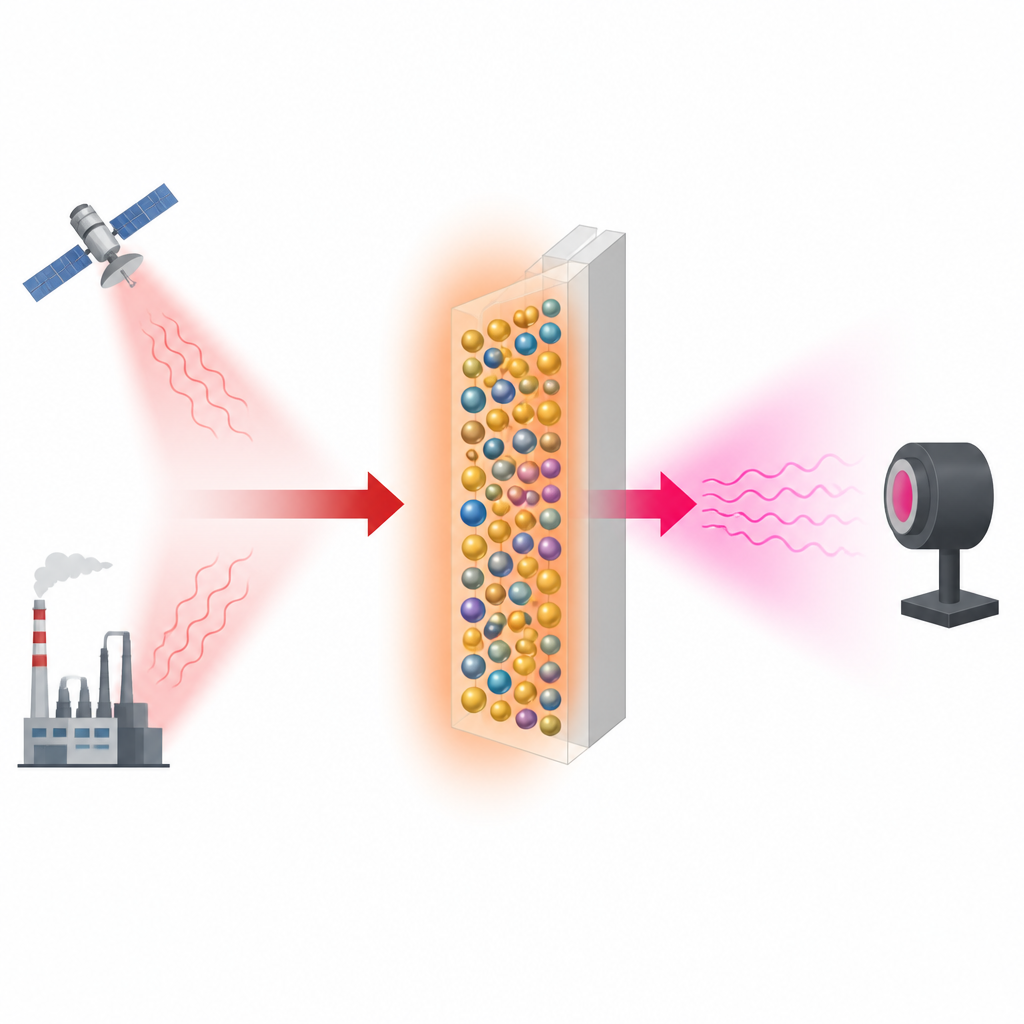
Much of the world around us gives off mid infrared light, a form of invisible heat radiation that carries rich chemical and environmental information. Detecting this light usually demands complex, costly sensors that must be kept very cold. This study presents a new way to sense mid infrared light at room temperature by turning tiny, specially coated nanoparticles into local heaters that translate invisible heat into easily measured near infrared glow.
Turning heat into a light signal
The researchers focus on mid infrared detection because it underpins technologies such as environmental monitoring, industrial process control, and security screening. Conventional materials that directly absorb this radiation often need cryogenic cooling and intricate manufacturing. Another approach converts mid infrared light into visible or near infrared light that standard silicon detectors can see, but existing methods are narrow in color range, complex, or inefficient. The team set out to build a simpler, broadband detector that works in ordinary conditions while remaining sensitive to very weak heat signals.
Tiny particles with built in heaters
To achieve this, the authors designed nanometer scale crystals containing lanthanide ions, which are known for their stable, color pure light emission. These nanoparticles are wrapped with a layer of organic molecules that strongly absorb mid infrared radiation. When mid infrared light shines on a film made from these particles, the organic shell heats up locally like a built in heater. This slight temperature rise alters how energy flows between two types of lanthanide ions inside the particle, shifting their near infrared emission from one color band to another. By tracking the ratio of these two emission colors, the system can sensitively read out the absorbed mid infrared light while canceling common noise from the pump laser and the environment.

How the light and heat dance inside the particle
The team carefully tuned the recipe of the nanoparticles, adjusting how much of each lanthanide ion they added. They showed that, under mid infrared illumination, one emission band almost vanishes while another grows strongly, producing a 177 fold change in the color ratio. Measurements of how long the light persists after excitation revealed that heating speeds up energy flowing back from one ion type to the other, explaining the sharp switching in brightness. Comparisons with particles stripped of their organic coating confirmed that the ligand layer is critical, boosting mid infrared absorption by nearly two orders of magnitude and providing thermal insulation so that even modest radiation produces a measurable local temperature rise.
From materials to a working sensor
Building on this mechanism, the researchers created a practical detector by shining a near infrared pump beam onto the nanoparticle film and measuring the resulting emission with a standard silicon photodetector. Incoming mid infrared light reduces the photovoltage signal in a way that scales linearly with mid infrared power across a broad range of wavelengths from 5 to 10 micrometers. The device responds in about two milliseconds and reaches a detectivity of 4.8 × 10^8 Jones at 6.3 micrometers, outperforming several commercial room temperature mid infrared detectors, especially at longer wavelengths. The system can even operate with mid infrared light emitting diodes, pointing to future low cost, wide area sensing layouts.
Seeing gas fingerprints with light ratios
To test real world usefulness, the authors used their nanoparticle module in a gas sensing setup targeting sulfur dioxide. Mid infrared light was passed through a gas cell and then onto the nanoparticle film, and the change in near infrared emission ratio was recorded. The resulting spectra closely matched trusted reference data, confirming high spectral accuracy. By comparing their module to a common pyroelectric sensor, they found similar or better sensitivity, and when they used the color ratio instead of a single color, the noise dropped enough to cut the detection limit for sulfur dioxide down to tens of parts per million. This shows that the ratiometric readout not only improves sensitivity but also stabilizes measurements against laser and environmental drifts.
A new path for heat sensing
In simple terms, this work turns carefully coated nanoparticles into tiny heat activated color shifters that translate mid infrared radiation into a robust near infrared signal. Because the approach works at room temperature, uses well established silicon detectors, and can be scaled into thin films, it opens a practical route to compact, sensitive mid infrared sensors. Such devices could one day help track pollutants, monitor industrial emissions, and improve thermal imaging without relying on bulky cooled cameras.
Citation: Wang, C.W., Liang, L., Zhang, X. et al. Mid-infrared detection through ligand-driven local heating in lanthanide-doped nanoparticles. Nat Commun 17, 4306 (2026). https://doi.org/10.1038/s41467-026-70900-7
Keywords: mid infrared detection, lanthanide nanoparticles, photothermal sensing, gas spectroscopy, optical sensors