Clear Sky Science · en
TaCNGC-2A suppresses seed dormancy and activates pre-harvest sprouting through modulating calcium and hormonal signaling pathways
Why early sprouting in wheat matters
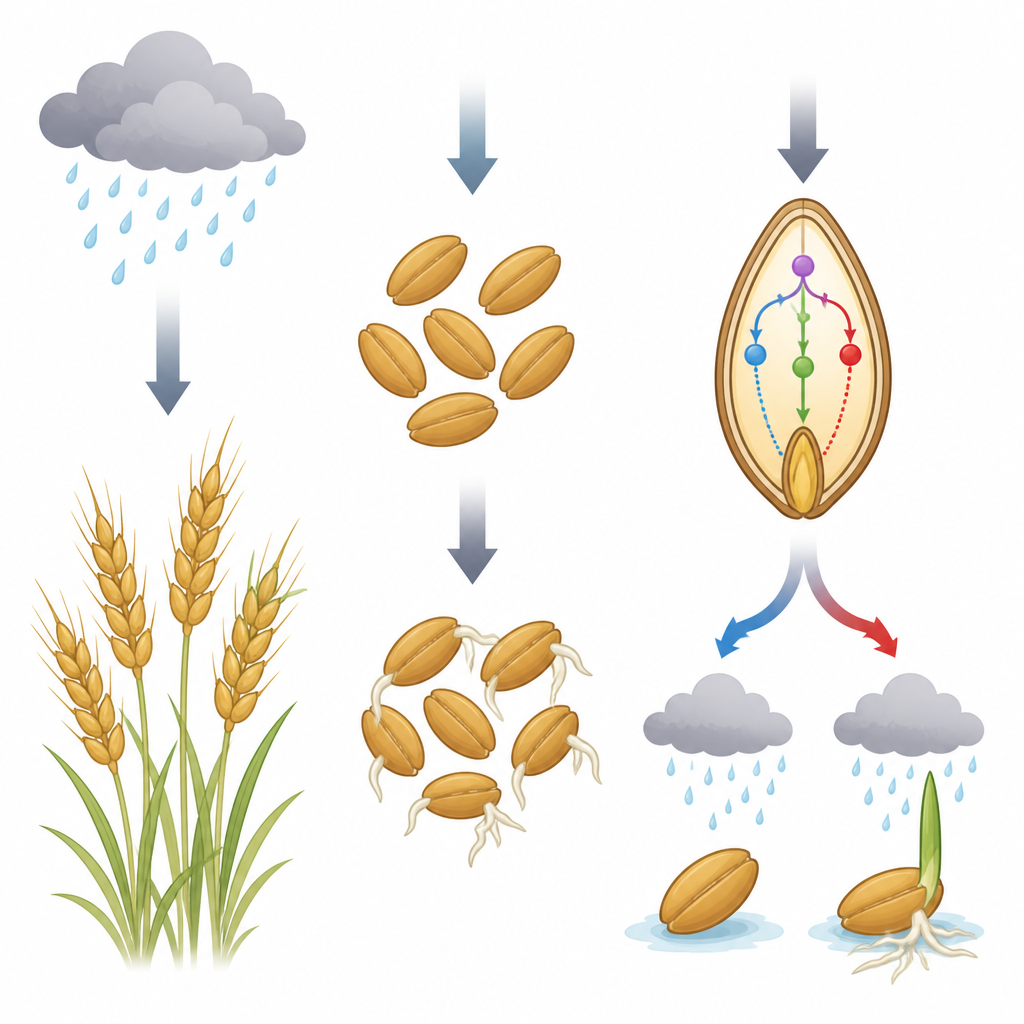
Farmers around the world face a frustrating problem: if heavy rain hits just before harvest, wheat grains can start to germinate while still on the plant. This "pre-harvest sprouting" turns plump grain into low-quality, sticky flour and cuts yields, costing growers and millers alike. The study summarized here uncovers how a pair of tiny molecular switches inside wheat seeds help decide whether grains stay asleep until harvest or wake up too soon, and shows how breeders might use these switches to develop varieties that stand up better to wet weather.
A built-in safety lock for seeds
Wheat, like other cereals, relies on seed dormancy, a built-in delay that keeps mature seeds from germinating even when conditions look good. Dormant seeds resist pre-harvest sprouting, but too much dormancy can cause uneven emergence after sowing. The researchers focused on a region of wheat chromosome 2A previously linked to dormancy and narrowed it down to a short stretch of DNA containing several genes. One stood out: TaCNGC-2A, which encodes a protein that forms a tiny gateway in cell membranes for calcium ions, key messengers in plant cells. This gene was especially active in seeds and showed different activity levels in wheat lines with strong versus weak dormancy.
A channel that weakens seed sleep
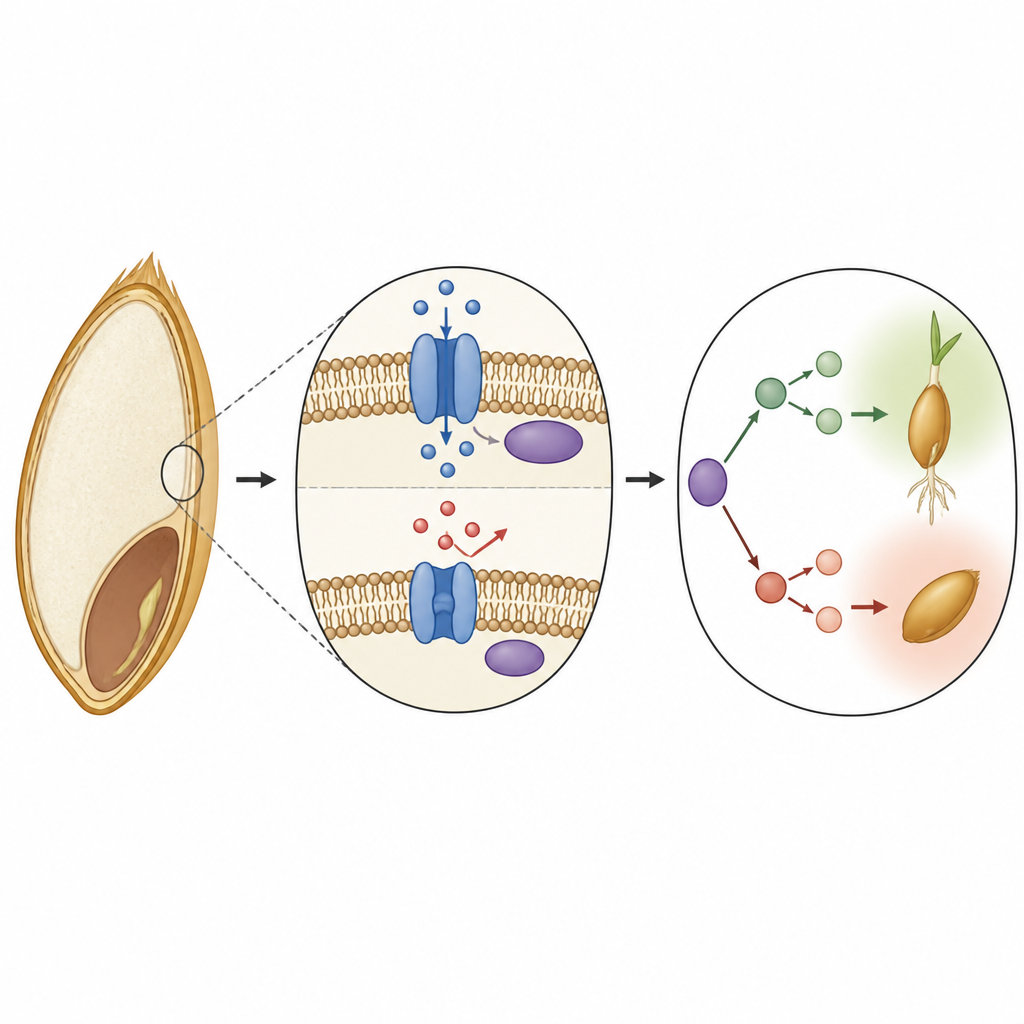
Through a combination of chemical mutants, gene editing, and overexpression lines, the team showed that TaCNGC-2A acts as a brake on dormancy. When they knocked out this gene in modern wheat varieties, seeds were slower to germinate and spikes were much less prone to sprouting under wet conditions, yet final germination after storage remained close to 100 percent and yields were unchanged. When they boosted TaCNGC-2A activity, the opposite happened: seeds germinated more readily and sprouted earlier on the spike. Similar experiments in rice using the wheat gene and its rice counterpart revealed the same pattern, suggesting that this mechanism is shared across cereals.
Seed decisions shaped by signals inside
The study also reveals how TaCNGC-2A is controlled and what lies downstream of it. Two related DNA-binding proteins, TaMYB-5B and TaMYB-5D, attach directly to a specific nucleotide in the TaCNGC-2A promoter, the on/off region in front of the gene. A single T-to-A change at this site makes the promoter more sensitive to these proteins, leading to stronger repression of TaCNGC-2A and higher dormancy. On the protein side, TaCNGC-2A physically interacts with a calcium-sensing partner called TaCaM-3A. Disrupting TaCaM-3A lowered germination, reduced sprouting on the spike, and, strikingly, increased grain size and yield per plant, while overexpressing it made seeds sprout more readily and slightly reduced yield. Together, these results place TaCaM-3A as a key helper that passes on the calcium signal started by TaCNGC-2A.
A web of hormones and dormancy genes
By comparing gene activity in normal and edited seeds during the first hours of water uptake, the researchers showed that TaCNGC-2A and TaCaM-3A sit near the top of a web of chemical messages. Seeds lacking TaCNGC-2A had lower calcium levels and altered expression of genes involved in plant hormones. Growth-promoting hormones such as certain gibberellins and auxin dropped, while the germination-blocking hormone abscisic acid and a form of jasmonate rose. Known dormancy genes, including those already used to select sprouting-resistant wheat, also changed their activity. This suggests that the calcium signal controlled by TaCNGC-2A and TaCaM-3A helps balance multiple hormone pathways and dormancy regulators that jointly decide whether a seed stays asleep or wakes up.
New tools for breeding sturdier wheat
Finally, the team surveyed 213 wheat genotypes and found that the favorable A version of the key promoter site in TaCNGC-2A, linked to stronger dormancy and better sprouting resistance, is common in traditional landraces but less so in improved varieties. They also showed that combining the resistant TaCNGC-2A allele with other dormancy-enhancing alleles yields lines with particularly low germination scores under test conditions. To a non-specialist, the message is clear: by tuning this calcium channel and its partners, breeders can create wheat varieties whose seeds stay safely dormant through late-season rains, yet still germinate well when planted, helping secure grain quality and yield in a changing climate.
Citation: Tian, B., Fang, Y., Zhang, Y. et al. TaCNGC-2A suppresses seed dormancy and activates pre-harvest sprouting through modulating calcium and hormonal signaling pathways. Nat Commun 17, 4498 (2026). https://doi.org/10.1038/s41467-026-70894-2
Keywords: wheat, seed dormancy, pre-harvest sprouting, calcium signaling, plant hormones