Clear Sky Science · en
Modulation of quantum geometry and its coupling to pseudo-electric field by dynamic strain
Shaping electrons with gentle pulls
Imagine being able to steer the motion of electrons in an ultra-thin material simply by rhythmically stretching it. This study shows how tiny, controlled vibrations of atom-thick carbon sheets can reshape the hidden "geometry" that guides electrons, allowing scientists to generate sideways voltages without conventional batteries or magnets. Such control could one day help build low-power electronics and sensors that are driven as much by motion as by electricity.
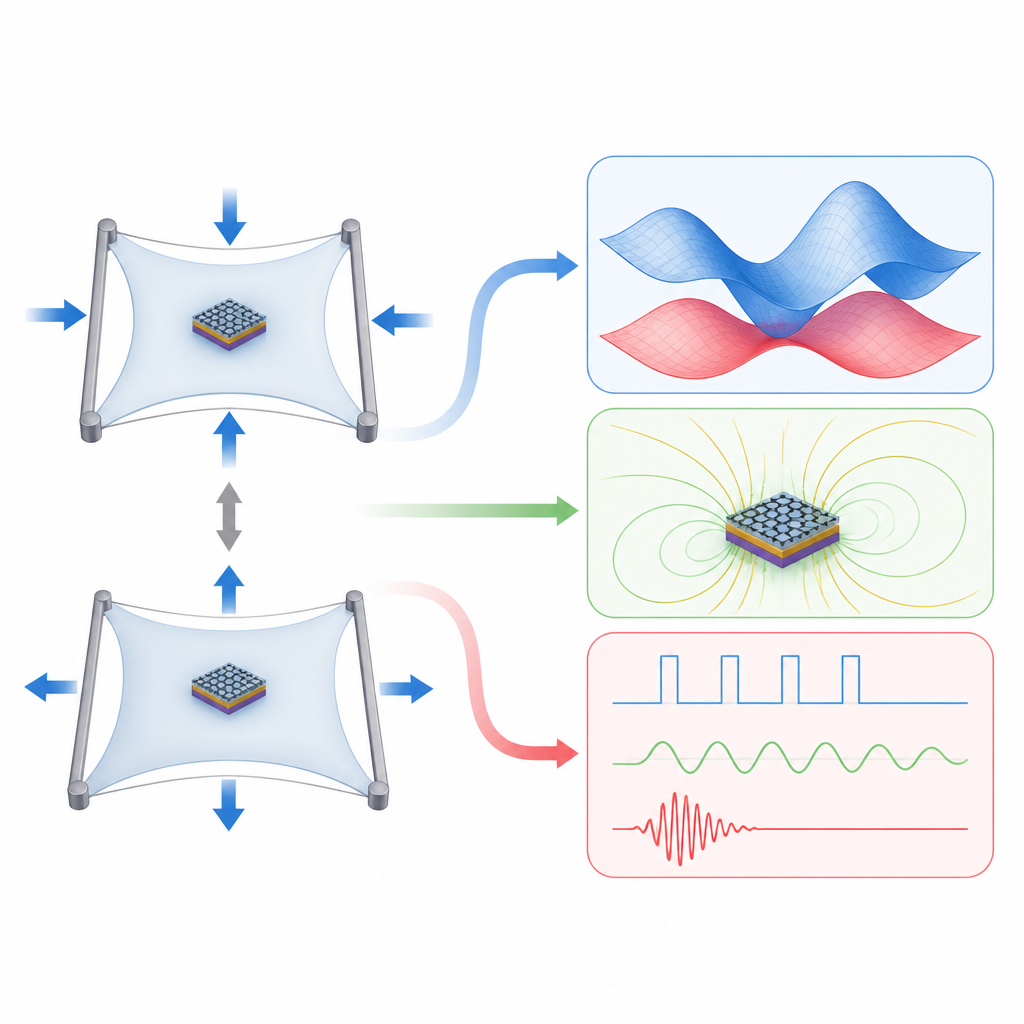
Why flat crystals are a special playground
Two-dimensional materials like graphene are only an atom or a few atoms thick, which makes their electrons extremely sensitive to small changes in their environment. In these systems, the paths electrons prefer to take are governed not just by familiar forces, but also by a subtle internal landscape known as quantum geometry. Features of this landscape influence sideways currents called Hall effects, which normally require magnetic fields or special crystal arrangements. Here, the researchers ask a new question: instead of using static knobs like fixed strain or electric fields, can we shake this quantum landscape in time and watch electrons respond in real time?
Gently vibrating a quantum drum
To explore this idea, the team built devices from two related graphene structures: twisted double bilayer graphene, where two bilayer sheets are rotated slightly to form a moiré pattern with very flat energy bands, and ordinary Bernal bilayer graphene, which is simpler and well understood. They placed these delicate stacks on thin silicon nitride membranes that act like tiny trampolines. Using a precision strain cell, they applied both a steady pull and a small rhythmic stretch to the membrane while also driving an alternating electric current along the device. At a temperature close to absolute zero, they measured tiny sideways voltages at combinations of the vibration and current frequencies, which act as fingerprints of how the quantum landscape is changing in time.
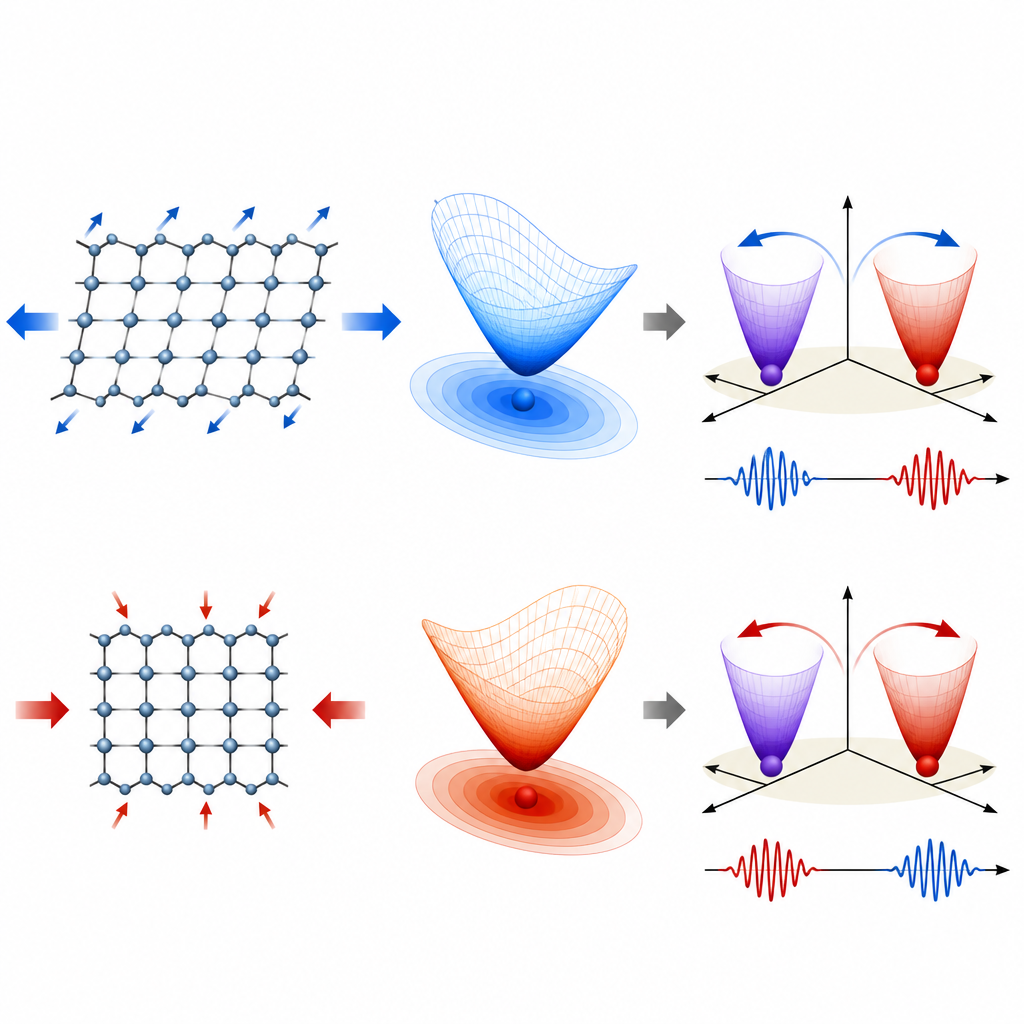
Seeing the hidden landscape shift in time
The sideways voltages revealed two key effects. First, the rhythmic stretching periodically distorted the internal landscape that guides electrons, turning a previously balanced pattern into one that is slightly lopsided. This time-varying asymmetry shows up as a nonlinear Hall signal that appears at mixed frequencies related to both the mechanical vibration and the electrical drive. By studying how these signals scale with vibration strength, frequency, and current, the authors demonstrate that they are directly watching the quantum geometry being modulated in time rather than just measuring ordinary electrical nonlinearities.
Creating an electric push without wires
The second effect is even more striking. Because the strain pattern changes in time, it effectively creates a "pseudo-electric" field inside the material that pushes electrons in opposite ways in two mirror-related valleys of momentum space. When combined with the material’s intrinsic quantum bending of electron paths, this internal push drives electrons sideways in the same direction in both valleys. As a result, the researchers observe a Hall voltage at the vibration frequency even when no external current is flowing. They also detect related signals at mixed frequencies that arise when this internal push acts together with the usual band motion of electrons, further confirming the presence of a strain-generated pseudo-electric field.
What this means for future devices
By showing that gentle, time-varying strain can both reshape the quantum landscape and generate internal electric-like fields, this work outlines a new way to control electron flow without relying solely on static gates or magnets. For a layperson, the key message is that mechanical motion itself can become a powerful knob for steering electrons in flat crystals. This dynamic control could enable sensors and electronic components where vibrations, sound, or engineered flexing provide tunable responses, and offers a fresh route to probe and use the topological properties of quantum materials.
Citation: Layek, S., Hingankar, M.A., Mukherjee, A. et al. Modulation of quantum geometry and its coupling to pseudo-electric field by dynamic strain. Nat Commun 17, 4366 (2026). https://doi.org/10.1038/s41467-026-70893-3
Keywords: dynamic strain, graphene, quantum geometry, Hall effect, pseudo-electric field
See more on the researcher's website: https://sites.google.com/view/nanoelectronicstifr/home