Clear Sky Science · en
Molecular signatures and causal factors underlying latent cytomegalovirus infection among people living with HIV (PLHIV)
Why this hidden virus matters
Many people living with HIV today take effective medication and feel well, yet they still face higher risks of heart and lung disease and other long‑term problems. One suspect behind this lingering danger is cytomegalovirus (CMV), a common herpesvirus that quietly persists in the body after infection. This study asks a simple but important question: how does a silent CMV infection reshape the immune system of people with well-controlled HIV, and could this help explain their ongoing health risks?
Looking beneath the surface of treated HIV
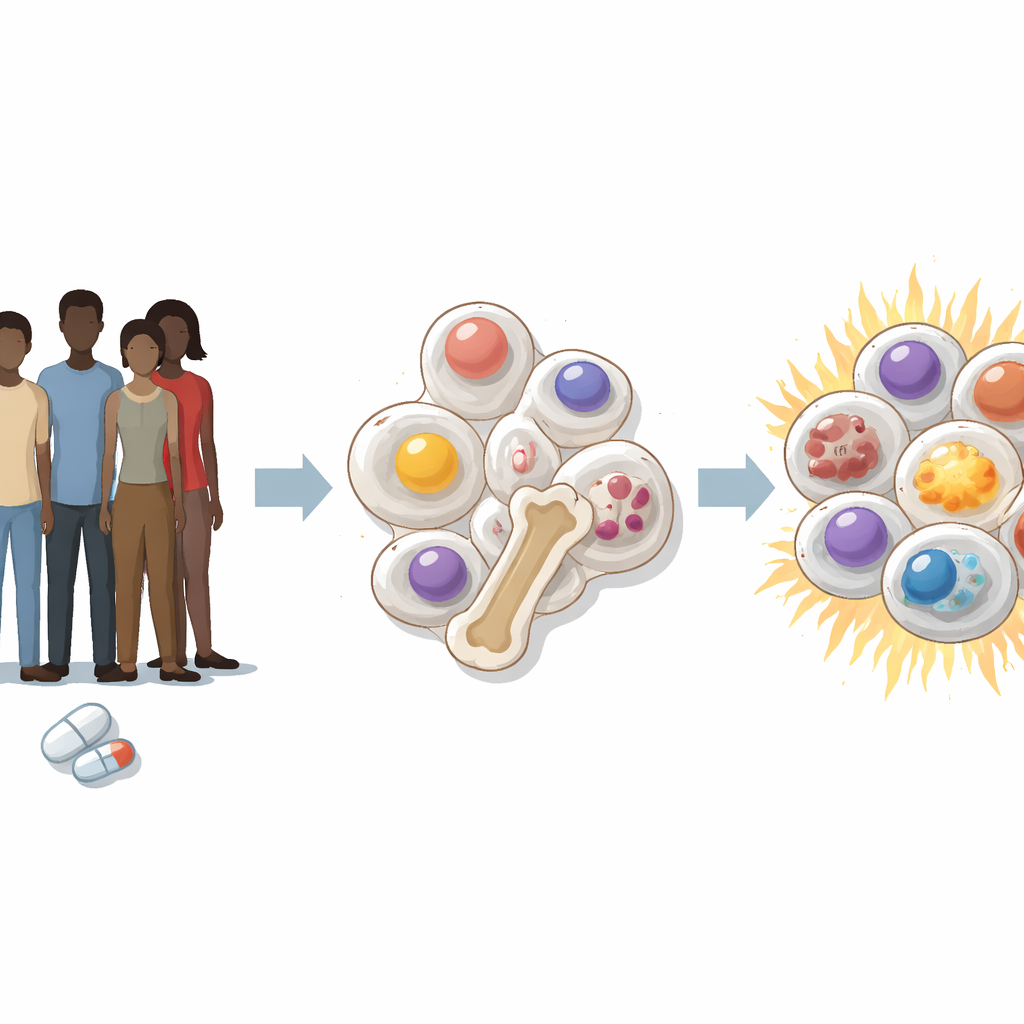
The researchers drew on the 2000HIV study, a large Dutch project that follows nearly 1,900 adults with HIV who are on long‑term antiretroviral therapy. About 94 percent of them showed antibodies against CMV, meaning they had encountered the virus and carried it in a latent, or dormant, state. Because a small fraction had never been infected with CMV, the team could directly compare people with and without this hidden virus. They examined blood in great detail: counting many types of immune cells, testing how those cells responded to infectious triggers in the lab, and profiling DNA, gene activity, proteins, and metabolic molecules all at once.
A primed and restless immune system
When immune cells from CMV‑positive participants were exposed to a CMV protein in the lab, they poured out more inflammatory messengers, such as IL‑1 family molecules and other signals that attract and activate white blood cells. Blood tests also revealed higher numbers of certain “activated” T cells, natural killer cells, and unusual γδ T cells, all known to expand in response to CMV. Together, these findings paint a picture of an immune system that has been trained by CMV to respond briskly and forcefully, even when HIV itself is held in check by modern drugs.
Marks of CMV written into DNA and genes
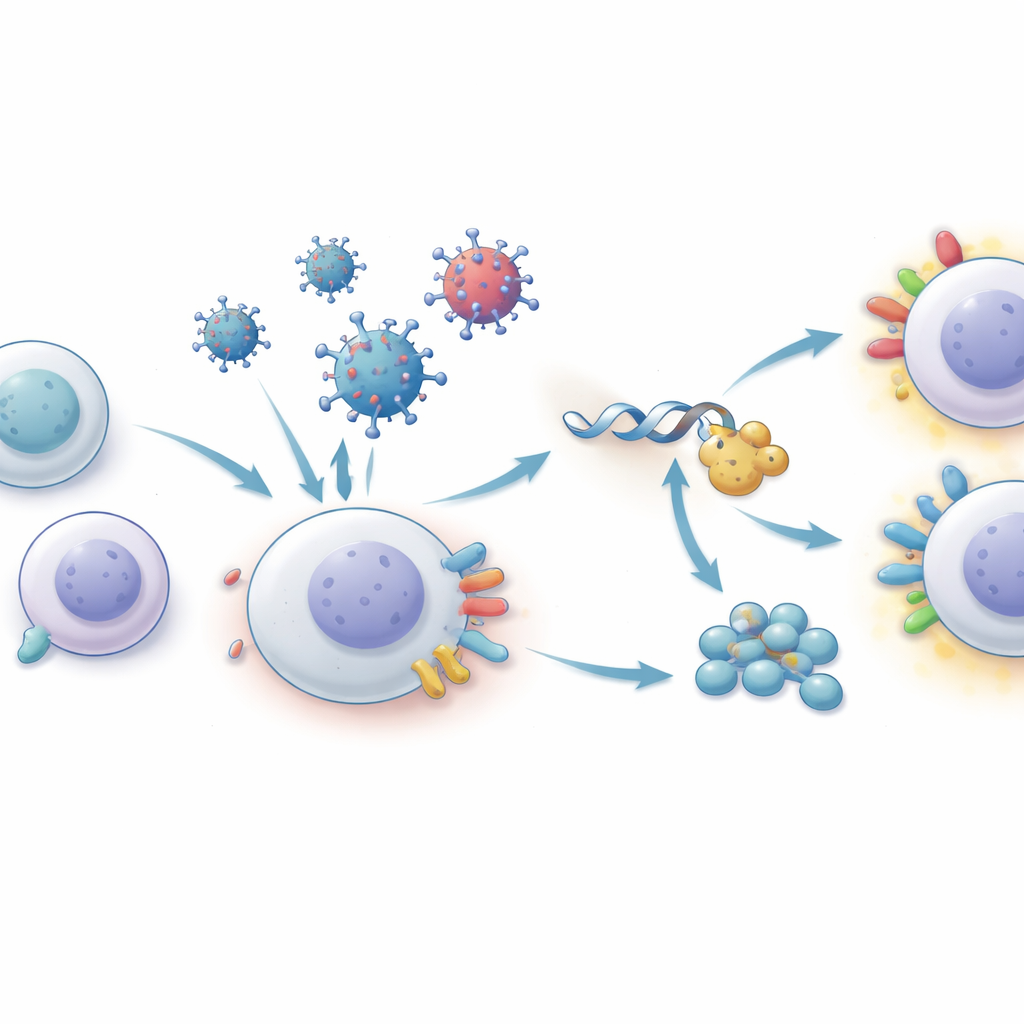
Going deeper, the team found that CMV’s influence reaches into the molecular script of blood cells. More than 16,000 spots along the DNA showed altered methylation—a chemical tag that can turn genes up or down—in CMV‑positive individuals. Many of the affected genes control how immune cells develop, move, and attack. These epigenetic changes were tightly linked to shifts in gene activity: over 1,400 genes, many involved in natural killer cell function and cell‑killing pathways, were either more or less active depending on CMV status. Although thousands of blood proteins were measured, only a few dozen consistently differed with CMV, and changes in metabolism were surprisingly modest. This suggests that CMV leaves its strongest, most durable imprint on the immune system’s control knobs rather than on everyday chemistry.
A single receptor stands out
Among all these signals, one molecule, called FCRL6, stood out across every layer of analysis. In people carrying latent CMV, the gene for FCRL6 was less methylated, more active, and produced higher levels of its protein in the blood. FCRL6 sits on the surface of mature killer T cells and natural killer cells and can interact with another molecule, HLA‑DR, which was also more common on several immune cell types in CMV‑positive participants. Additional experiments suggested that cells such as CD8 T cells, γδ T cells, monocytes, and natural killer cells were all contributing to this rise in FCRL6. Using genetic analyses that mimic randomized trials, the authors found that people whose inherited DNA tends to drive higher FCRL6 levels were more likely to be CMV‑positive, implying that this receptor is not just a bystander marker of infection but may help determine who becomes infected or remains latently infected.
Genetic fingerprints of resistance and risk
The team also scanned the entire genome to look for variants linked to CMV status in people with HIV. They identified a region on chromosome 15 where one version of a variant was linked to a lower chance of having CMV antibodies. This protective version was also associated with reduced levels of an immune receptor called KIR2DS4 and lower production of a cytokine, IL‑22, both of which were otherwise higher in CMV‑positive individuals. Nearby lies a gene, CHRNB4, which may participate in viral responses and other traits such as smoking behavior, hinting at complex interactions between lifestyle, genetics, and infection risk. Although more work is needed, these findings sketch an emerging network in which inherited differences in immune receptors and signaling pathways can tip the balance toward or away from chronic CMV infection.
What this means for people living with HIV
Taken together, this study shows that a latent CMV infection leaves a broad and lasting mark on the immune system of people with treated HIV. It heightens inflammatory responses, rewires DNA regulation, and boosts molecules such as FCRL6 that both signal and shape immune activation. Some of these changes overlap with biological pathways tied to heart disease, chronic lung problems, and faster HIV progression, suggesting that CMV may quietly fuel the non‑AIDS illnesses that now dominate long‑term outcomes. Recognizing CMV’s fingerprint—and especially tracking markers like FCRL6—could help doctors identify those at highest risk and, eventually, guide therapies that dial down CMV‑driven immune activation in HIV and possibly in other immunocompromised groups.
Citation: Nguyen, N., Zhang, Z., Jiang, X. et al. Molecular signatures and causal factors underlying latent cytomegalovirus infection among people living with HIV (PLHIV). Nat Commun 17, 2871 (2026). https://doi.org/10.1038/s41467-026-70889-z
Keywords: cytomegalovirus, HIV, immune activation, epigenetics, biomarkers