Clear Sky Science · en
Atlas of predicted protein complex structures across kingdoms
Why mapping protein partnerships matters
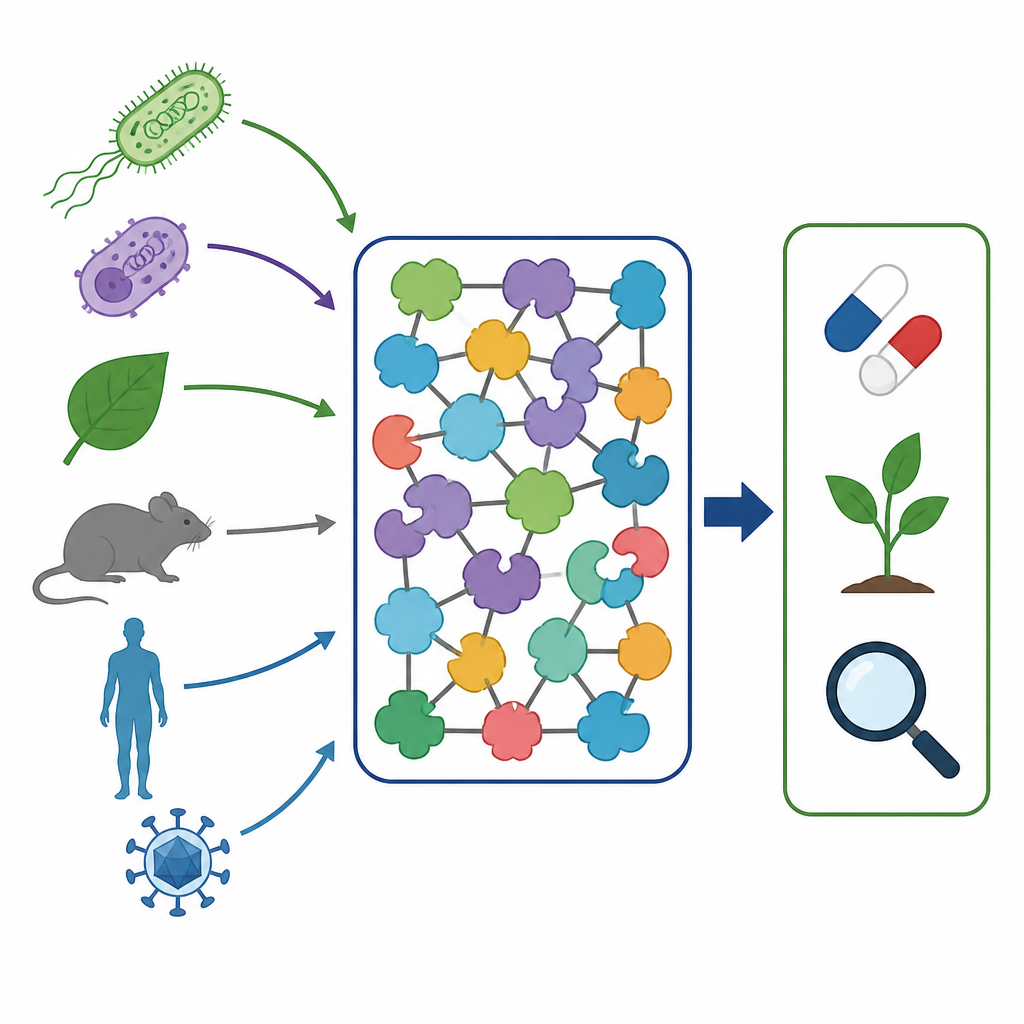
Every cell in your body is packed with tiny molecular machines built from proteins. These proteins rarely act alone; they team up in pairs and groups to carry out almost every task of life. Yet while scientists know of millions of potential partnerships between proteins, they have had detailed three dimensional blueprints for only a small fraction of them. This study uses artificial intelligence to predict how more than a million such protein pairs fit together, across bacteria, archaea, plants, animals, and viruses, creating an atlas that can guide future biology and medicine.
Building a giant map of protein pairs
The researchers set out to predict the shapes of protein complexes at a scale never seen before. They used AlphaFold based tools, which can infer protein structure from amino acid sequence, and applied them to candidate protein partners drawn from large public interaction databases and genome data. In total they modeled about 1.1 million possible protein pairs and then applied strict quality checks to decide which predictions were reliable. These checks focused on how well the protein surfaces fit together and how strong the interface between the proteins appeared to be, based on several independent scoring methods.
After filtering, the team obtained 181,671 high confidence complexes. These included more than 100,000 complexes from bacteria and archaea, over 37,000 from human proteins, and nearly 20,000 from mouse and plant proteins. This rich collection of predicted shapes allowed them to cluster complexes that looked alike, revealing common partnership patterns that appear again and again across distant branches of the tree of life. Such recurring shapes hint at ancient solutions that evolution has reused in many organisms.
Uncovering hidden machines in microbes
The atlas is especially powerful for microbes. In bacteria and archaea, genes that work together often sit close together on the chromosome. By combining this simple genomic rule with their structure predictions, the authors identified more than 100,000 likely physical partnerships, including many in disease causing bacteria. By tracing networks of these interactions they could reconstruct large molecular assemblies, such as parts of the protein factories known as ribosomes and complex shells that help bacteria process unusual nutrients. They also showed how smaller repeating units can stack into sophisticated multi layer machines, offering hypotheses about how bacterial virulence systems are built.
Linking human proteins and viral tricks
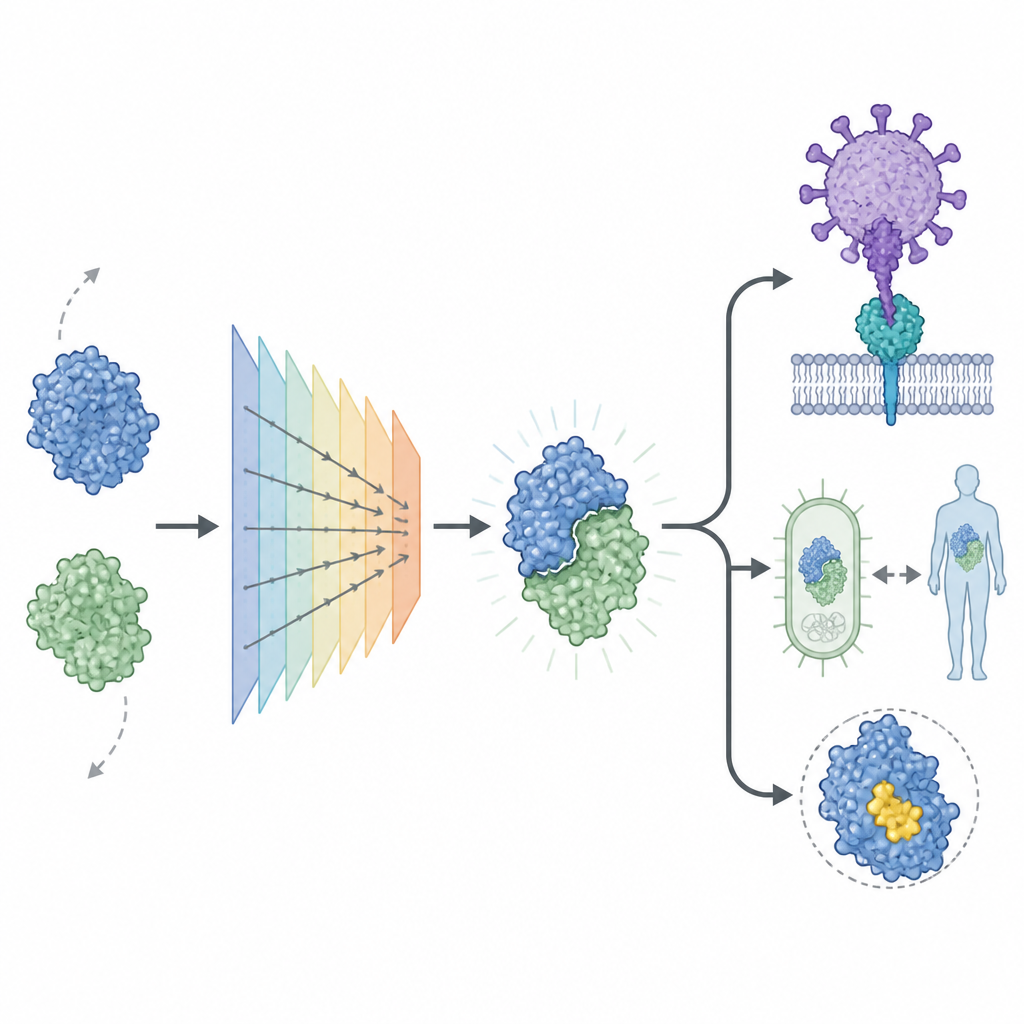
The team also focused on how viruses connect to human proteins. Using curated databases of predicted human virus contacts, they modeled over 80,000 candidate interactions and found more than 5,000 that passed their confidence thresholds. Some human proteins appeared as hubs, contacted by many different viruses, including members of the 14 3 3 family that help control cell signaling. The models suggested that certain viral proteins may grab the same surface on a human protein that another human partner normally uses, effectively cutting into the line and disrupting normal cell processes. Laboratory experiments confirmed several predicted contacts, including viral proteins that bind known or potential entry points on human cells.
Following protein history through shape
Beyond cataloging present day complexes, the authors used the atlas to explore protein history. By comparing each partner in their complexes to millions of single protein structures in the AlphaFold database, they found many cases where two modern proteins that interact resemble different sections of a single longer protein in another species. These patterns point to past fusion events, where genes joined together, or fission events, where a once continuous gene split into parts. The study also uncovered examples where viral or microbial proteins closely mimicked human complexes, suggesting long term evolutionary pressures to preserve certain shapes.
From atlas to practical tools
To show that their atlas is more than a static reference set, the scientists used it to improve a deep learning model that predicts which spots on a protein surface will form contacts with partners. Training on high quality predicted complexes sharpened the model’s ability to identify binding sites on real experimentally solved structures. This suggests that large collections of accurate predictions can feed back into new methods, even when experimental data are limited, and can aid efforts in drug discovery, protein engineering, and vaccine design.
What this means for the future
For a non specialist, the key message is that we now have a first draft of how an enormous number of protein pairs might fit together across many forms of life. While not perfect, this atlas greatly expands the structural information available to researchers. It offers starting points for understanding how infections take hold, how cellular machines are built, and how protein families have changed over evolution. As experimental tests refine these predictions and similar atlases grow to include more types of molecules, this kind of map will become an essential guidebook for exploring and eventually re designing the molecular machinery of life.
Citation: Qi, X., Ye, C., Liang, J. et al. Atlas of predicted protein complex structures across kingdoms. Nat Commun 17, 4397 (2026). https://doi.org/10.1038/s41467-026-70884-4
Keywords: protein complexes, AlphaFold, protein interactions, human virus interactions, structural biology