Clear Sky Science · en
Macroscopic particle transport in dissipative long-range bosonic systems
Why moving particles in noisy quantum systems matters
Modern quantum technologies, from quantum computers to ultra-cold atom experiments, rely on sending particles and information across tiny lattices without losing control. In the real world, however, particles constantly leak out or interact with their surroundings, which slows or even stops this motion. This article explores how fast particles can travel across such noisy quantum systems, and under what conditions long-distance, reliable transport is still possible.
Setting the stage with a quantum highway
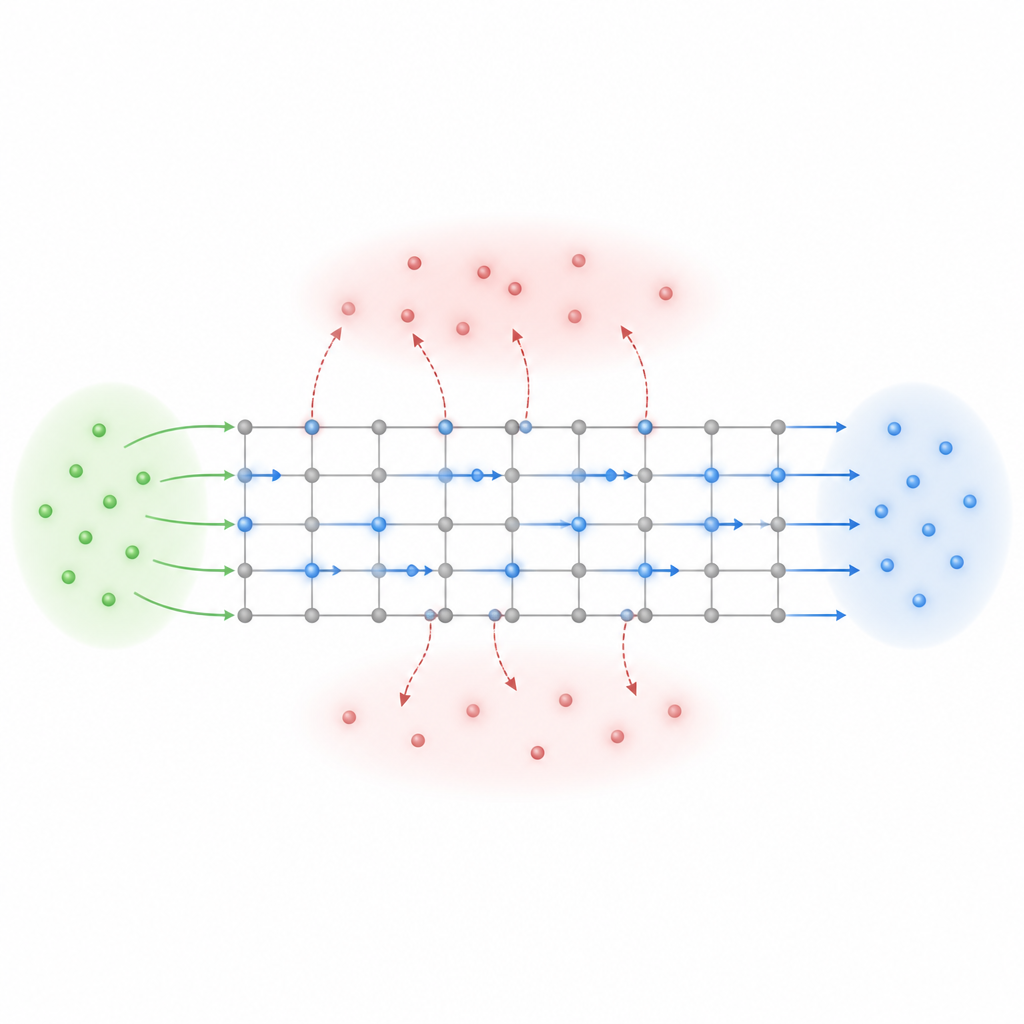
Imagine a grid of sites forming a quantum highway, where many identical particles can hop from one site to another, even over long distances. In earlier work, scientists mainly studied ideal highways that are perfectly isolated, so nothing ever leaks out. Those studies led to the idea of a light cone, an effective horizon that limits how fast signals and particles can move. Here, the authors turn to a more realistic setting, where particles can be lost or even added as they move, and develop a new mathematical framework to describe how fast a macroscopic number of particles can be transported between two distant regions on such a lattice.
How loss slows the flow of particles
The first key result concerns systems where particles are lost one by one, a common situation in cold-atom and molecular setups. In this case, the authors show that the time needed to move a fixed fraction of all particles from a source region to a distant target grows not only with distance, but is also stretched by an overall exponential decay in particle number. This means that even if hopping across the lattice is allowed over long ranges, there is a maximum amount of matter that can ever arrive far away. They translate this into a maximum effective reach, a distance beyond which at most one particle can be transported, no matter how long one waits, because most particles disappear before getting there.
Hidden safe zones that protect transport
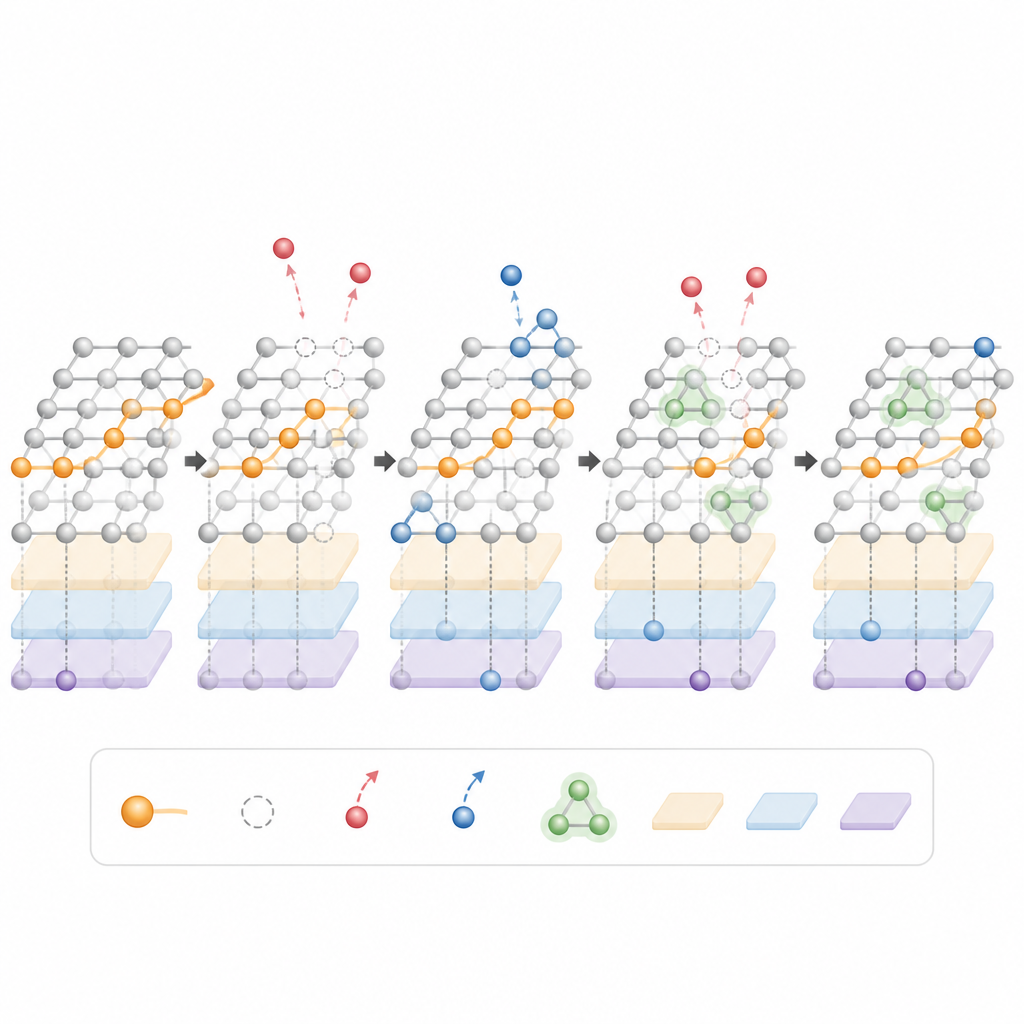
The story changes dramatically when particle loss only occurs in groups, such as two or three particles at a time. In that case, there exist special many-body states where each site holds fewer particles than needed to trigger loss. These states form what the authors call decoherence-free subspaces, where the environment cannot effectively touch the system. If the system starts in such a protected configuration and is kept there by strong on-site repulsion, particles can travel across the lattice as if there were no loss at all. The lower bound on transport time then matches that of a perfectly closed system, and, at least in principle, perfect long-distance transfer of many particles becomes possible.
Balancing loss with gain to reach farther
The authors next explore what happens when particles can both leak out and be replenished locally. They find that particle gain fundamentally changes the picture: the mathematical expression that limited transport in the pure loss case no longer shrinks to zero at long times. Instead, when the initial particle density is low, even a very small gain rate can sustain transport over distances comparable to the entire system size. Intuitively, gain acts like a gentle refill that nudges the system toward a special steady state where the effect of loss is largely balanced, allowing particles to hop across the lattice without being drained away too quickly.
Chances of successful transfer and experimental tests
Beyond typical or average behavior, the article also addresses the likelihood of rare events where a specified number of particles are found in a target region after a fixed time. The authors derive an upper bound on this probability, showing that dissipation does not generally speed up transport compared with closed systems. They then outline how their ideas could be tested experimentally, for example using arrays of neutral atoms dressed with Rydberg states. In such platforms, long-range hopping, tunable loss and gain, and site-resolved detection can all be engineered, making the theoretical bounds directly relevant to real devices.
What this means for future quantum devices
In simple terms, this study explains when noisy quantum systems behave like clogged pipes and when they can still move particles cleanly over long distances. One-body loss acts like many small leaks, limiting how far and how much can be transported. In contrast, special protected states and a careful balance of particle loss and gain can keep the flow going, sometimes across an entire lattice. These insights provide design rules for future quantum simulators and information-processing devices that must operate in imperfect, dissipative environments.
Citation: Li, H., Shang, C., Kuwahara, T. et al. Macroscopic particle transport in dissipative long-range bosonic systems. Nat Commun 17, 4289 (2026). https://doi.org/10.1038/s41467-026-70881-7
Keywords: quantum transport, open quantum systems, bosonic lattices, particle loss and gain, decoherence-free subspaces