Clear Sky Science · en
Emergent discrete space-time crystal of Majorana-like quasiparticles in chiral liquid crystals
Patterns that tick like a clock
Crystals are usually thought of as repeating patterns in space, like the atoms in a diamond. In this work, scientists explore a stranger idea: materials that also develop repeating patterns in time, ticking in their own rhythm even when pushed by a regular external signal. They show that a common display material, liquid crystals, can form such "time crystals" in an ordinary lab setup, revealing a new way that matter can organize in both space and time.
Everyday liquid crystals under unusual driving
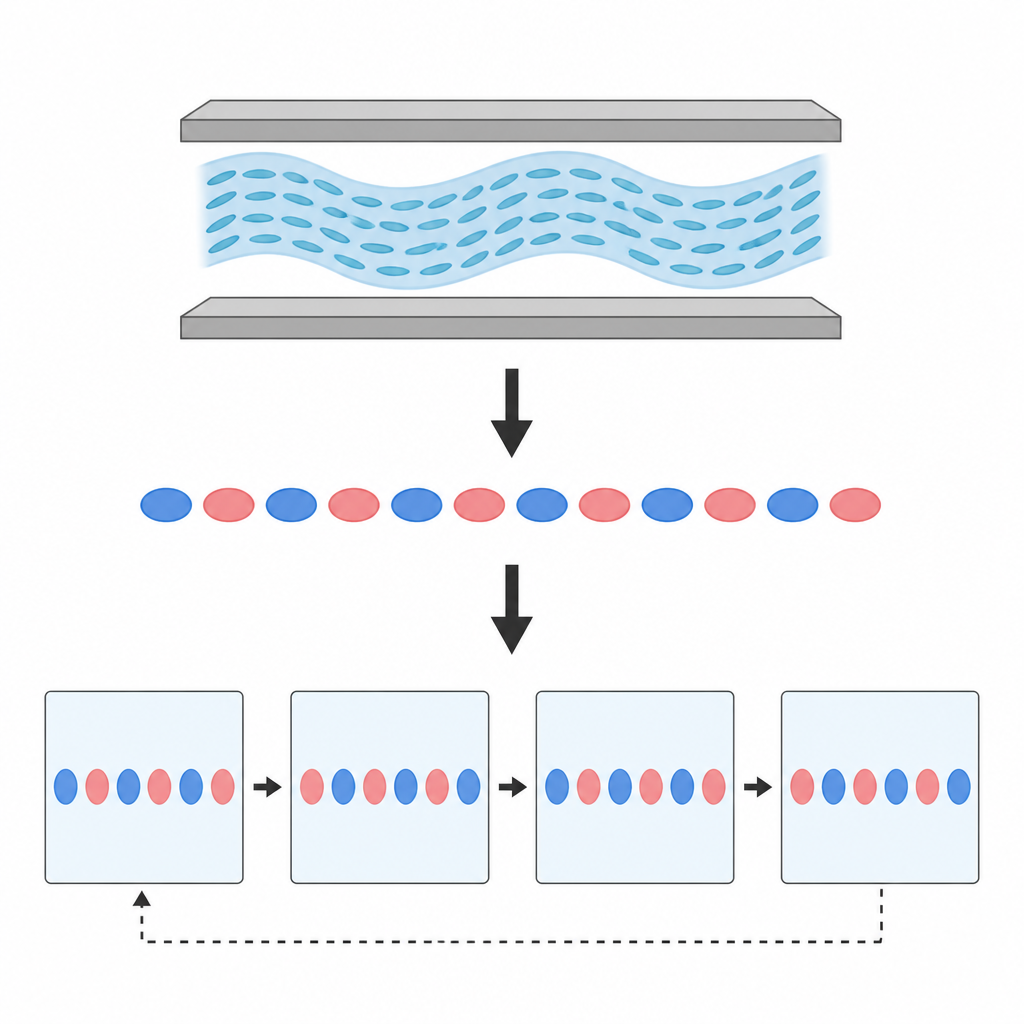
Liquid crystals already power most flat-panel screens, where electric fields gently reorient their rod-like molecules. Here, the researchers use a chiral (twisted) liquid crystal, doped with charged molecules, and confine it between two glass plates that act as transparent electrodes. Instead of a constant or smoothly varying voltage, they apply a repeating sawtooth-shaped electrical signal, known as a Floquet drive. Under the microscope, the sample does not simply brighten and darken. Instead, it spontaneously develops striped or lattice-like color patterns that repeat regularly in space while their appearance changes rhythmically over time.
A system that skips every other beat
By recording movies of the transmitted light and analyzing the colors pixel by pixel, the team discovers that the liquid crystal settles into a new kind of order. The driving voltage has one basic period, but the visible pattern returns to exactly the same state only after two periods of the drive. This "period doubling" means the material has broken the simple time-repetition of the forcing signal and created its own slower clock. At the same time, neighboring bright regions in space tend to move and change in opposite ways, forming an antiferromagnetic-like alternation both across the sample and from one cycle to the next. These behaviors qualify the system as a discrete space-time crystal: ordered in space and in time, yet not just slavishly following the external rhythm.
Tiny defects acting like particles
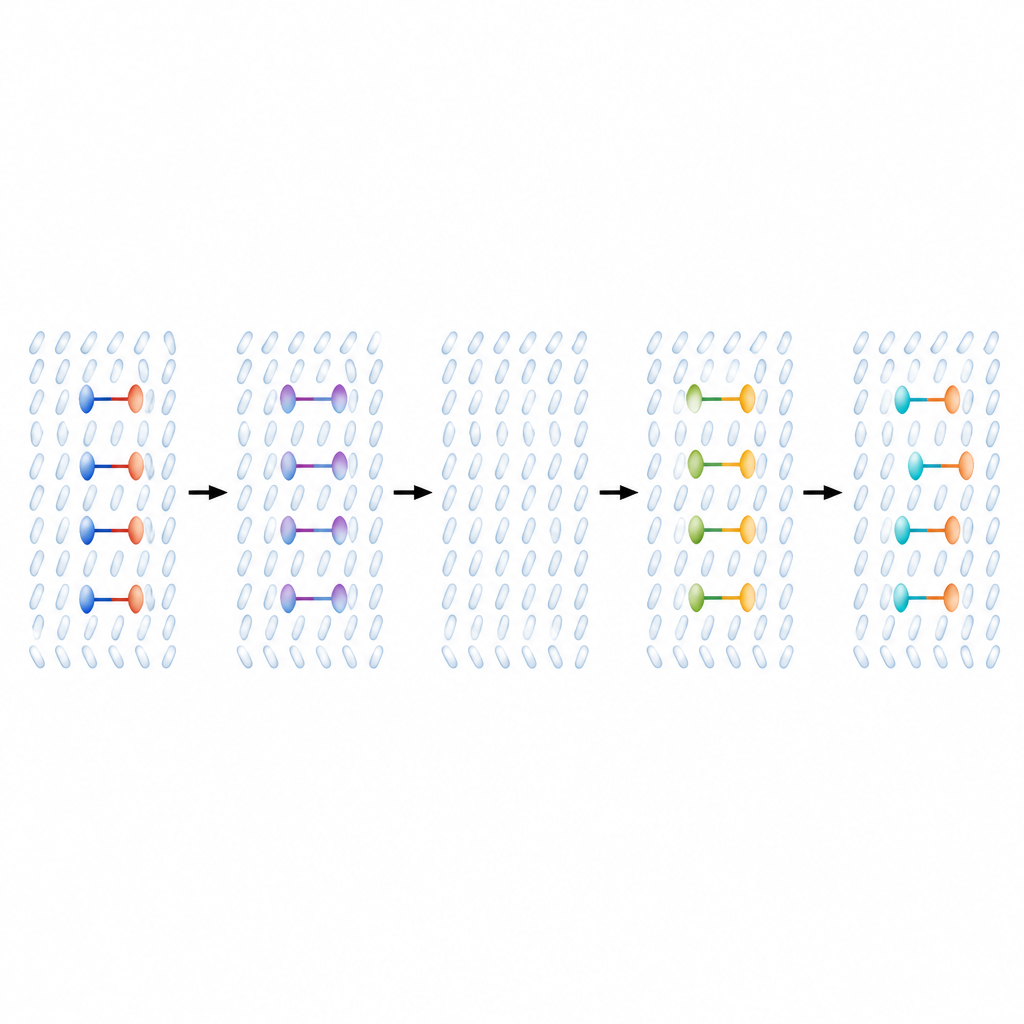
To understand what moves and changes inside the liquid crystal, the authors combine experiments with detailed computer simulations. The twisted material naturally hosts narrow walls and line-like defects where the local orientation of molecules is ill-defined or strongly distorted. In the time-crystal state, these defects appear in repeating chains, and their shapes and connections change smoothly as the voltage ramps from negative to positive and back. Pairs of such defects, bridged by domain walls, behave like particle and anti-particle partners: they can morph continuously into each other, annihilate, and then reappear half a period later shifted by half a lattice spacing. Because these defect profiles follow mathematical rules similar to those of elusive Majorana particles in quantum physics, the authors describe them as Majorana-like quasiparticles in a classical liquid crystal.
Robust ticking and rich phase behavior
The time-crystal patterns do not require fine tuning. The researchers map out how they appear and disappear as they vary temperature, the strength of the voltage pulses, the drive period, cell thickness, and the intrinsic twist of the liquid crystal. They find broad regions where one-dimensional stripe-like time crystals and two-dimensional lattice-like time crystals are stable, separated from ordinary and disordered phases. Once formed, these patterns can persist locally for hours and over tens or hundreds of thousands of drive cycles, surviving random fluctuations in the timing of the electrical pulses and even recovering after defects are introduced using focused laser beams. In thicker samples with stronger twist, the team also observes quasi-hexagonal patterns whose internal timing does not match the drive by a simple integer factor, hinting at more exotic "fractional" time crystals.
Why this new kind of order matters
This study shows that time-crystal behavior is not limited to delicate quantum devices, but can arise in soft classical materials familiar from everyday technology. In these liquid crystals, localized defect structures act as building blocks that arrange themselves into ordered patterns repeating in both space and time. Because such structures are reconfigurable and robust, they could form the basis of new optical elements that steer or modulate light in programmable rhythms. More broadly, the results support the idea that simultaneous breaking of space and time symmetry is a common possibility in driven, open systems, expanding our picture of how matter can organize itself when forced away from equilibrium.
Citation: Zhao, H., Zhang, R. & Smalyukh, I.I. Emergent discrete space-time crystal of Majorana-like quasiparticles in chiral liquid crystals. Nat Commun 17, 4376 (2026). https://doi.org/10.1038/s41467-026-70880-8
Keywords: time crystals, liquid crystals, topological defects, Floquet driving, Majorana-like quasiparticles