Clear Sky Science · en
Antigen-specific immunotherapy with a CD4+ T cell neoepitope restrains CD8+ T cell differentiation in murine pancreatic islet grafts
Why this research matters for people with type 1 diabetes
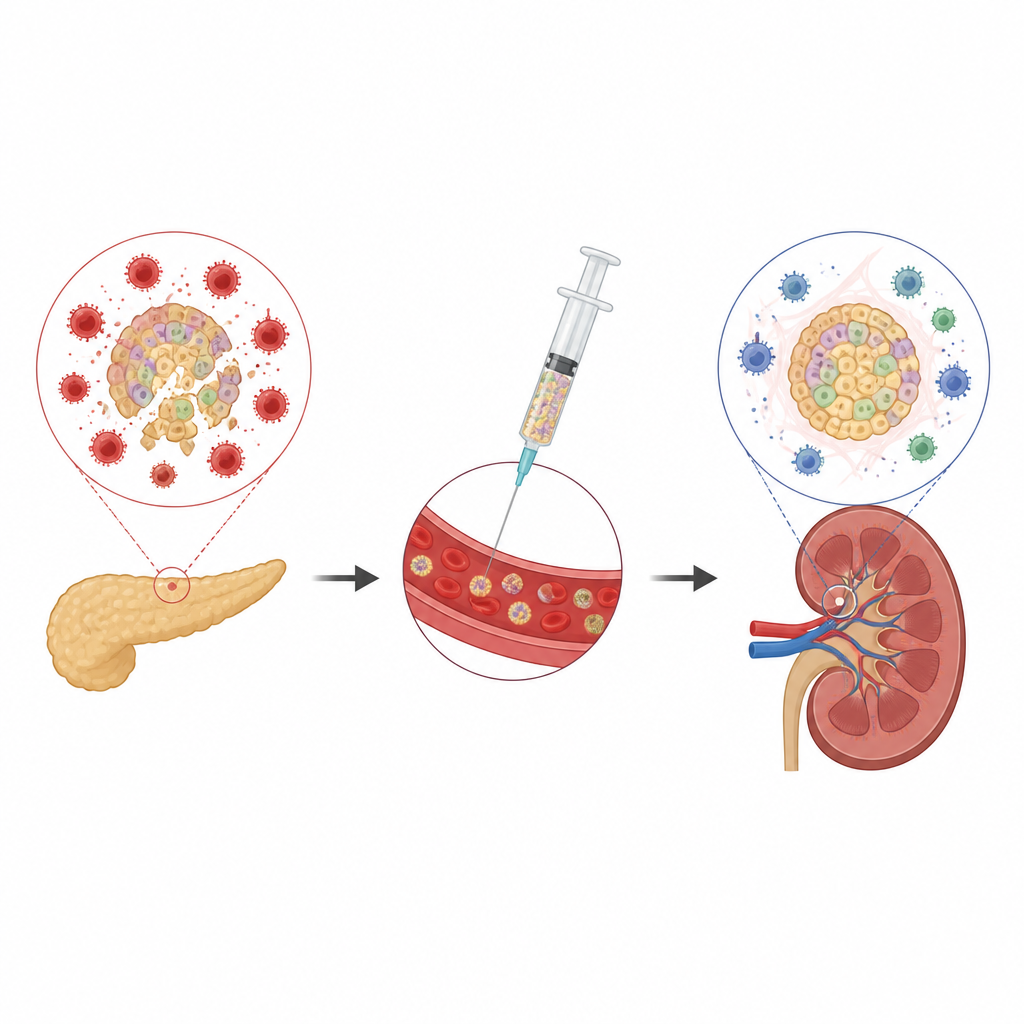
Type 1 diabetes occurs when the immune system destroys the cells in the pancreas that make insulin. Transplanting healthy islet cells can restore natural insulin production, but recipients usually need strong, lifelong immune-suppressing drugs, which carry serious risks. This study in mice explores a more precise strategy that teaches the immune system to tolerate transplanted islets by retraining specific immune cells, rather than shutting down immunity across the board.
Turning down a targeted immune attack
The immune attack in type 1 diabetes is driven by T cells that recognize tiny fragments of proteins from insulin-producing cells. The researchers focused on one such fragment, called a hybrid insulin peptide, that is recognized by a key group of helper T cells. They packaged this peptide onto biodegradable nanoparticles designed to mimic harmless dying cells. When injected into diabetic mice receiving islet transplants, these particles repeatedly exposed the immune system to the peptide in a way that encourages tolerance instead of attack, sparing most of the rest of the immune system.
From aggressive fighters to restrained responders
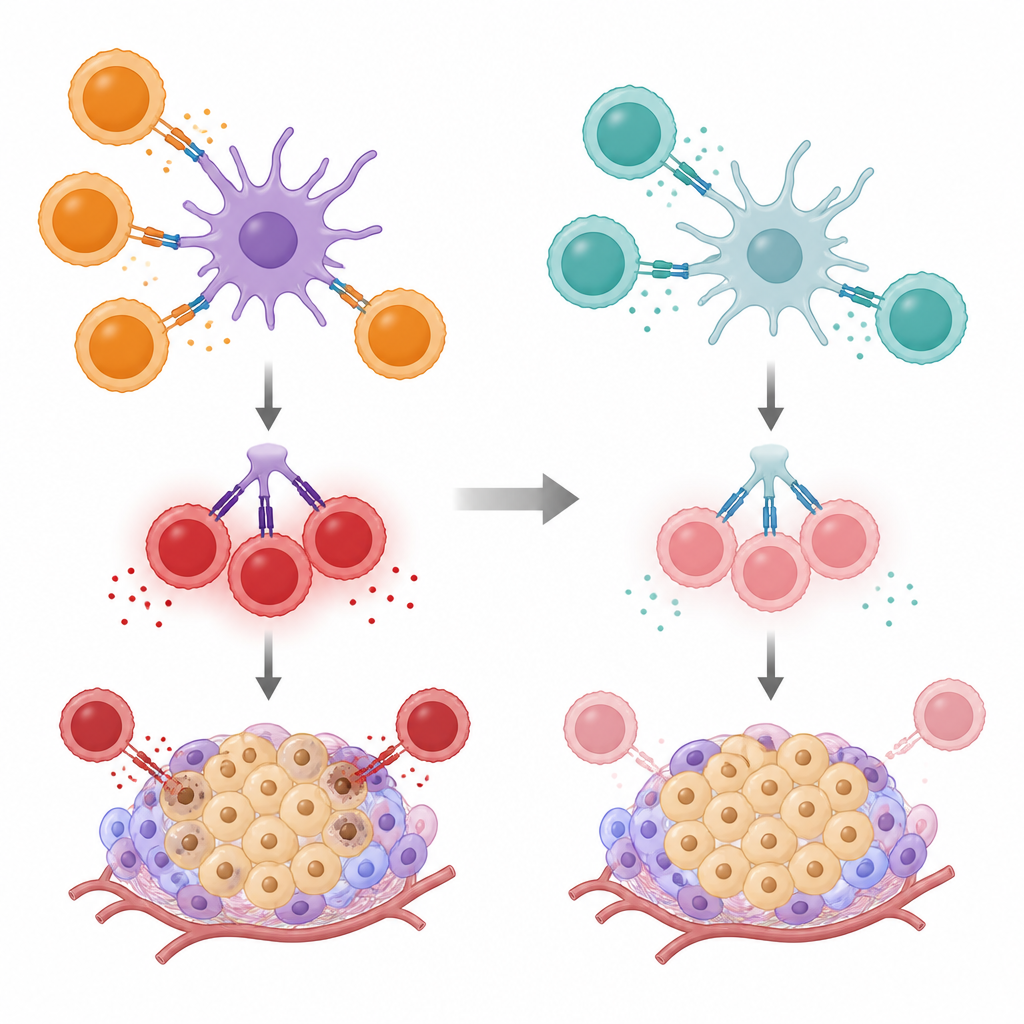
In untreated mice, both helper T cells (CD4) and killer T cells (CD8) that recognize islet proteins follow a predictable path. They start as “stem-like” cells in nearby lymph nodes and then mature into highly active effector cells once they enter the islet graft, where they express strong activation markers, multiply, and release inflammatory molecules that destroy the graft. With the peptide-carrying nanoparticles, this maturation process was disrupted. Fewer aggressive effector cells appeared inside the grafts, and more cells stayed in a less differentiated, stem-like state. The remaining effector cells produced less of the damaging inflammatory signals that normally drive tissue destruction.
Rewiring killer T cells and their sensitivity
Using single-cell RNA sequencing, the team examined in detail how the therapy changed the gene activity of killer T cells that target a major islet protein. In untreated grafts, many of these cells adopted a highly cytotoxic profile, marked by strong antiviral and cell-killing programs. After treatment, this high-powered state was largely absent. Instead, killer T cells followed an alternate path toward a weaker, less functional state and showed lower apparent sensitivity to their target. Their receptors bound the islet protein less tightly, and the population became dominated by a shared, lower-avidity T cell clone, suggesting that the most aggressive cells were either blocked from maturing or failed to thrive in the treated grafts.
Regulatory T cells and calming signals to gatekeepers
The therapy did more than simply weaken attacking cells. It expanded a population of regulatory helper T cells that produce the anti-inflammatory molecule interleukin-10 (IL-10). These regulatory cells included classic FOXP3-positive regulatory T cells and a larger group of Tr1-like cells that lack FOXP3 but still secrete IL-10. Within the grafts, IL-10 dampened the activation of dendritic cells, the immune “gatekeepers” that license killer T cells to fully arm themselves. When IL-10 was blocked with an antibody, dendritic cells regained their activation signals, killer T cells recovered their aggressive traits and higher target sensitivity, and the protective effect of the therapy on graft survival was lost.
How long the protection lasts and what it means
The nanoparticle treatment, given three times, significantly delayed rejection of islet grafts in diabetic mice. When the doses were continued every 10 days, graft survival nearly reached the full observation period, showing that ongoing therapy can maintain protection. However, once treatment stopped, regulatory cells in the graft waned, dendritic cells became reactivated, and aggressive T cells built up again, ultimately leading to graft failure. This work shows that teaching the immune system to tolerate a single, well-chosen islet peptide can indirectly restrain many damaging T cells by calming key immune gatekeepers. For patients, it suggests a future in which islet transplants, or even stem cell–derived islets, might be protected by targeted immune “re-education” instead of blanket immunosuppression, though much more research is needed before such approaches can be safely used in people.
Citation: DiLisio, J.E., Beard, K.S., Neef, T. et al. Antigen-specific immunotherapy with a CD4+ T cell neoepitope restrains CD8+ T cell differentiation in murine pancreatic islet grafts. Nat Commun 17, 4355 (2026). https://doi.org/10.1038/s41467-026-70878-2
Keywords: type 1 diabetes, islet transplantation, antigen-specific immunotherapy, regulatory T cells, nanoparticles