Clear Sky Science · en
Intrinsically chiral exciton polaritons in an atomically-thin semiconductor
Spinning Light in Ultra-Thin Materials
Light can carry a kind of “twist,” much like a rotating corkscrew, and electrons in some crystals have their own preferred spins and neighborhoods. This paper explores how to lock these twists of light and matter together inside a sheet of material only one atom thick. The result is a new kind of hybrid particle that could help build future devices for ultra-fast, spin-based computing and secure communication, where information is carried not just by light intensity, but by its handedness.
A New Way to Trap and Twist Light
The researchers start with a special nanostructured surface, called a metasurface, that can trap light in a very unusual way. Instead of letting light freely leak out, this surface supports a “bound state in the continuum,” a resonance that holds light strongly even though it sits among freely propagating waves. By deliberately breaking the symmetry of this patterned surface, the team makes this trapped light strongly circularly polarized—favoring one sense of rotation over the other. This chiral trapped mode acts as a highly selective filter: it responds strongly to one twist of circular light and almost not at all to the opposite twist, giving an exceptionally clean handle on the spin of photons. 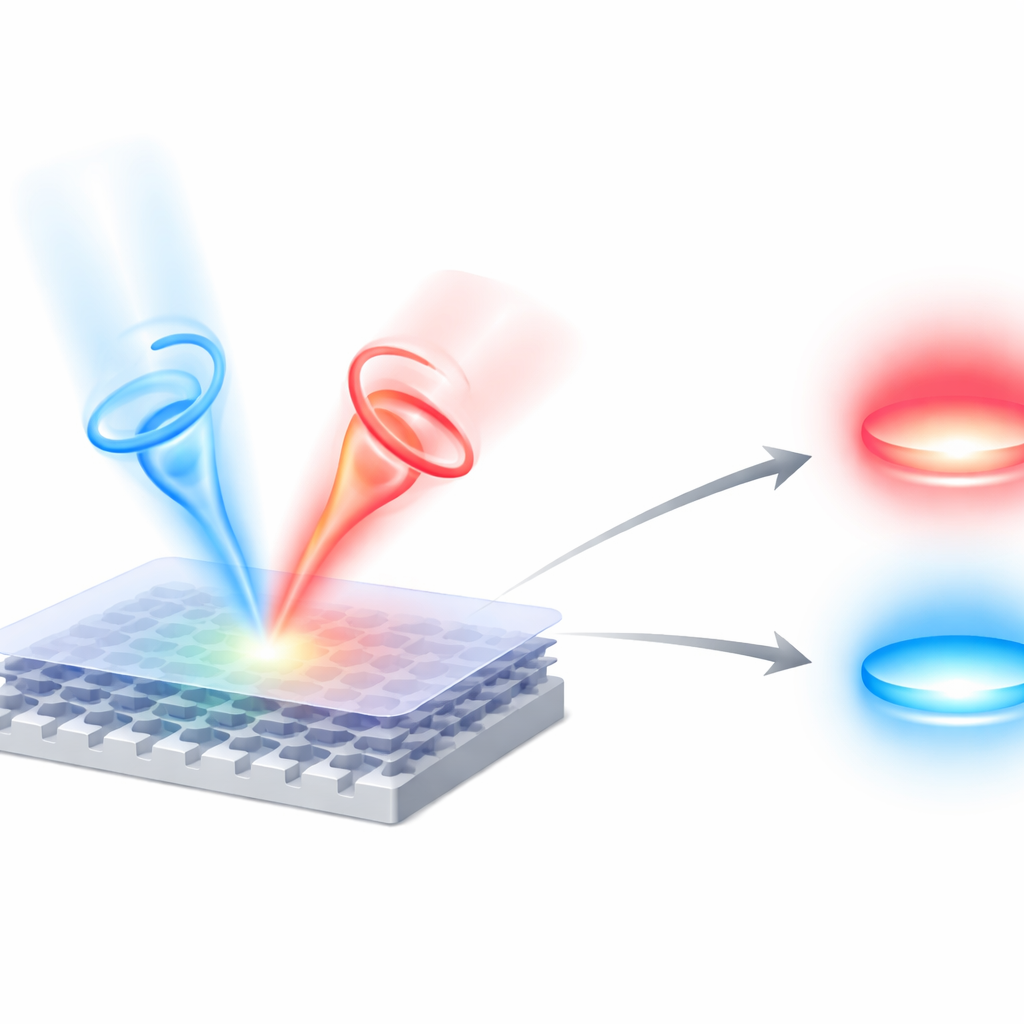
Marrying Twisted Light with Twisted Matter
On top of this metasurface, the authors place a single atomic layer of tungsten disulfide, a semiconductor in which electrons and the vacancies they leave behind form tightly bound pairs known as excitons. These excitons live in two distinct “valleys” in momentum space, each tied to a specific spin and a specific circular polarization of light. When the energy and position of the trapped light in the metasurface are tuned to match the excitons, the two systems no longer act independently. Instead, they hybridize to form exciton polaritons—quasi-particles that are part light and part matter. Because both ingredients are chiral, the resulting polaritons inherit a built-in preference for one spin direction.
Creating Bright, Spin-Selective Hybrid Emission
Using angle-resolved reflectivity and photoluminescence measurements at cryogenic temperatures, the team shows that the coupling between the trapped light and the monolayer excitons is strong enough to split the spectrum into two distinct branches, called the upper and lower polaritons. These branches behave differently: the lower polariton is more “photonic,” taking on the spin selectivity of the chiral trapped mode, while the upper polariton is more “excitonic,” retaining the valley character of the material. Strikingly, the light emitted from these polaritons is both brighter and more strongly circularly polarized than light from uncoupled excitons—by about an order of magnitude in intensity and polarization contrast.
A Shortcut for Energy Flow and Spin Preservation
Ordinarily, excitons tend to lose their spin information as they scatter and relax toward lower energies, which washes out circular polarization and limits applications that rely on spin. Here, the periodic pattern of the metasurface changes how exciton polaritons can emit light. The folding of the band structure provides a direct optical escape route for polaritons from high-momentum states that would normally be hidden from the outside world. The authors’ modeling shows that diffraction from the lattice, rather than slow thermal relaxation, is what brings these hybrid states into view. This shortcut enhances light emission while bypassing many of the spin-scrambling processes, helping the system maintain its circular polarization. 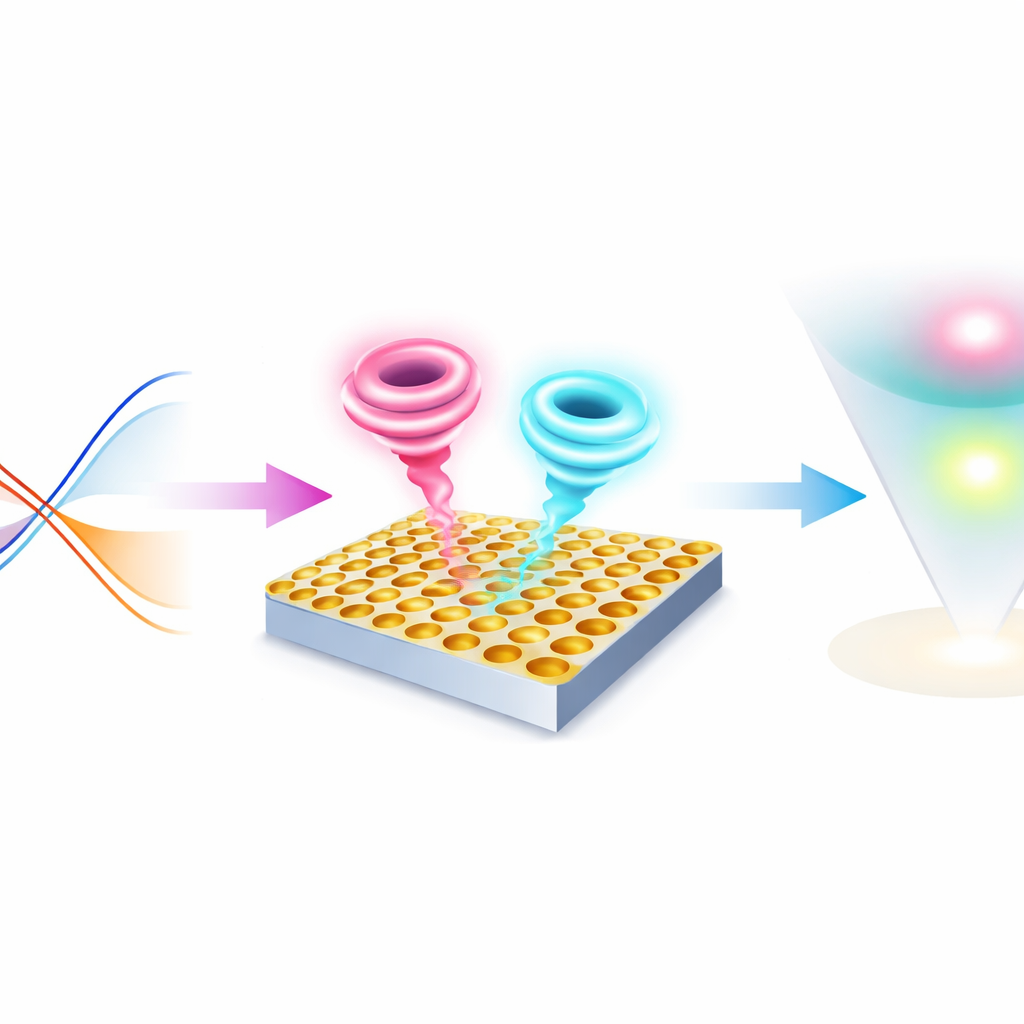
Switchable Spin States on Demand
Because the two polariton branches carry different mixtures of light and matter, their spins can be arranged in either parallel or anti-parallel configurations simply by changing the circular polarization of the incoming laser. Under one choice of input, both branches emit with the same spin; under the opposite choice, they emit with opposite spins. Measurements of the circular polarization show very high contrast near the main emission direction, while the polarization fades at larger angles where ordinary excitons dominate. The lower polariton also remains sensitive to its material component: its brightness is highest when the spin of the valley exciton aligns with the preferred twist of the trapped light and decreases as temperature rises and vibrations in the lattice grow stronger.
Why This Matters for Future Technologies
In everyday terms, the researchers have engineered a new kind of “spin-tunable light” inside an ultra-thin semiconductor. By combining a twisting light trap with spin-selective excitons, they created hybrid particles whose spin and brightness can be sharply controlled using the polarization of a laser. This approach offers a promising building block for devices that encode information in the spin of light, enabling fast switching, compact spin-based circuitry, and sensitive chiral sensors. The work also reveals a general design principle: periodic photonic structures can route energy in ways that protect and enhance spin information, pointing the way toward more efficient, spin-aware optical technologies.
Citation: Wurdack, M.J., Iorsh, I., Vavreckova, S. et al. Intrinsically chiral exciton polaritons in an atomically-thin semiconductor. Nat Commun 17, 2742 (2026). https://doi.org/10.1038/s41467-026-70875-5
Keywords: chiral polaritons, valley excitons, metasurfaces, circular polarization, atomically thin semiconductors