Clear Sky Science · en
Balanced-state electrolytes overcome crossover in vanadium redox flow batteries
Smarter big batteries for a renewable grid
As solar panels and wind farms spread across the grid, we need huge, safe batteries that can store electricity for hours. Vanadium redox flow batteries are front-runners for this job, but they slowly lose usable capacity because their charged ingredients creep through an internal barrier. This study shows that instead of endlessly redesigning that barrier, we can tame the problem by carefully rebalancing the liquids inside the battery, keeping performance high while cutting cost.
Why today’s flow batteries lose strength
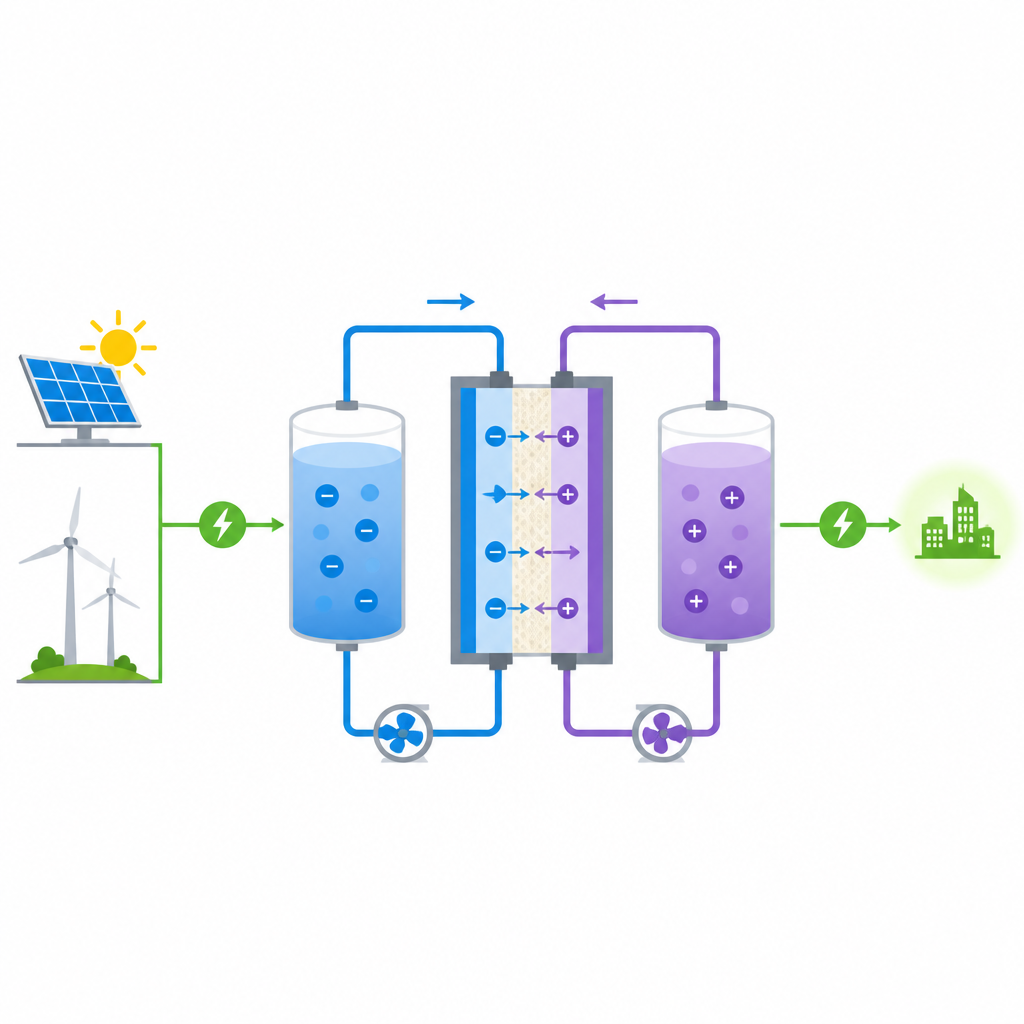
In a vanadium redox flow battery, two large tanks of liquid containing different vanadium ions are pumped past a membrane that should mainly let tiny charge-carrying ions through. In reality, the larger vanadium ions also drift across, a process called crossover. Over many charge and discharge cycles, more vanadium tends to move from the negative side to the positive side. One tank becomes too concentrated, the other is depleted, and the battery’s capacity and efficiency steadily fall. Making the membrane thicker or more selective can slow this drift, but that also makes it harder for charges to pass, which lowers power and raises cost.
Turning the problem into a balancing act
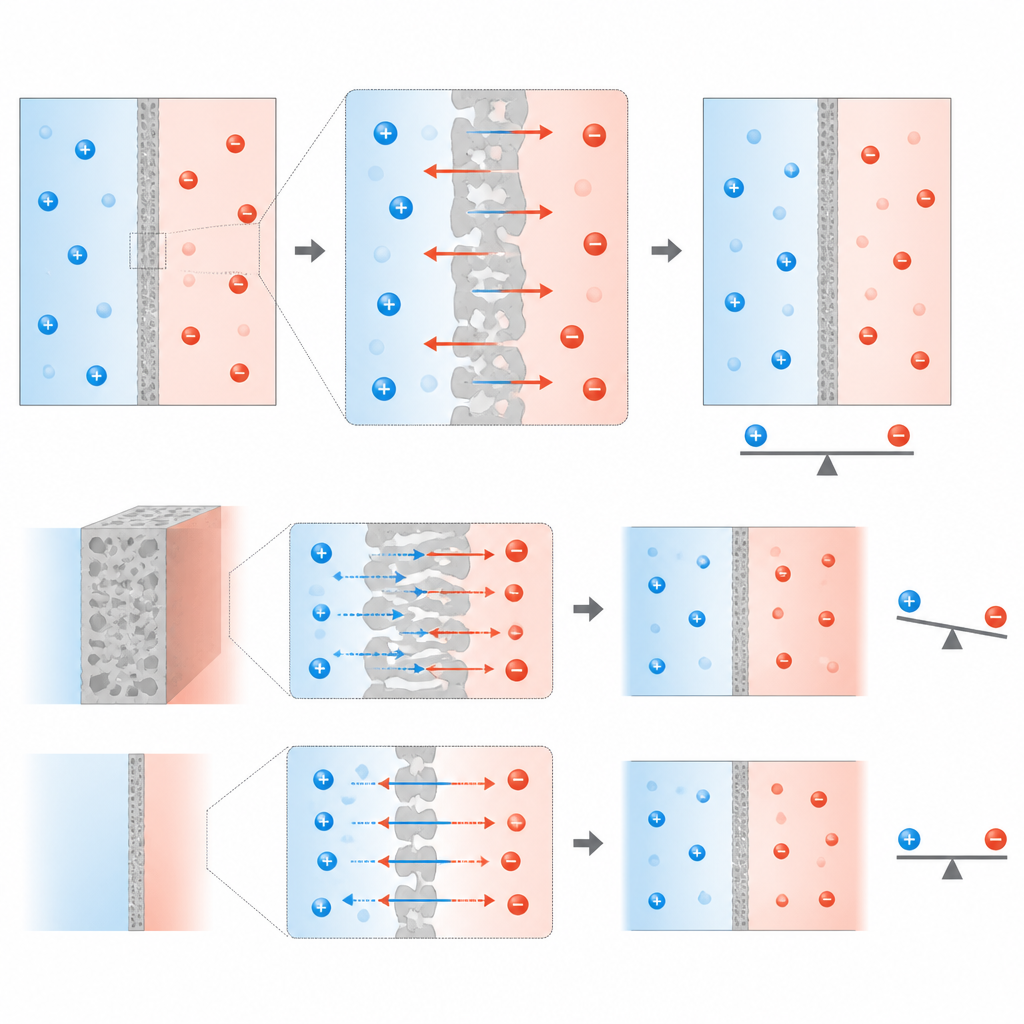
The authors take a different view: instead of fighting crossover only with better membranes, they treat the battery as a dynamic diffusion system. According to basic diffusion physics, ion movement depends not just on membrane properties but also on differences in concentration between the two sides. By tracking how the liquids change during long cycling, the team identifies a “balanced state” where the net flow of vanadium ions in one direction is offset by flow in the opposite direction. At this state, the battery’s discharge capacity curve levels off, indicating that the harmful accumulation of imbalance has nearly stopped.
Designing balanced-state electrolytes
To lock in this favorable state from the start, the researchers deliberately prepare the two liquids with different vanadium contents and slightly different average oxidation levels. They increase the concentration and average valence of the positive liquid and decrease the concentration of the negative one. This may sound like it should worsen crossover, because the concentration difference across the membrane is larger. Instead, the tailored mixture causes ions to move in opposing directions in just the right proportions so that the net crossover during cycling is greatly reduced. Experiments and computer simulations show that the diffusion rates of key vanadium ions become more similar, and the most harmful ion flows are slowed.
Thinner membranes, longer life, lower cost
Using these balanced-state electrolytes, the team runs vanadium flow batteries with much thinner commercial Nafion membranes than usual. A battery with a 51 micrometer membrane and balanced-state liquids loses capacity far more slowly than a conventional system that uses a membrane more than three times thicker. Going even thinner, down to 25 and 15 micrometers, maintains strong capacity retention while boosting power output, because electrical resistance drops. Over 1000 cycles, the capacity decay rate falls by as much as 75.4 percent compared with a standard thick-membrane design. Because thinner reinforced membranes are cheaper and can be used effectively with this strategy, the estimated capital cost of a one megawatt, four megawatt-hour system could fall by over 40 percent.
Beyond one battery chemistry
The authors further test their approach on iron–vanadium flow batteries, a related technology that suffers from even stronger crossover. By choosing unequal but carefully tuned mixtures of iron and vanadium ions on the two sides, they again slow capacity loss and increase the total energy delivered over hundreds of cycles. This suggests that the balancing idea is not tied to one specific material or membrane, but can be adapted to different chemistries that share the same crossover challenge.
What this means for future energy storage
For non-specialists, the key message is that the liquids inside a flow battery can be designed to police themselves. Rather than relying only on ever more complex membranes, this work shows that adjusting concentration and composition can set up a self-correcting flow of ions that keeps the system near balance. That makes long-lasting, powerful, and more affordable flow batteries more realistic, helping large-scale renewable energy storage move closer to everyday use.
Citation: Wang, Z., Guo, Z., Wang, T. et al. Balanced-state electrolytes overcome crossover in vanadium redox flow batteries. Nat Commun 17, 4470 (2026). https://doi.org/10.1038/s41467-026-70872-8
Keywords: vanadium flow battery, electrolyte design, energy storage, ion crossover, grid batteries