Clear Sky Science · en
Engineering ligands for theophylline riboswitches expands its regulatory dynamic range in prokaryotic and eukaryotic systems
Smarter molecular switches for living cells
Modern biology increasingly relies on tiny molecular "switches" that can turn genes on or off inside living cells. This study shows how redesigning the small chemical trigger for one of the field’s most popular RNA switches can make gene control far more precise, powerful, and versatile across bacteria and human cells alike. 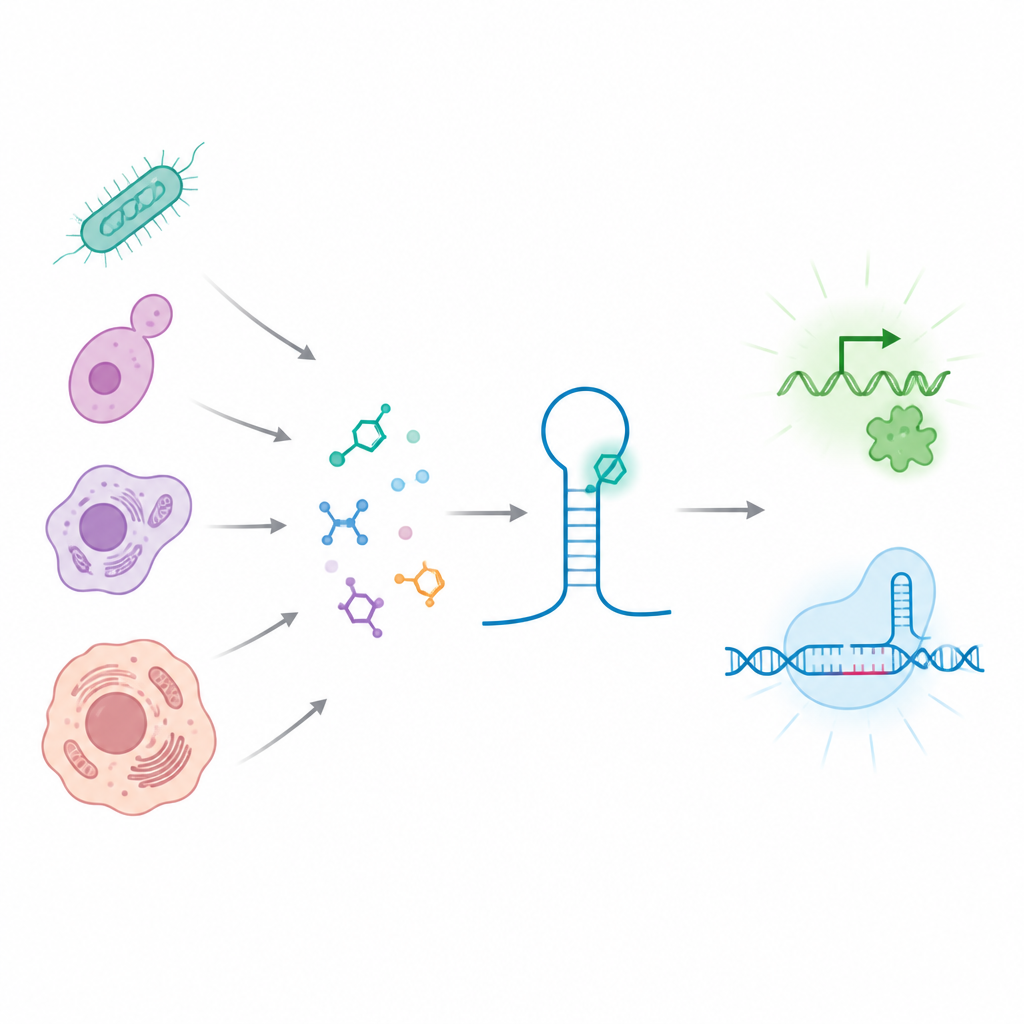
Why gene switches matter
Being able to control when and how strongly a gene turns on is central to many goals in biotechnology, from making cleaner fuels to engineering safer gene therapies. One widely used tool is the theophylline riboswitch, a short piece of RNA that changes shape when it senses a drug called theophylline, thereby controlling production of a target protein. However, this drug does not bind very tightly, must be used at high doses, and can cause side effects, all of which limit how precisely scientists can tune gene activity in research and potential medical applications.
Designing a better chemical key
The researchers set out to keep the same RNA switch but upgrade its chemical key. They used computer modeling to screen about a million small molecules and homed in on a family called 4-quinazolinones that could slip into the same pocket of the RNA as theophylline. They then synthesized a focused set of these candidates and tested how well each one bound to the RNA using a series of biophysical techniques. Two new molecules, named HMB and NMB, clamped onto the RNA around 9 to 30 times more tightly than the original drug, while remaining non-toxic and entering both bacterial and mammalian cells more efficiently.
From stronger binding to stronger control
To see whether tighter binding translated into better gene control, the team wired the improved ligands into actual genetic circuits. In bacteria, they built RNA switches that could either turn a fluorescent protein on or off in response to the chemical. With the old drug, cells brightened about 75-fold; with HMB, the same switch produced up to a 380-fold change, and the “off” design shut down protein output by more than 80 percent. These effects held across several strains, growth conditions, temperatures, and pH levels, showing that the upgraded ligands work robustly in real biological settings. The new molecules also outperformed theophylline in mycobacteria, an important group that includes the tuberculosis bacterium, where lower and safer doses are especially valuable.
Extending control to human cells and gene editing
Next, the scientists tested the molecules in human cells using an RNA device called an aptazyme that links ligand sensing to self-cleavage of a message. When HMB or NMB was added, the aptazyme stabilised a fluorescent reporter message, boosting its production up to about 11-fold compared with roughly 3-fold for theophylline. They then adapted the system to control CRISPR gene editing: the guide RNA needed for cutting DNA was locked until the ligand triggered an RNA rearrangement that freed it. In this setup, HMB achieved around 70 percent editing of a test gene at concentrations ten times lower than those required for theophylline, with clear reductions in the target protein and its messenger RNA. 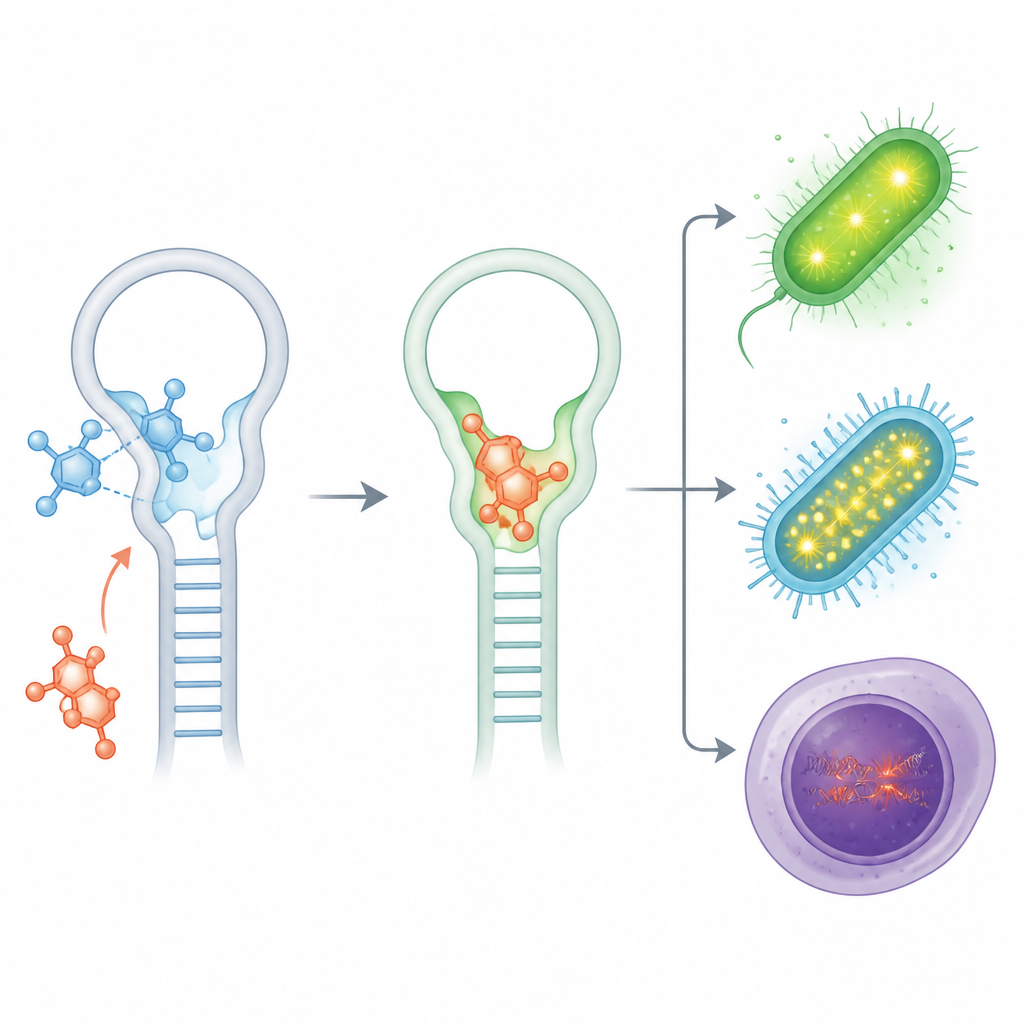
What this means for future applications
For non-expert readers, the core message is that the researchers did not invent an entirely new genetic switch; instead, they sharpened an existing one by supplying a better chemical key. By swapping in new ligands that bind more snugly, enter cells more readily, and work at lower doses, they greatly expanded how strongly and cleanly the theophylline riboswitch can control genes in bacteria and human cells. This improvement should make it easier to design precise gene circuits for tasks such as sensing disease markers, fine-tuning metabolic pathways, or timing CRISPR editing, all while using familiar RNA parts that many labs already rely on.
Citation: Khadake, R.M., Shinde, K. & Rode, A.B. Engineering ligands for theophylline riboswitches expands its regulatory dynamic range in prokaryotic and eukaryotic systems. Nat Commun 17, 4326 (2026). https://doi.org/10.1038/s41467-026-70870-w
Keywords: riboswitch, theophylline, synthetic biology, gene regulation, CRISPR