Clear Sky Science · en
Carbon, nitrogen, and sulfur cycling unveil deep-sea microbial niches in the Atacama Trench
Life in the deepest dark
Far below the waves off northern Chile, the seafloor is cold, dark, and seemingly barren. Yet these sediments host bustling microbial communities that quietly recycle key elements and help keep the ocean habitable. This study explores who those microbes are and how they make a living in the depths of the Atacama Trench region, revealing both a widespread “rain-fed” deep-sea ecosystem and a hidden oasis powered by chemical energy leaking from below.
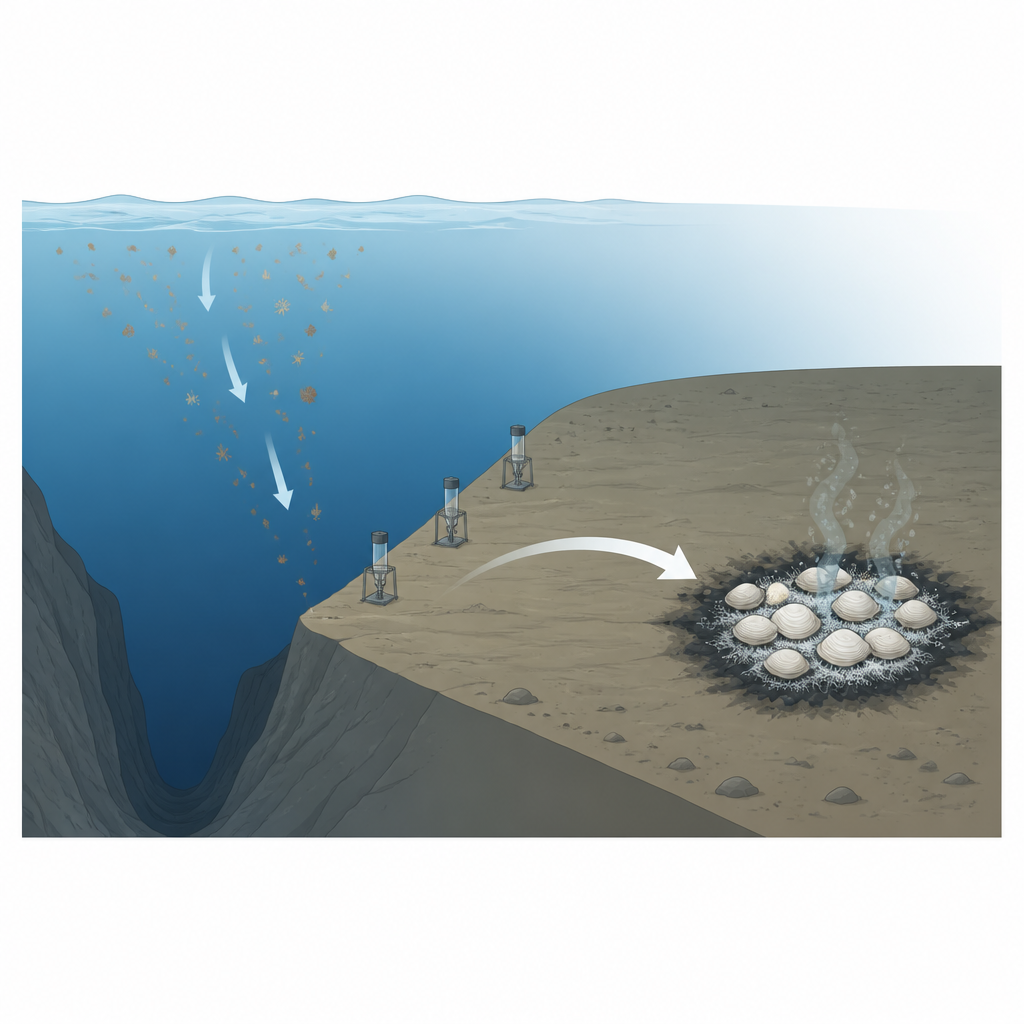
Two ways to feed a deep ocean
The researchers joined an expedition to the Peru–Chile Trench system, focusing on abyssal sediments between about 2,400 and 4,000 meters below sea level. Most sites they sampled were typical deep seafloor, where life relies on a slow drizzle of “marine snow” – tiny particles of dead plankton and other debris sinking from the sunlit surface. In these places, microbial communities were surprisingly uniform across tens of kilometers. Bacteria and archaea dominated and mainly earned their living by breaking down this aged organic material, using oxygen where it was available and switching to other pathways deeper in the mud.
A chemical oasis on the seafloor
One site, however, stood out. At about 2,800 meters depth, the remotely operated vehicle found darker sediments, bright white microbial mats, and beds of large clams. These clues pointed to a cold seep – a spot where chemically rich fluids seep from the seafloor without the heat of a hydrothermal vent. Here, instead of relying mostly on falling detritus from above, many microbes appeared to tap into reduced sulfur compounds rising from below as an energy source. The team collected sediment cores in and around this patch to compare its chemistry and biology with the surrounding plain.
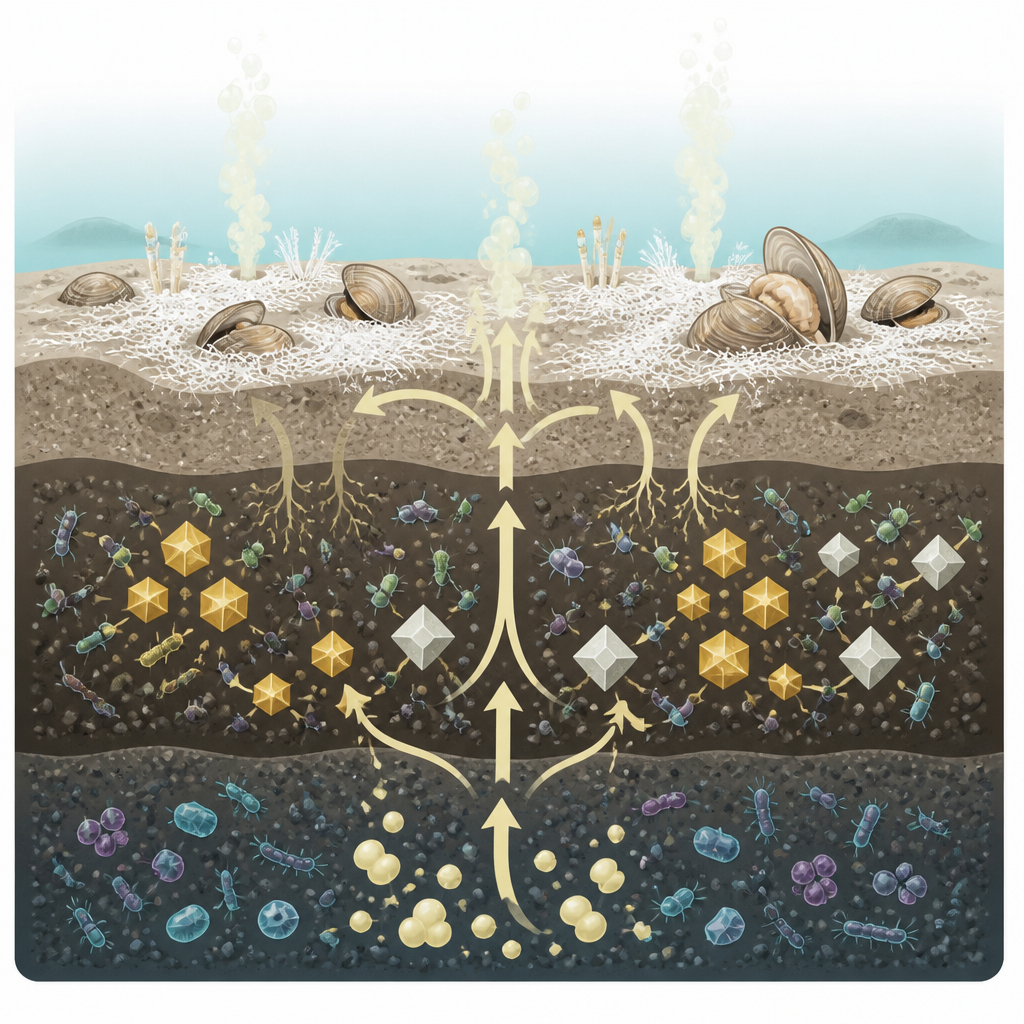
Clues written in minerals and molecules
Back in the lab, the sediments told a layered story. Across the region, grains of quartz and other rock fragments were mixed with the shattered remains of diatoms from the surface ocean, confirming the link to marine snow. But in the special seep site, the upper centimeter of sediment held small crystals of dolomite, and deeper layers were packed with iron sulfide minerals such as pyrite. Together with elevated sulfur and iron, these minerals suggested that seep fluids once promoted intense chemical reactions in the mud. At the same time, porewater measurements showed little oxygen and signs of strong reduction in the deeper layers, ideal conditions for microbes that use sulfate and other compounds instead of oxygen to breathe.
Microbes that trade in sulfur, not methane
The team used metatranscriptomics, which reads out actively expressed genes, to map which microbes were doing what. Outside the seep, communities were dominated by oxygen-loving bacteria and archaea that oxidize ammonia and process nitrogen, carbon, and traces of sulfur. Inside the seep, the surface mats teemed with sulfur-oxidizing bacteria related to classic white filamentous forms, along with clams that host internal sulfur-eating partners. Just a few centimeters down, the community changed sharply: oxygen users faded, and anaerobic specialists took over, including microbes that reduce sulfate to sulfide, fix carbon using dissolved carbon dioxide, and break down stubborn organic compounds. Strikingly, the typical methane-eating archaea found at many cold seeps were almost absent, and key methane-processing genes were rare, pointing to a system fueled mainly by sulfur rather than by methane.
What this hidden world tells us
Together, the geological and genetic evidence paints a picture of a deep-sea landscape with two intertwined modes of life. Most of the seafloor in this region hosts communities that survive on the slow decay of marine snow, recycling carbon and nitrogen in a fairly stable way. In contrast, the cold seep acts as a localized oasis where chemical energy from reduced sulfur supports dense mats of bacteria, clams, and a highly specialized subsurface microbiome. The presence of dissolving dolomite and abundant pyrite hints that seepage may have been stronger in the past, but even today sulfur cycling remains intense. For a lay observer, the key message is that the deep ocean is not a uniform desert: subtle leaks of chemical energy can carve out distinct habitats, each with its own cast of microscopic players that quietly shape global cycles of carbon, nitrogen, and sulfur.
Citation: Arribas Tiemblo, M., Azua-Bustos, A., Sánchez-España, J. et al. Carbon, nitrogen, and sulfur cycling unveil deep-sea microbial niches in the Atacama Trench. Nat Commun 17, 4606 (2026). https://doi.org/10.1038/s41467-026-70869-3
Keywords: deep-sea microbes, cold seep, sulfur cycling, marine snow, Atacama Trench