Clear Sky Science · en
Computational engineering of the polyester hydrolase PHL7 for efficient poly(ethylene terephthalate) degradation in biocatalytic recycling processes
Turning Plastic Waste into a Resource
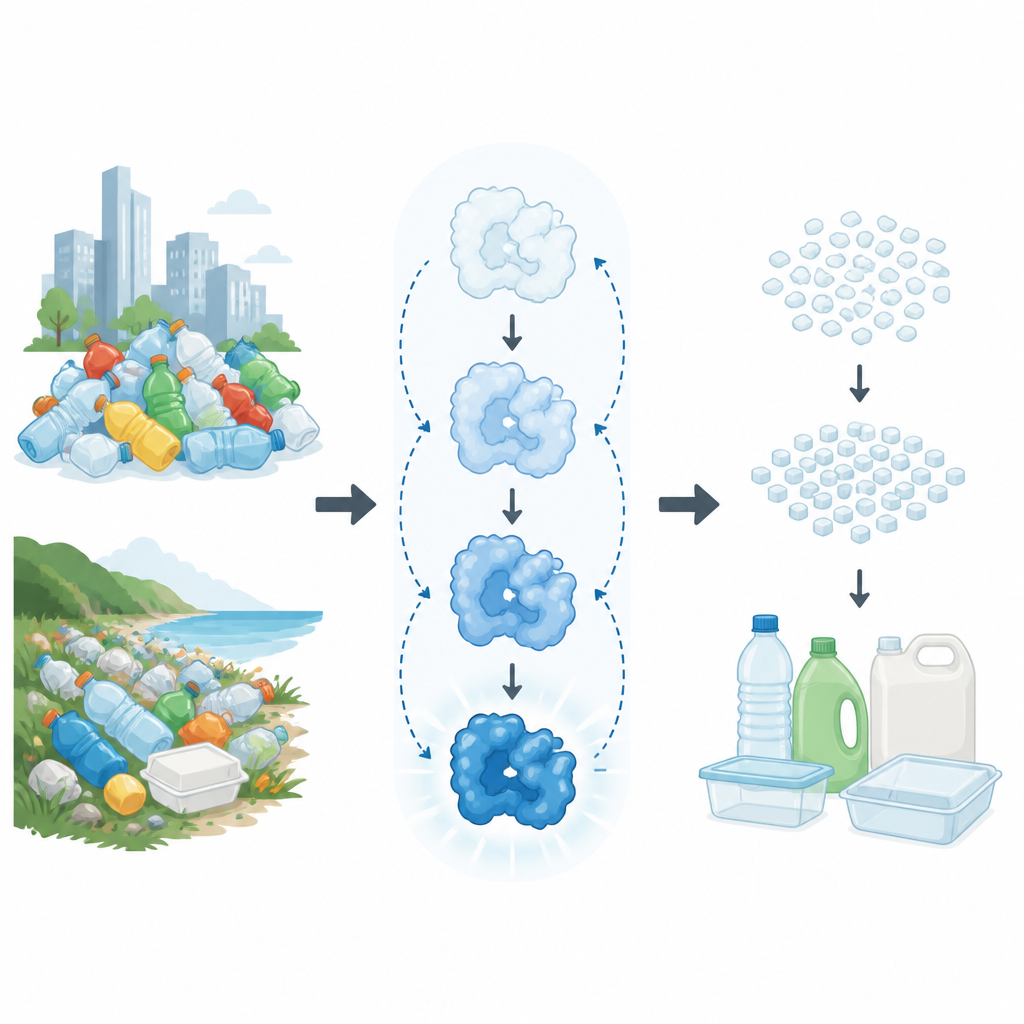
Most of us use plastic bottles and food containers every day, but only a small fraction is recycled and much of it lingers in landfills or the environment. This study explores how to harness specialized proteins called enzymes to break down one of the most common plastics, PET, so its building blocks can be reused again and again. By redesigning a natural enzyme with computer tools, the researchers aim to help turn mixed plastic waste into a true raw material for a circular economy.
Why PET Bottles Are Hard to Recycle
Polyethylene terephthalate, or PET, is the tough, clear plastic used in drink bottles, packaging, and textiles. Its strength and durability make it useful but also difficult to dispose of. In 2020, only about a quarter of plastic waste was recycled, and much PET ends up polluting land and oceans. One promising solution is biocatalytic recycling, in which enzymes cut PET back into its original small molecules. Those molecules can then be turned into new plastic without pumping more oil out of the ground. The challenge is that real-world recycling requires enzymes that work fast, stay stable at high temperatures, and do not depend on costly salts or delicate conditions.
Designing a Tougher, Faster Enzyme
The team focused on an enzyme called PHL7, originally found in a compost heap and already known for chewing through low-crystalline PET at about 70 degrees Celsius. However, PHL7 quickly lost activity in the low-salt solutions favored for industrial plants. Using a computer program called Rosetta PROSS, the researchers proposed dozens of small changes in the enzyme’s amino acid sequence that should make it more stable without disturbing its working site. They built a series of variants in several rounds, each time measuring how hot the enzyme could get before unfolding and how much PET film it could digest. Some early designs were very stable but slower, revealing a trade-off between toughness and speed that had to be carefully balanced.
Fine-Tuning the Molecular Machinery
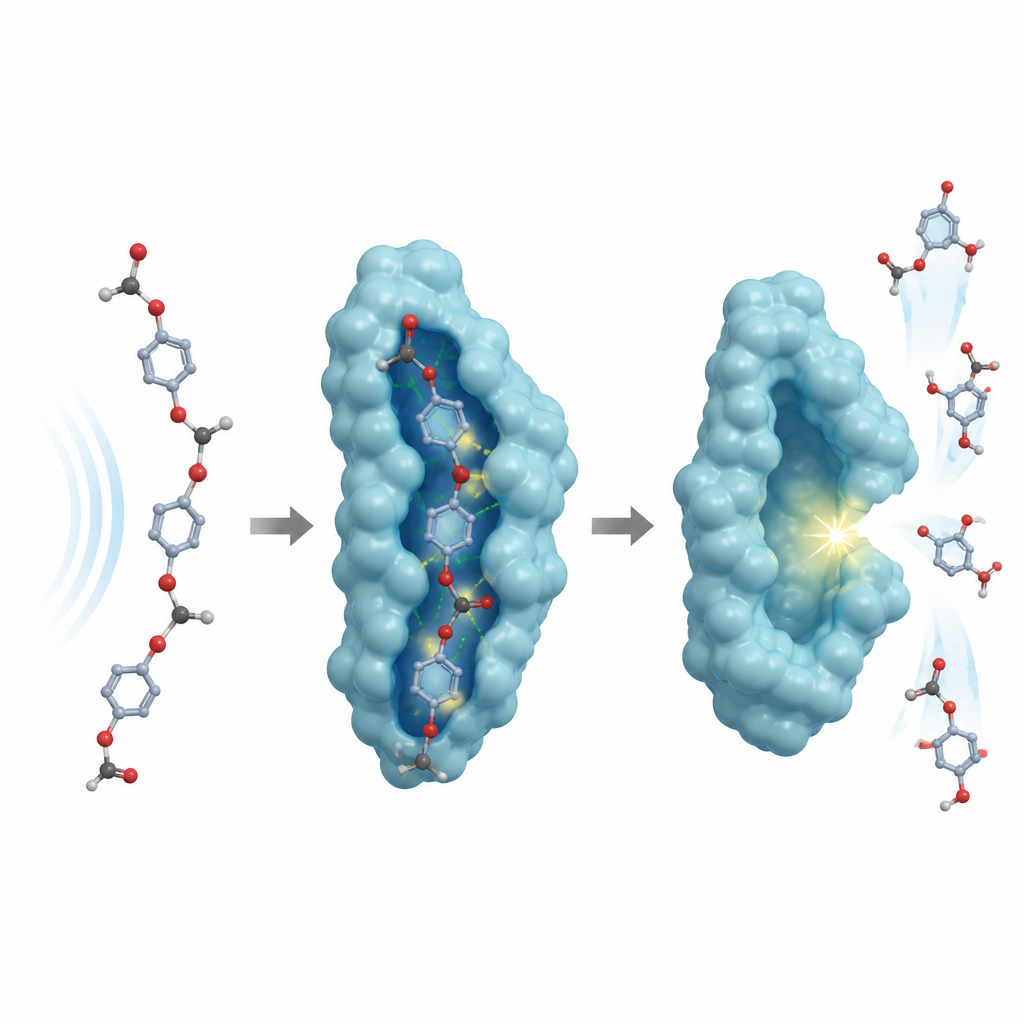
To understand why certain changes helped or hurt performance, the researchers solved high-resolution crystal structures of the redesigned enzymes and ran molecular dynamics simulations that follow atomic motion over time. Many of the stabilizing changes were on the enzyme’s surface, where they reduced clusters of negative charge that previously required high salt to remain folded. Other key changes occurred next to the active site, rearranging buried water molecules and subtle hydrogen bonds that control how the catalytic triad of residues lines up to cut PET. By selectively undoing some stability-boosting mutations near the active site and adding rationally chosen ones from other successful PET-degrading enzymes, they restored and even improved the cutting power while keeping the new stability.
Putting the New Enzymes to the Test
The best engineered variants, named R4M6, R4M9, and R4M10, carried up to 24 mutations and melted only above about 90 degrees Celsius, well above the parent enzyme. In dilute buffer at 70 degrees, they were more than 110 times more active than the original PHL7. When compared with leading PET-degrading enzymes such as ICCG, LCC-A2, and TurboPETase across different temperatures and salt levels, the top PHL7 variants matched or nearly matched the highest degradation rates while showing superior long-term stability. In bioreactor tests with hefty PET loads, they broke down about three-quarters of a 10 percent PET mixture within a day, clearly outperforming ICCG. An optimized version, R4M10-H185Y, handled even tougher conditions, degrading over 80 percent of a 20 percent PET slurry in 24 hours.
What This Means for Future Recycling
For non-specialists, the main message is that the researchers have turned a natural PET-eating enzyme into a rugged, efficient tool that works in more realistic recycling conditions. Instead of simply dissolving bottles with harsh chemicals or high heat, these redesigned enzymes can gently chop PET into reusable pieces while using less salt and energy. The study also maps out which tiny changes in the protein’s structure matter most for both stability and activity, offering a blueprint for improving other plastic-eating enzymes. If incorporated into industrial plants, such biocatalysts could help move society closer to closing the loop on PET, where yesterday’s packaging becomes tomorrow’s products without adding more plastic to the planet.
Citation: Blázquez-Sánchez, P., Gunkel, J., Useini, A. et al. Computational engineering of the polyester hydrolase PHL7 for efficient poly(ethylene terephthalate) degradation in biocatalytic recycling processes. Nat Commun 17, 4370 (2026). https://doi.org/10.1038/s41467-026-70868-4
Keywords: PET recycling, plastic-degrading enzymes, enzyme engineering, biocatalysis, circular plastics