Clear Sky Science · en
Antimony oxide buffer layer for single- and double-junction perovskite-based solar cells
New ways to catch more sunlight
Solar panels are getting close to their physical limits, so squeezing out even a small extra share of sunlight can mean cheaper clean power. This study shows how a little-known material, antimony oxide, can make cutting-edge perovskite–silicon solar cells both more efficient and easier to manufacture at useful sizes.
Why today’s tandem solar cells waste light
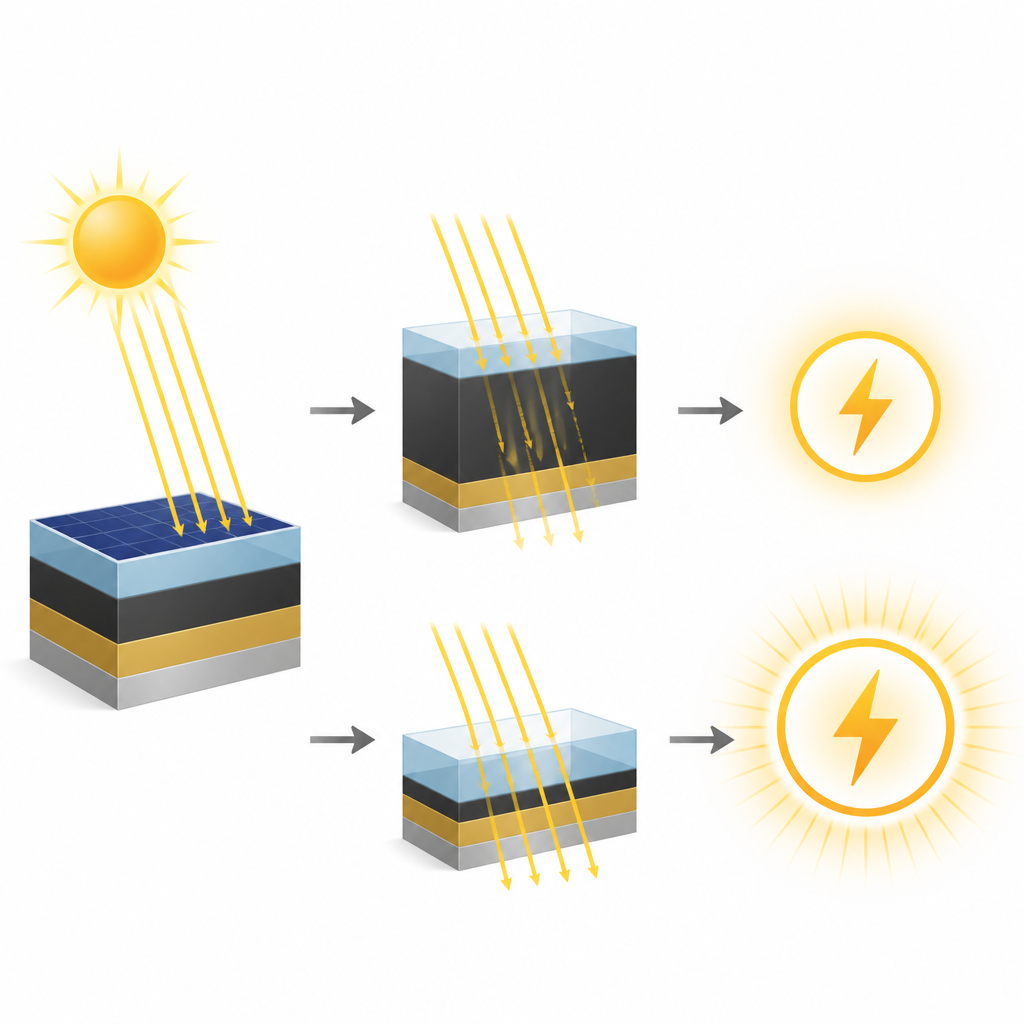
Some of the highest-performing solar panels stack a perovskite cell on top of a silicon cell, letting each absorb a different slice of the solar spectrum. Between these layers sit ultra-thin films that guide electrical charges and protect delicate materials during processing. A commonly used buffer material, a form of tin oxide deposited atom by atom, does this job well but also reacts chemically with the perovskite layer. To shield the perovskite, engineers have been forced to add a thicker layer of carbon-based material called fullerene. That extra thickness, however, soaks up useful blue and violet light instead of letting it reach the active layers, quietly robbing the device of current and efficiency.
A gentler protective layer that lets in more light
The researchers replaced the reactive tin oxide layer with a film of antimony oxide laid down by simple thermal evaporation. This process gently turns powdered material into vapor and condenses it as a smooth coating, avoiding the harsh chemistry that damages perovskites. Because antimony oxide is kinder to the underlying layer, the fullerene film above the perovskite can be thinned from 15 nanometers to just 5 nanometers without sacrificing stability. Thinner fullerene means less parasitic absorption in the 300 to 560 nanometer wavelength range, allowing more short-wavelength light to be converted into electricity by the perovskite top cell.
Hidden highways for electrical charges
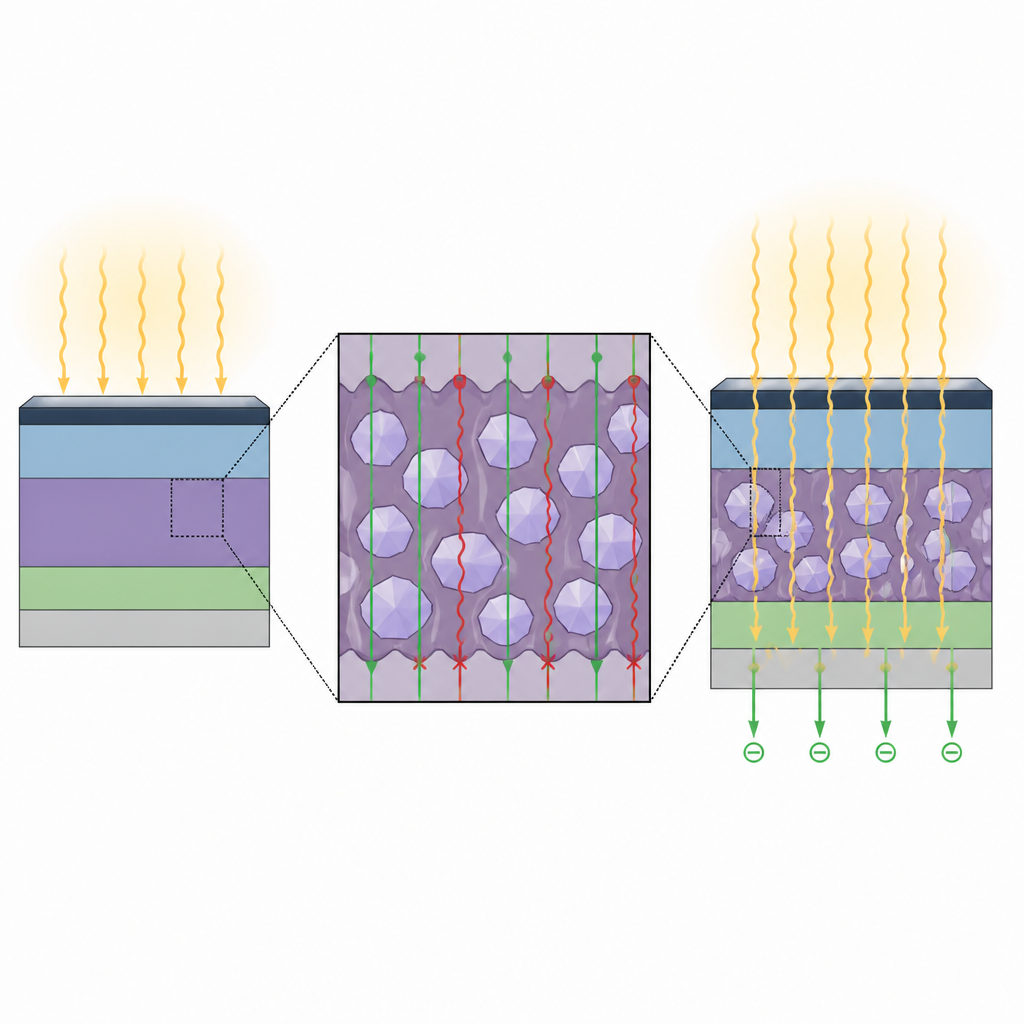
Looking closely with electron microscopes and specialized electrical probes, the team found that the antimony oxide film is not uniformly glassy. Instead, it combines amorphous regions with tiny ordered crystals. These nanocrystals line up in a way that forms vertical pathways for electrons, while the surrounding amorphous material remains more insulating. Additional measurements suggest that defects associated with antimony atoms create energy states that help electrons cross the energy barrier between layers. Together, these features allow charges to move quickly through the buffer in the direction needed, while still blocking unwanted leakage sideways.
From lab-scale cells to larger panels
To show that antimony oxide is practical, the researchers tested it in both single perovskite cells and full perovskite–silicon tandems. Single cells with different bandgaps all reached high efficiencies above 22 percent, with the best at 23.18 percent, matching state-of-the-art tin oxide devices made with similar methods. When integrated into tandem cells of one square centimeter in area, the new buffer layer raised the power conversion efficiency to 30.28 percent, mainly by boosting the current from the top perovskite cell by about 1 milliampere per square centimeter. Crucially, the approach scaled well: a fully encapsulated module with an aperture area of 64.64 square centimeters reached 28.16 percent efficiency, with an independently certified value of 27.70 percent, and showed little degradation during extended light exposure and heat tests.
What this means for future solar panels
For non-specialists, the main message is that a subtle change in a nearly invisible layer of a solar cell can translate into noticeable gains in how much sunlight is harvested, without making manufacturing more complex or fragile. Antimony oxide offers a way to protect perovskite layers gently while letting in more light and carrying charges efficiently, in both small test cells and larger modules. This combination of higher efficiency, good stability, and lower processing cost points toward tandem solar panels that could surpass 35 percent efficiency and become attractive for widespread commercial use.
Citation: Shi, B., Sunli, Z., Liu, P. et al. Antimony oxide buffer layer for single- and double-junction perovskite-based solar cells. Nat Commun 17, 4394 (2026). https://doi.org/10.1038/s41467-026-70848-8
Keywords: perovskite solar cells, tandem solar cells, antimony oxide, buffer layer, solar efficiency