Clear Sky Science · en
Cell-type-specific immune programs orchestrate spatial defense in the Arabidopsis leaf epidermis
How leaves fight germs one cell at a time
Plant leaves may look like simple green sheets, but each surface cell plays a specific role in stopping invading germs. This study peels back that surface, showing how different cells on an Arabidopsis leaf share the work of spotting fungal and bacterial attackers and halting their spread. By zooming in on single cells over time, the authors reveal a surprisingly organized neighborhood watch system that helps plants survive in a microbe filled world.
A patchwork battlefield on the leaf surface
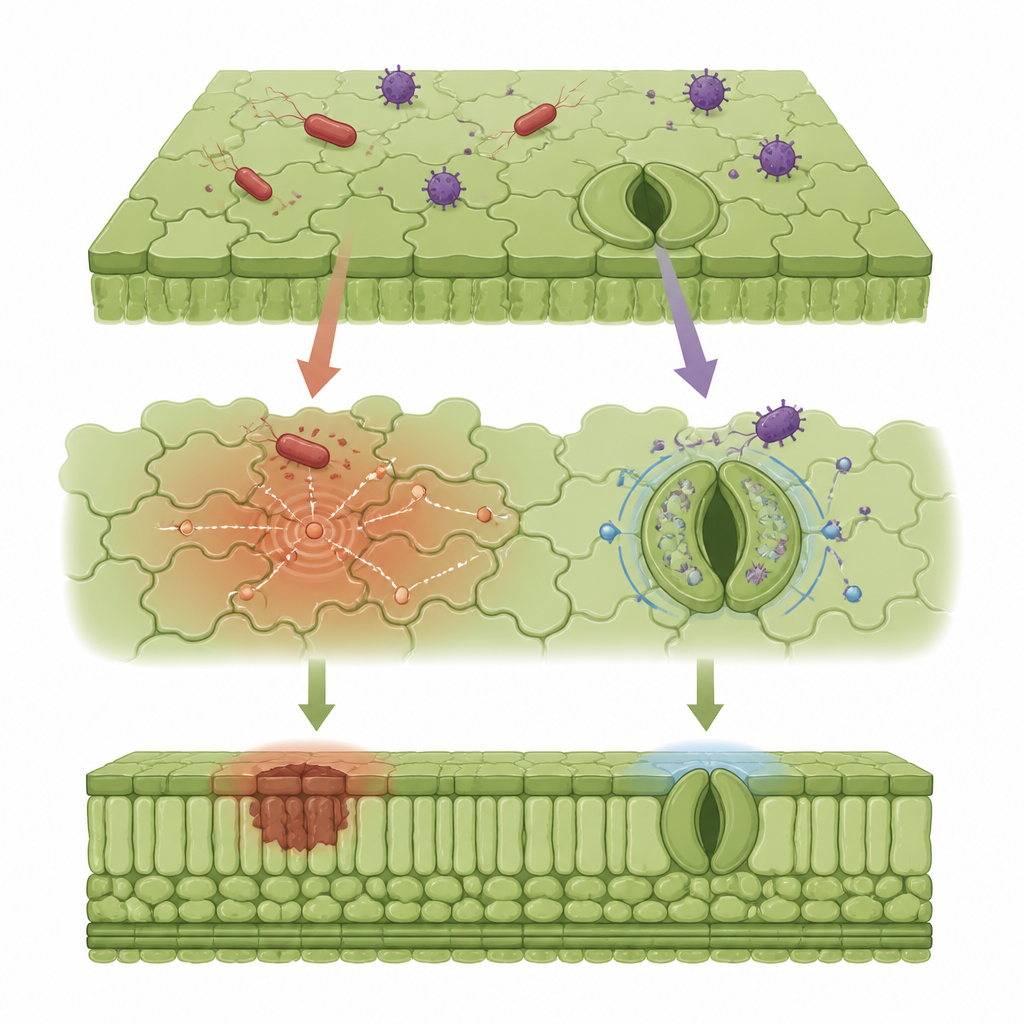
The outer skin of a leaf is made of large puzzle piece pavement cells and tiny paired guard cells that frame the pores for gas exchange. Many microbes try to enter through this layer, landing as spores or bacteria and probing for weak spots. Using fluorescent reporter plants and high resolution microscopes, the researchers watched what happens after infection by several pathogens, including powdery mildews and the bacterial strain Pseudomonas syringae. They found that when a fungus attempts to break in, a central “patient zero” cell switches on defense genes, and that alarm quickly spreads to rings of neighboring pavement and even underlying photosynthetic cells in a patchy halo.
How one hormone signal spreads through the tissue
A key player in these defenses is salicylic acid, a hormone related to the active ingredient in aspirin. The team tracked genes that control its production and transport, such as ICS1 and EDS5. These genes lit up first in the infected pavement cell, then in nearby pavement cells and some deeper cells, forming a bright island of activity around the infection site. Blocking calcium movement into cells, or disturbing calcium pumps that reset calcium levels, prevented this salicylic acid related response. Genetic tests confirmed that calcium sensitive switches turn these defense genes on, tying together ion signals, hormone production, and the broad protective zone around each infection.
Guard cells follow their own defense script
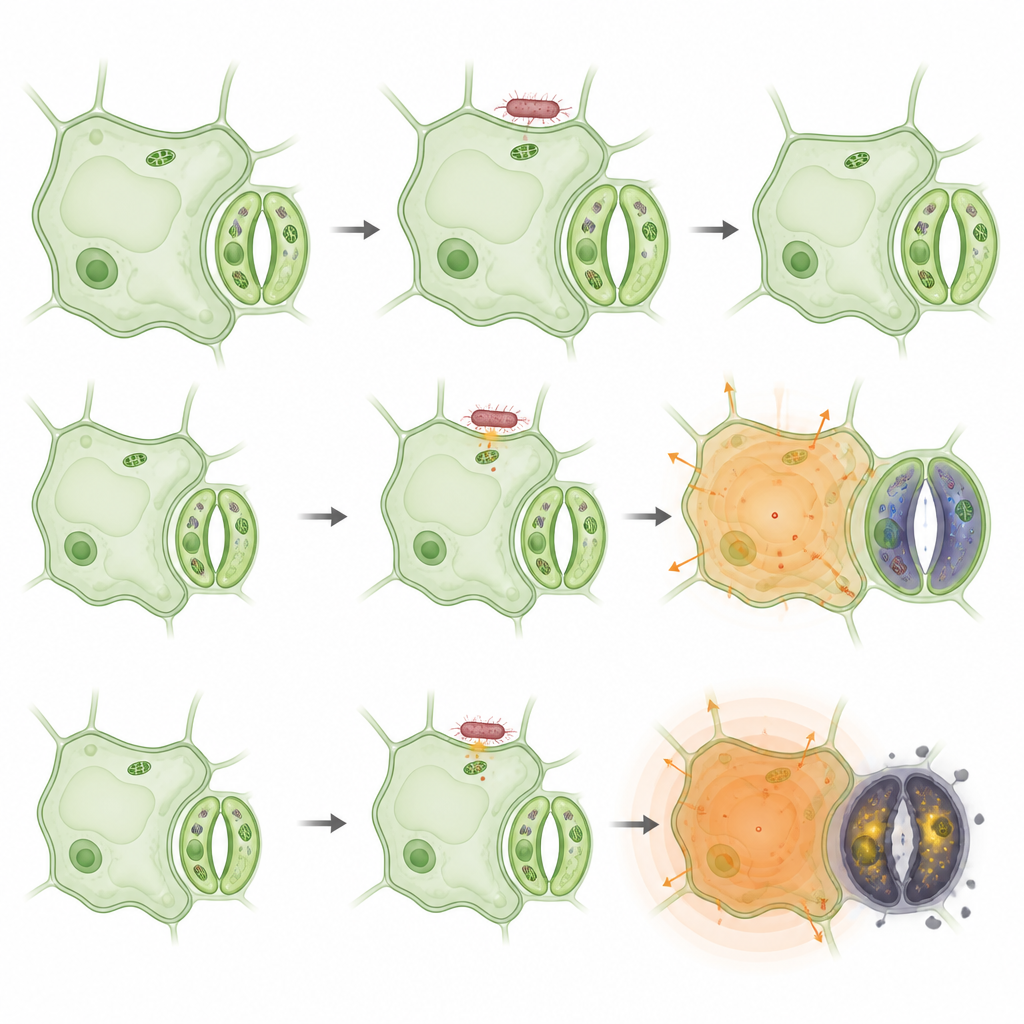
Guard cells, which open and close stomatal pores, behaved very differently. Even when they sat right next to an infected pavement cell, or were themselves pierced by a fungal structure, they did not switch on salicylic acid genes or classic hormone responsive defense genes. They also failed to build callose, a strengthening wall material often laid down at attack sites. Yet guard cells were not passive. They showed sharp bursts of calcium and strong build up of reactive oxygen species, chemical signals that can damage cells and microbes alike. These signals then appeared to travel through the space outside cells to nearby pavement cells, which did launch salicylic acid based defenses and callose walls.
A stable division of labor across different attackers
To test whether this split behavior was a special case, the authors examined infections by other fungi and bacteria and mined single cell RNA sequencing datasets. Across these very different attackers, pavement cells consistently turned on genes for salicylic acid pathways and hormone based defense, while guard cells shifted their metabolism toward stress handling and water control. Notably, adapted powdery mildews that grow well in pavement cells stalled inside guard cells. In these pores, fungal feeding structures remained stunted and failed to produce the spreading hyphae seen in surrounding tissue, while neighboring pavement cells often showed strong callose and other defense marks.
What this means for plant health and crop protection
Together, the findings show that Arabidopsis leaves organize defense spatially: pavement cells act as hormone powered hubs that coordinate wider tissue resistance, while guard cells use rapid calcium and reactive oxygen signals and are themselves poor hosts for invading fungi. This cell type specific division of labor helps explain how leaves can both breathe through stomata and fend off disease. Understanding these distinct programs could help breeders and biotechnologists design crops whose leaf surfaces are better wired to sense pathogens, contain infections locally, and maintain healthy gas exchange under pressure from a changing community of microbes.
Citation: Song, J., Modareszadeh, M., Kumarapeli, D. et al. Cell-type-specific immune programs orchestrate spatial defense in the Arabidopsis leaf epidermis. Nat Commun 17, 4296 (2026). https://doi.org/10.1038/s41467-026-70843-z
Keywords: plant immunity, salicylic acid, guard cells, powdery mildew, Arabidopsis leaves