Clear Sky Science · en
Atomic-scale strain waves for stronger and more ductile lightweight steels
Making Stronger, Safer, and Lighter Metals
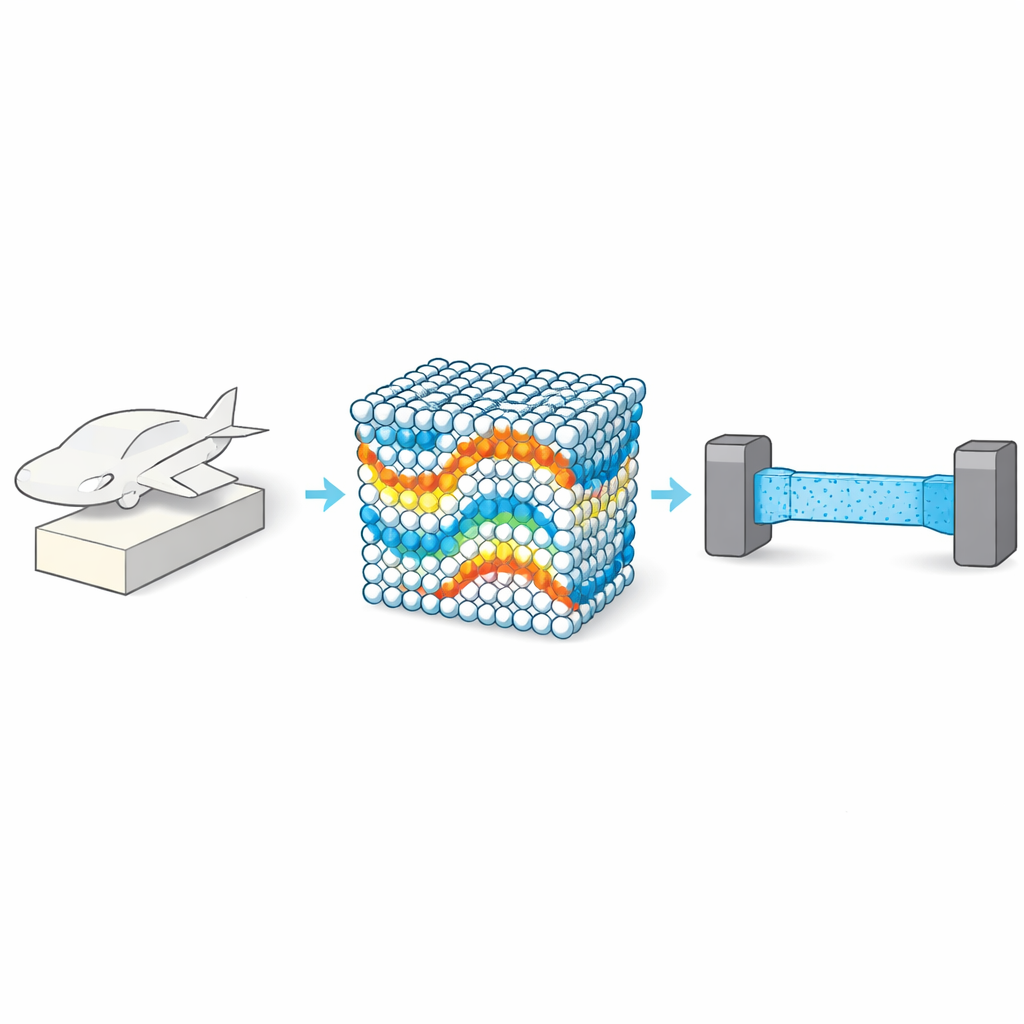
Modern cars, trains, and planes all face the same challenge: how to be lighter to save fuel and cut emissions, yet strong and tough enough to keep people safe. This paper reports a way to push that balance further than before, using a special kind of steel that is both unusually light and remarkably resistant to breaking. The key is a subtle trick at the atomic level, where tiny wave-like distortions in the crystal structure help the metal bend and stretch without failing.
Tiny Waves Inside Solid Metal
At first glance, the new steel looks like an ordinary metal, but zooming in to the size of atoms reveals a very different picture. The alloy is based on iron mixed with manganese, aluminum, and carbon to create a lightweight steel with a face-centered cubic crystal structure. Within this crystal, very small clusters rich in aluminum and carbon form, only about half a billionth of a meter across. Because aluminum atoms are larger than iron and manganese atoms, these clusters cause the surrounding lattice to expand and contract in a regular, wavy pattern. The result is a built-in landscape of alternating tension and compression at the atomic scale, with wavelengths under one nanometer and strain amplitudes of up to about 3%.
Tuning the Invisible Landscape
The researchers showed that this wave pattern can be tuned by carefully controlling how the steel is heated and cooled. By adjusting annealing time and adding an aging step, they varied both the amount and size of these aluminum-rich regions and the larger, ordered particles that grow from them. Using advanced electron microscopy and atom probe techniques, they mapped how these chemical clusters and the resulting strain waves change with processing. Samples with stronger, finer strain waves—higher amplitude and shorter wavelength—were found to contain more of these sub-nanometer clusters, and to have strain patterns that extend into both the surrounding metal and the larger nano-sized particles that form during aging.
How Atomic Waves Tame Defects
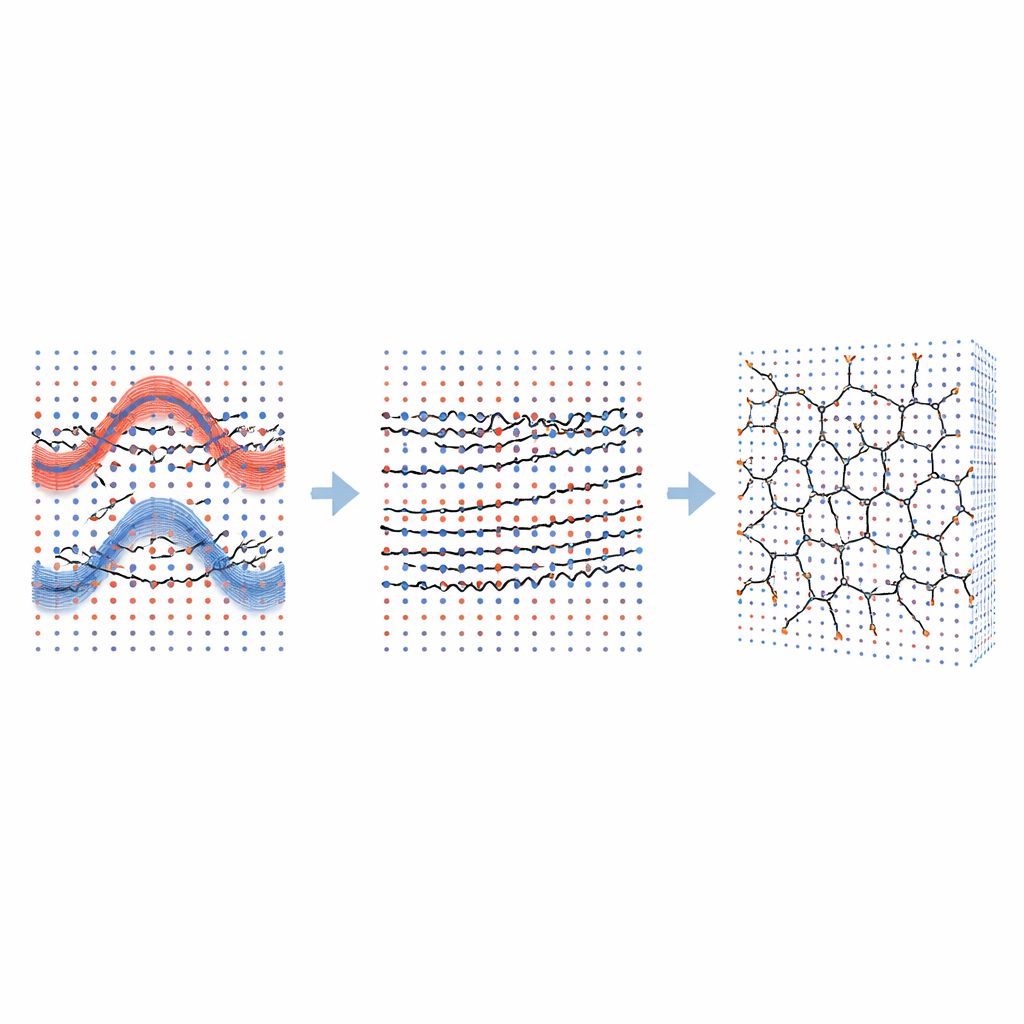
When a metal is stretched, its atoms do not all move smoothly. Instead, lines of defects known as dislocations glide through the crystal and carry the permanent shape change. In many strong alloys, these dislocations pile up and concentrate stress, which can trigger cracks and sudden failure. In this steel, the atomic-scale strain waves act like a patterned landscape that nudges and pins these moving lines. Rather than forming long, straight defects that stack up, the dislocations become short, wavy, and often paired. As stretching continues, these paired defects rearrange and cross from one atomic plane to another, weaving dense hexagonal networks. At the same time, the slip bands—thin zones where many dislocations move together—are dynamically refined and grow closer together, which spreads deformation more evenly through the material.
Breaking the Usual Strength–Ductility Trade-Off
Most metals face a trade-off: making them stronger usually makes them less stretchable. The team measured how their steels responded in tension and found that the versions with strong atomic strain waves achieved both higher yield and ultimate strengths and much larger elongations than those with weaker waves. Remarkably, even when the steel was further strengthened by nano-sized particles, the variant with tuned strain waves maintained far better ductility than comparable lightweight steels reported in earlier work. Quantitatively, the best compositions achieved record-high combinations of specific strength and uniform elongation among this class of alloys, while also showing higher stiffness due to subtle changes in the average lattice spacing.
What This Means for Future Structures
To a non-specialist, the main message is that the authors have found a way to use invisible, built-in atomic waves to guide and tame the defects that normally weaken metals as they deform. By engineering this wavy strain landscape—rather than adding only harder particles or new phases—they created a lightweight steel that is both exceptionally strong and unusually stretchable before breaking. This approach could provide a new design principle for many structural materials: instead of simply blocking defects, reshape their pathways at the atomic level to store more damage safely. In the long run, such strategies may lead to lighter vehicles and infrastructure that are safer, more energy-efficient, and more durable.
Citation: Yang, Q., Wu, W., Zhang, W. et al. Atomic-scale strain waves for stronger and more ductile lightweight steels. Nat Commun 17, 4094 (2026). https://doi.org/10.1038/s41467-026-70841-1
Keywords: lightweight steel, atomic strain waves, high strength ductility, dislocation networks, structural materials