Clear Sky Science · en
All-optical logic processing unit using Kerr nonlinearity of MXene
Why Faster Thinking Machines Matter
Every tap on a smartphone or click on a laptop wakes up billions of tiny electronic switches called logic gates. They are the basic yes–no decision makers that power everything from web searches to self‑driving cars. But as we demand ever more speed and ever smarter artificial intelligence (AI), traditional electronic chips are running into hard limits: they heat up, waste energy, and can only switch so fast. This paper explores a different route—using light instead of electricity—and shows how a new kind of ultra-thin material can act as a reprogrammable, light‑driven logic processor that tackles AI tasks at high speed and with low energy use.
Turning Light Into Logic
Digital devices work by combining simple logic steps like AND, OR, and NOT into vast circuits. Conventional versions use electrons flowing through silicon. The authors instead build logic gates that use only photons—particles of light—as both the information carriers and the switching signal. Because light travels quickly and can pass through itself without interfering, optical logic promises operations that are much faster and more parallel than in electronics, while generating less heat. The catch has been flexibility: most optical logic devices are designed for a single task and cannot easily be reprogrammed. This work addresses that roadblock by designing an all‑optical “logic processing unit” whose behavior can be changed electrically without rebuilding the hardware.
A New Kind of Light‑Sensitive Material
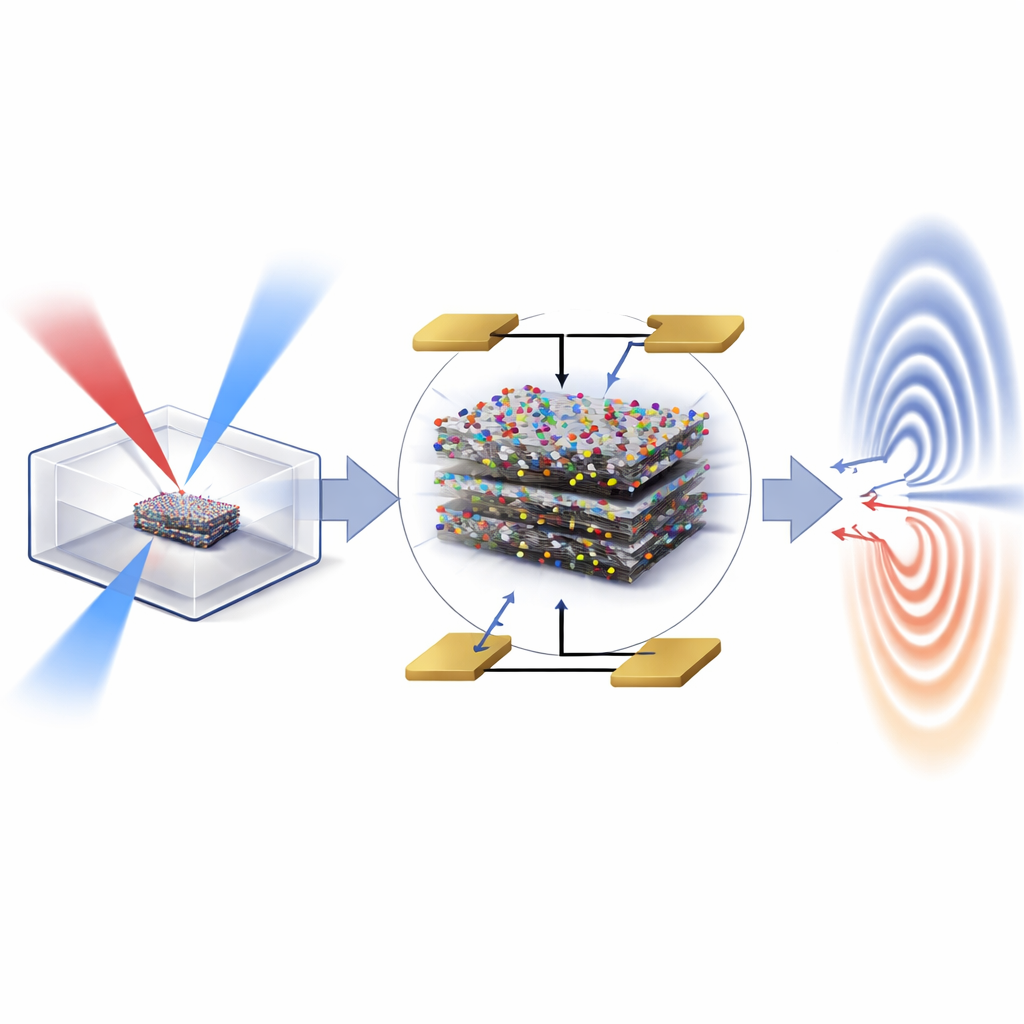
At the heart of the device is a high‑entropy MXene, a sheet‑like material only a few atoms thick and made from a mix of several transition metals and carbon. Because different metal atoms and surface groups are mixed together, this MXene has a rich and tunable electronic structure. When a strong light beam passes through it, the material’s optical properties change slightly—a phenomenon known as the Kerr effect. That small shift is enough to bend and reshape light waves, creating bright ring patterns or changing how one beam affects another. The researchers show that by gently changing the chemistry of the MXene surface with a tiny applied voltage in an electrochemical cell, they can strengthen or weaken these light‑driven effects and thereby control how the material responds to incoming beams.
Reconfigurable Light‑Only Logic
Using these tunable responses, the team builds logic gates that accept two light beams as inputs. The presence of strong light represents a “1,” while weak light stands for “0.” When the beams meet in the MXene cell, they can trigger or fail to trigger a distinct ring pattern in the transmitted light. The appearance of rings is read as an output “1”; their absence is “0.” By choosing the applied voltage and the exact position of the MXene relative to the laser focus, the same physical setup can be switched among seven different basic logic operations: AND, OR, NOT, NOR, NAND, XOR, and XNOR. In other words, a single piece of MXene in a simple optical layout can impersonate an entire toolbox of electronic logic chips, all controlled by low electrical signals without moving parts.
From Single Gates to Optical Neural Networks
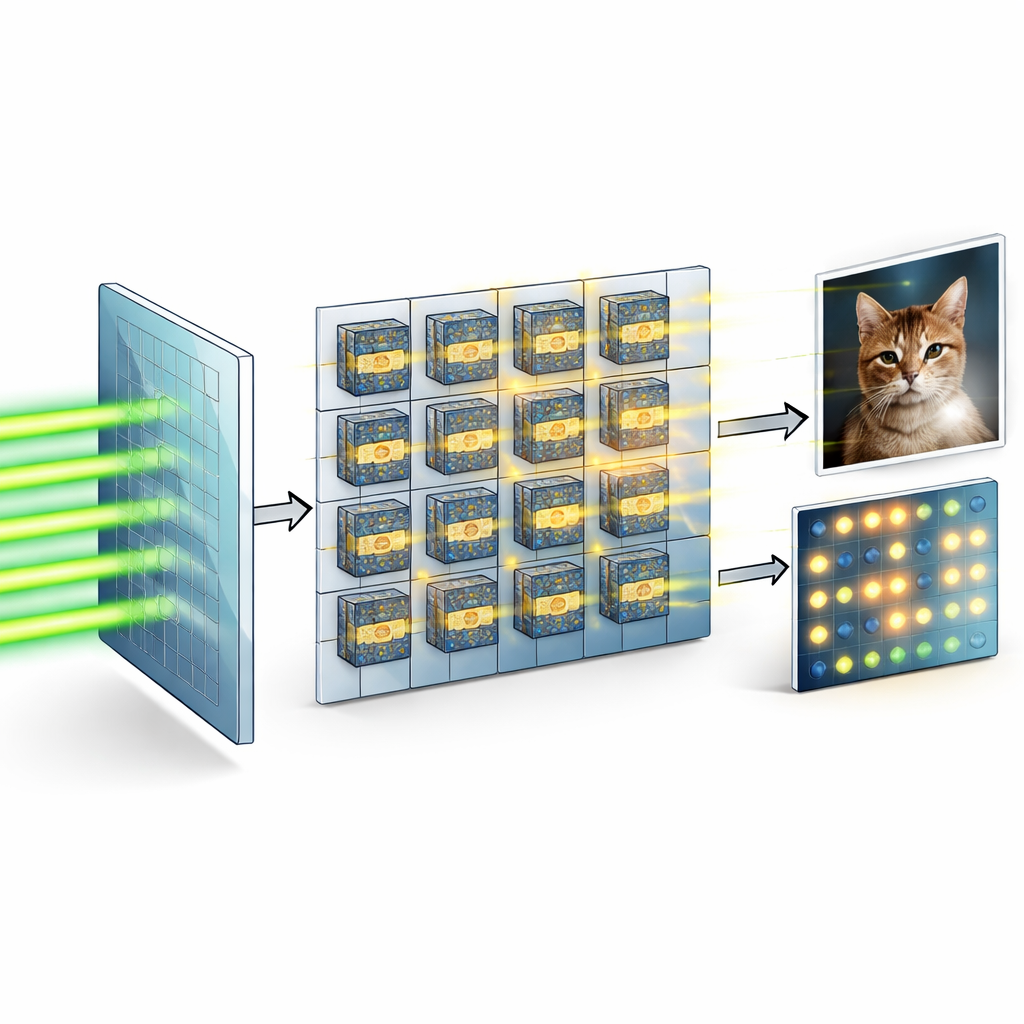
To show that this approach can do more than toy examples, the authors assemble many such gates into modular blocks they call logic processing units. Each unit encodes input data—such as pixels of an image—into patterned light using a spatial light modulator, passes the beams through an array of MXene‑based gates, and records the outgoing patterns with a camera sensor. Several layers of these units are then linked by free‑space diffraction, forming a three‑layer optical network that operates in a way similar to a neural network, but using only Boolean logic instead of arithmetic. During training, a computer decides which logic function each gate should implement; at run time, the whole process happens in optics. With this setup, the system can recognize handwritten digits from the standard MNIST dataset with 97.7% accuracy, and it also shows promising, though more modest, performance on a more complex image dataset.
What This Means for Future AI Hardware
For non‑specialists, the key message is that the researchers have demonstrated a tiny, flexible “thinking” unit that uses light and a tunable 2D material to carry out many kinds of logic, then combined these units into an optical network that performs real image recognition. While challenges remain—such as speeding up the electrical tuning and scaling to tougher tasks—the work points to a future in which parts of AI workloads may run directly in light, with reprogrammable optics handling decisions at ultrafast speeds and with far less energy than today’s electronics. This blend of programmable materials, optical physics, and logic‑based AI could help push computing beyond the limits of traditional chips.
Citation: Ge, Y., Wang, W., Wang, M. et al. All-optical logic processing unit using Kerr nonlinearity of MXene. Nat Commun 17, 4078 (2026). https://doi.org/10.1038/s41467-026-70834-0
Keywords: all-optical computing, MXene materials, optical logic gates, photonic neural networks, energy-efficient AI hardware