Clear Sky Science · en
Plasmonic Dirac-vortex lasers via three-dimensional photonic mass vortices engineering
Shaping Light in New Ways
Light is not just bright or dim; its direction, color, and vibration pattern can all be sculpted to carry information or reveal fine details of the world. This article describes a new kind of tiny laser that can generate such sculpted light directly from its source, potentially simplifying technologies for fast communications, sharp imaging, and quantum information.
Why Sculpted Light Matters
Modern optics often relies on “structured light,” beams whose brightness and polarization change from place to place across the beam. These patterns can act like extra channels for encoding data or for picking out features smaller than a conventional microscope can see. Today, engineers usually create these beams by sending light through multiple external components that must be carefully aligned. That complexity makes systems bulky and hard to scale up. A more elegant solution is to build lasers that emit structured light on their own, but existing designs have offered only a limited menu of beam shapes and polarization patterns.
Using Tiny Metal Patterns to Control Light
The authors explore a platform based on plasmonic crystals: ordered arrays of aluminum nanoparticles on a flat surface. When light hits these particles, electrons in the metal move collectively, producing strong local fields that can be tightly confined. By arranging the particles in a honeycomb pattern and then gently shifting their positions and sizes, the team can steer how light waves couple and interfere across the array. These carefully chosen distortions act like a built in “pattern dial,” controlling how light is trapped in the center of the structure and how it eventually escapes into free space.
Vortices Hidden in the Laser Cavity
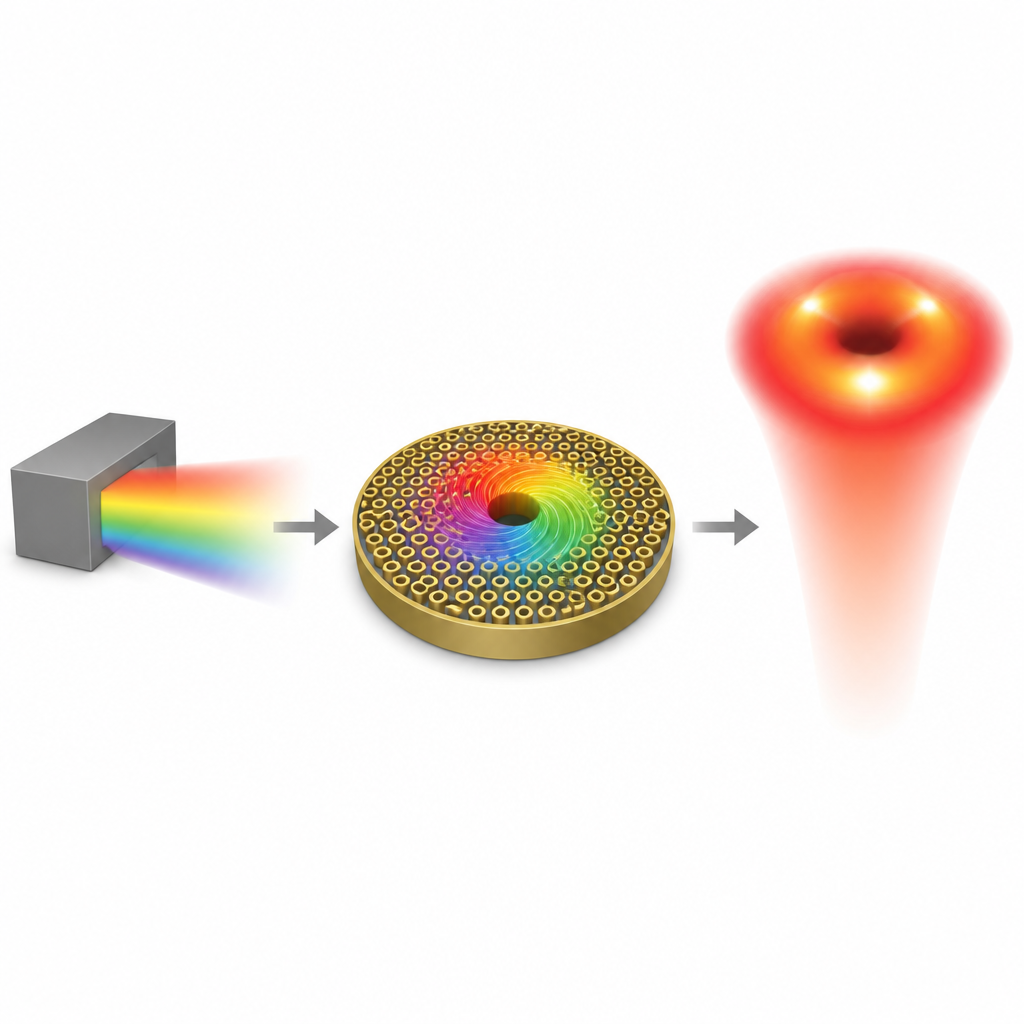
At the heart of the design is a special kind of light-trapping state known as a Dirac-vortex mode. In simple terms, the particle pattern around the cavity center twists in angle, like a spiral ramp. This twisting changes how the light waves pick up phase as they circulate, forcing a single, robust mode to become pinned at the middle of the device. Detailed computer simulations show that this state is confined to a small region near the core and radiates a donut-shaped beam with three bright lobes and a swirling polarization pattern. Because the pattern of distortions wraps around the center, the trapped light mode is protected against many fabrication errors, helping to stabilize the laser output.
Turning a Vortex into a Laser
To make the system lase, the researchers place a thin layer of dye solution over the nanoparticle lattice and cap it with a glass plate, forming a simple waveguide. When this dye is pumped with short green laser pulses, it amplifies light that matches the special vortex mode of the cavity. The result is a visible light laser that operates in a single, clean color with a very narrow spectral width and a small divergence angle. Measurements of the emission pattern confirm the simulated donut-like beam and reveal that the polarization follows a circular path around the beam axis, a clear fingerprint of the underlying vortex state inside the cavity.
Programming Many Beam Patterns
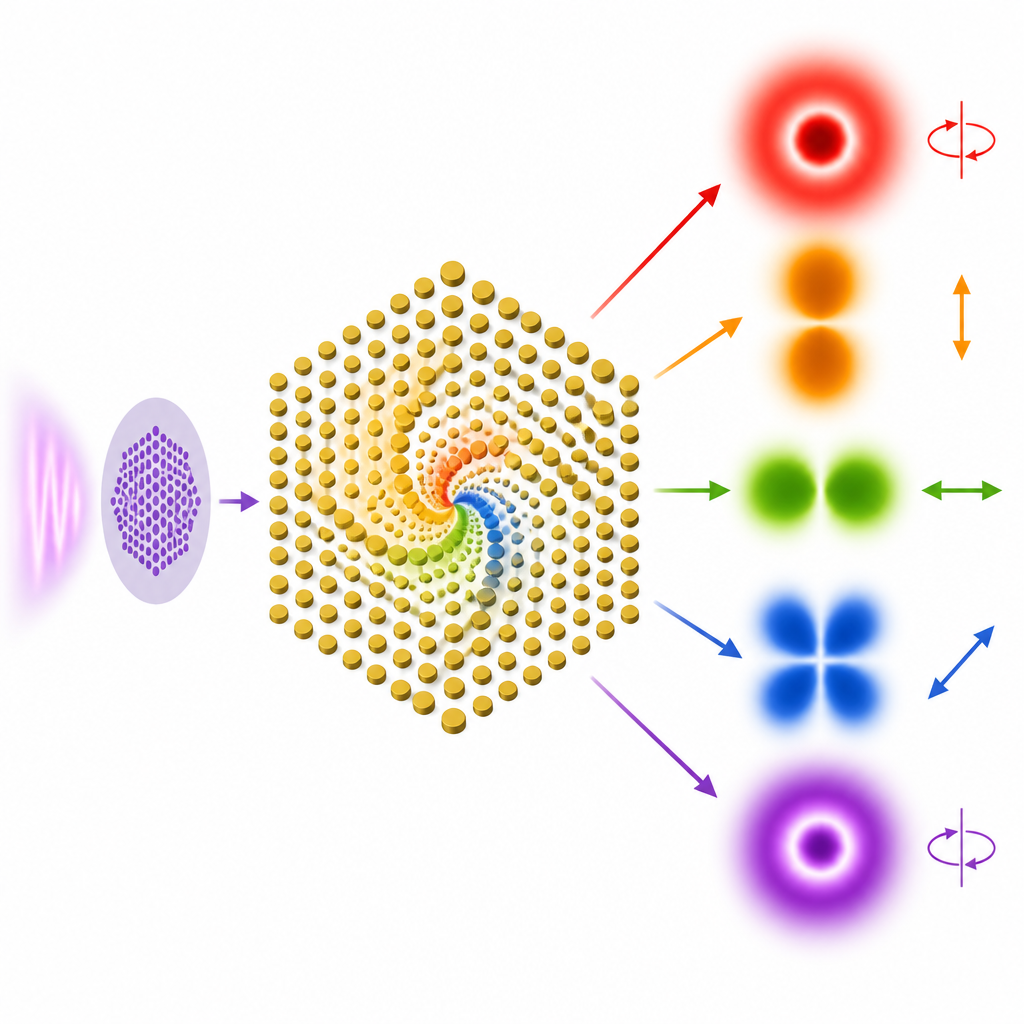
The most powerful aspect of the work is that the same design rules can generate many different output beams just by changing how the nanoparticles are distorted. The authors describe a three dimensional “design sphere” whose coordinates correspond to radial shifts, angular shifts, and size changes of the particles. Moving along different paths on this sphere produces different forms of symmetry breaking in the lattice. Experiments with five distinct paths show that all of them support stable single mode lasing, but the far field beams vary widely: some show donut shapes with swirling polarization, others show two main lobes with uniform linear polarization, and still others display uneven brightness and complex polarization textures across the beam.
What This Means for Future Technologies
In summary, the study introduces a flexible recipe for building tiny lasers that directly emit sculpted light, using vortexlike patterns in a carefully distorted array of metal nanoparticles. By treating particle shifts and size changes as three independent control knobs, the authors can program the brightness and polarization of the beam in great detail while preserving the robustness of a topological state. This approach could become a useful building block for compact devices that need tailored light fields, including free space optical links, holographic displays, high resolution imaging systems, and future quantum photonic circuits.
Citation: Zhong, M., Bi, X., Song, M. et al. Plasmonic Dirac-vortex lasers via three-dimensional photonic mass vortices engineering. Nat Commun 17, 4161 (2026). https://doi.org/10.1038/s41467-026-70833-1
Keywords: structured light, plasmonic lasers, topological photonics, nanophotonics, vector beams