Clear Sky Science · en
Tough asymmetric thermochromic ionogels via dynamic in situ phase separation for dual-modal smart optical switching
Windows That Think About the Weather
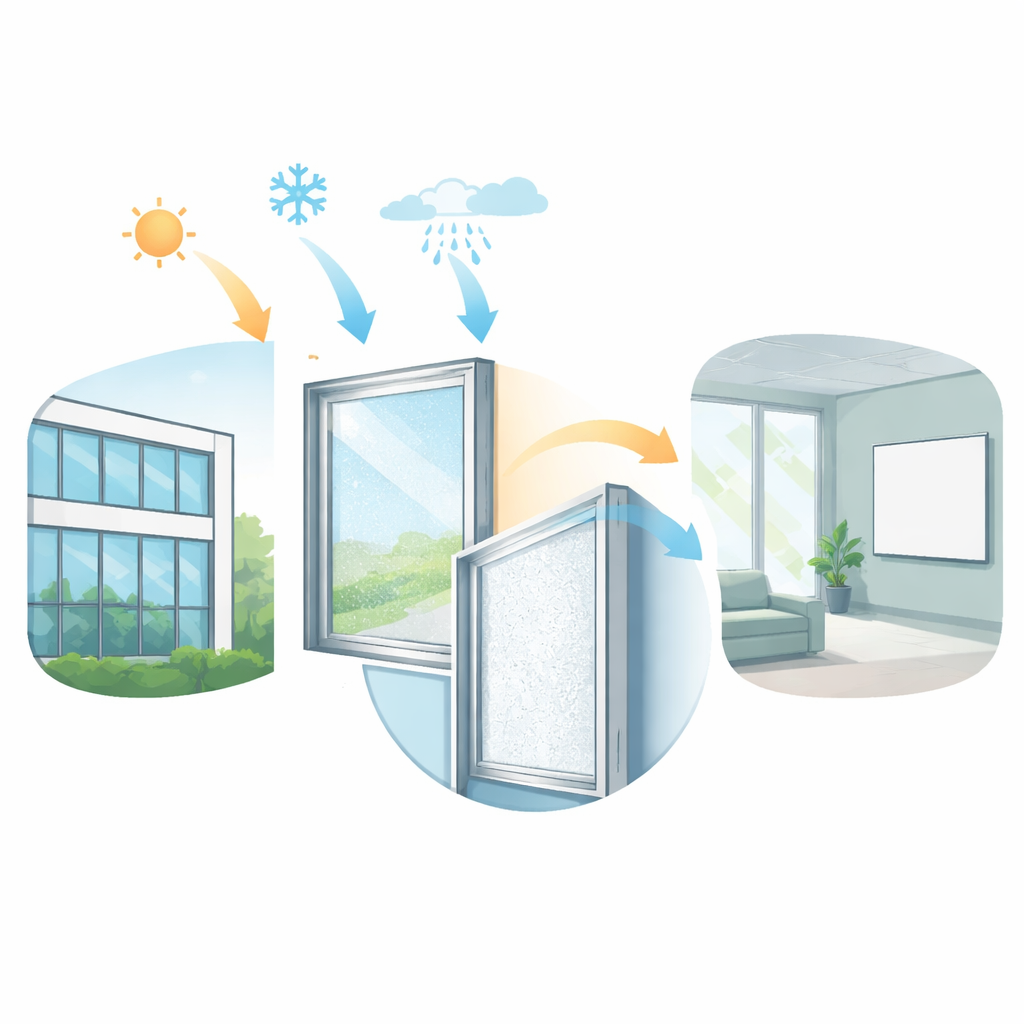
Imagine a window coating that can keep your home cooler on scorching days, stay clear in deep winter cold, shrug off rain and frost, and even turn into a movie screen when you want it to. This paper describes a new kind of soft, transparent material that does all of that at once. It changes how much light gets through depending on temperature, yet remains tough, flexible, and durable enough for real buildings and devices, without needing bulky protective layers.
Why Changing Light Matters
Modern cities are full of glass, and those gleaming windows are a major source of unwanted heat in summer. Materials that can switch between clear and cloudy with temperature—called thermochromic materials—are a promising way to cut air-conditioning costs and build smarter devices like sensors and displays. But existing options tend to force trade-offs. Inorganic coatings are rigid and often only switch at high temperatures. Classic water-based gels can switch at more practical temperatures but are weak, dry out or freeze, and usually must be sealed inside glass. The researchers set out to design a material that could change transparency near room temperature while also being strong, stretchable, weather-resistant, and simple to apply directly onto surfaces.
Two Layers Working as One
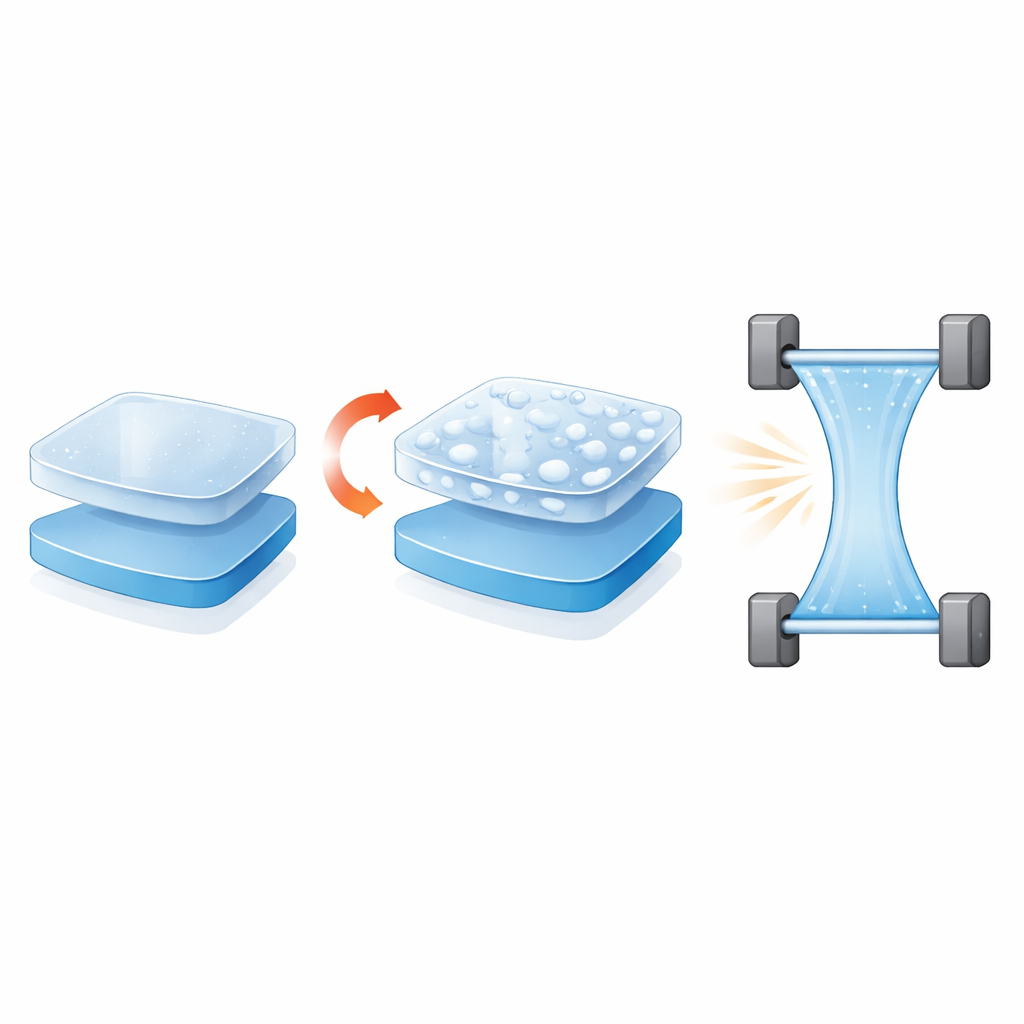
The team created what they call asymmetric thermochromic ionogels, or ATIs—soft solids made from polymers and a salty liquid known as an ionic liquid. The key idea is a “Janus” or two-faced structure: a top layer that changes how it scatters light with temperature, and a bottom layer that provides mechanical strength and adhesion. Both layers share the same ionic liquid, but their polymer networks are tuned differently. The top layer stays clear at room temperature, then forms tiny liquid-rich pockets when warmed, which scatter light and turn the material cloudy. The bottom layer has a finely interwoven structure that dissipates stress and keeps the whole sheet tough and flexible. The layers are grown together in sequence so they are chemically locked at the interface, preventing peeling or failure when bent, stretched, or punctured.
How It Switches Without Falling Apart
Inside the light-switching layer, the ionic liquid and polymer chains mix evenly when cool, so the material looks clear. As the temperature rises past a carefully tuned threshold—around body temperature—subtle shifts in the attractions between charged ions and the polymer backbone cause the liquid to clump into nanoscale and microscale domains. That internal rearrangement is reversible: cool it down and the structure smooths out again. Because the liquid does not evaporate or freeze easily, this process repeats reliably even at extreme temperatures. The ionogel stays transparent down to about minus 70 degrees Celsius and shows no cracking or clouding even when dipped into liquid nitrogen. Over many heating–cooling cycles, its switching between clear and cloudy remains strong, and the sheet resists fatigue under repeated compression and stretching.
From Cooling Glass to Living Screens
By laminating ATI directly onto glass, the authors built “smart windows” that brighten when cool and dim themselves when hot. Under simulated and real sunlight, these coated windows let in most visible light at room temperature but block a large fraction of solar energy once warmed, reducing incoming solar heat by more than half compared with bare glass. The surface is naturally water-repellent, so raindrops slide off, yet it adheres strongly to common building plastics and glass without added glue. Beyond passive cooling, the material can be actively triggered using electrical heating. When paired with a patterned flexible heater, selected regions can be turned cloudy against a clear background, acting as simple on-demand displays on flat or curved surfaces. When the entire sheet is warmed electrically, it behaves as a flexible projection screen that can be rolled, bent, or stretched while still showing projected images with good clarity.
What This Could Mean for Everyday Life
In simple terms, this work shows that it is possible to combine three usually conflicting traits—smart optical switching, mechanical toughness, and all-weather stability—in a single, easily handled material. The ionogel coating changes from clear to cloudy near everyday temperatures, stays functional from deep-freeze to hot summer conditions, clings to many surfaces without extra encapsulation, and can support both passive energy-saving windows and active visual displays. If scaled up and manufactured economically, such coatings could help buildings use less energy, turn ordinary glass into information surfaces, and blur the boundary between structural materials and interactive electronics in our daily environments.
Citation: Du, G., Li, J., Wang, C. et al. Tough asymmetric thermochromic ionogels via dynamic in situ phase separation for dual-modal smart optical switching. Nat Commun 17, 4124 (2026). https://doi.org/10.1038/s41467-026-70830-4
Keywords: smart windows, thermochromic materials, ionogels, energy-efficient buildings, flexible displays